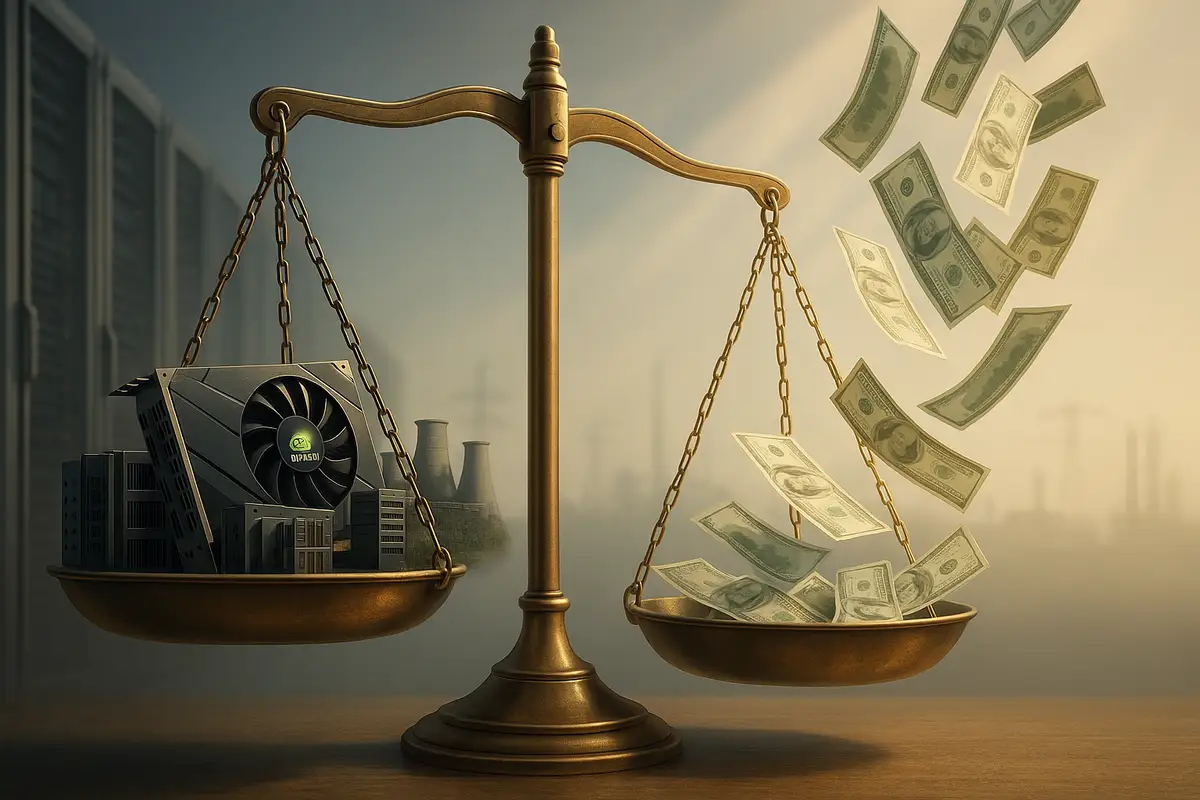

Monday brought good news from the IMF. Also a warning about why the good news might not last.
The fund bumped its global growth forecast to 3.3 percent for 2026. The number looks solid. Dig into the reasoning and you find something else: a 390-page admission that the world economy is balanced on a single bet. That bet is artificial intelligence.
"Global growth has been impressively resilient," IMF chief economist Pierre-Olivier Gourinchas acknowledged in a blog post. Then came the qualifier that matters: "but this masks underlying fragilities tied to the concentration of investment in the tech sector."
Concentration is the polite word. What the IMF described is an economy running on one engine. Tech investment as a share of U.S. economic output has surged to its highest level since 2001. That comparison should make anyone nervous. We know how 2001 ended.
The Breakdown
• IMF raised global growth forecast to 3.3% but warns it depends almost entirely on AI investment continuing
• U.S. market cap at 226% of GDP vs. 132% in 2001, meaning even small corrections hit harder now
• Only 26% of companies have cut costs with AI, per PwC survey released the same day
• Hyperscalers financing AI buildout with debt, raising leverage concerns at the IMF
The dotcom echo
Run the numbers and the parallels get uncomfortable. Market cap relative to GDP has hit 226 percent. Back in 2001, at the dotcom peak, it was 132 percent. The IMF estimates current valuations might only be half as overvalued as they were then. But the sheer scale of the market relative to the economy means a correction would hurt more, not less.
Gourinchas framed this delicately: "Even a small reversal could have a big impact on people's wealth relative to their income."
Translation: household balance sheets are loaded with tech stocks. When those stocks drop, spending drops. When spending drops, growth stalls. And because American consumption drives global demand, the contagion spreads.
The fund ran the scenarios. A "moderate" correction in tech valuations, combined with a pullback in AI investment, would knock global growth from 3.3 percent to 2.9 percent this year. That's 0.4 percentage points wiped out. For context, the entire upgrade the IMF just announced was 0.2 percentage points. The fund is celebrating gains that its own model says could vanish twice over.
What the optimism is buying
The AI investment boom isn't theoretical. Data centers are going up across Texas and Virginia. Nvidia reported another record quarter. Microsoft, Google, and Amazon are spending hundreds of billions on compute infrastructure. The money is real.
What remains unproven is the return on that money.
A PwC survey released the same day as the IMF report found that only 26 percent of companies have managed to cut costs using AI. Thirty percent have boosted revenue. The rest are still waiting for productivity gains that have been promised since ChatGPT launched in late 2022.
Stay ahead of the AI curve
Strategic AI analysis from San Francisco. No hype, no breathless predictions. Just what moved, who won, and why it matters. Daily at 6am PST.
No spam. Unsubscribe anytime.
The IMF knows this. The report's tone is unmistakably defensive, hedging every positive sentence with a warning. If AI-driven productivity gains "turn out to be overly optimistic and outcomes disappoint," the fund warned, expect "a sharp drop in real investment in the high-tech sector" followed by "a more prolonged correction in stock market valuations."
The mechanism is straightforward. The bet is productivity. Every dollar going into AI infrastructure assumes that dollar will come back multiplied. If the multiplication doesn't happen, the spending stops. When they stop spending, the revenue disappears for chipmakers, cloud providers, and the entire supply chain built around AI infrastructure. Stock prices adjust. Wealth evaporates. Consumers pull back. The engine doesn't sputter. It seizes.
Leverage enters the picture
There's another detail the IMF flagged, almost in passing. The hyperscalers, the companies driving the AI buildout, are increasingly relying on debt to finance their spending sprees.
"When you see leverage rising, you kind of get a little bit worried," Gourinchas said.
Worried is the professional way to say alarmed. Debt-financed investment booms have a specific failure mode. When the underlying asset loses value, the debt remains. Companies that borrowed to build data centers can't unbuild them. The debt stays on the books. Credit tightens. The correction accelerates.
If you're an economist who lived through 2008, or an investor who remembers the telecom bust, you've seen this script before. The 2008 financial crisis played it out with housing. The dotcom crash played it out with fiber optic cable, laid across the country based on demand projections that never materialized. The cable is still there, under farmland and oceans. The companies that borrowed to lay it are not.
The other engine sputtering
While AI props up global growth, the traditional engines are losing power.
Manufacturing remains subdued worldwide. Chinese consumers aren't spending. Germany, supposedly Europe's engine, will manage 1.1 percent growth. The eurozone's 1.3 percent forecast? That's government money, not organic demand.
And then there's the Federal Reserve.
The IMF's report landed days after the Justice Department opened a criminal investigation into Fed Chair Jerome Powell. Looked like pressure. Gourinchas addressed it head-on, and his word choices gave away more than he probably intended.
"Central bank independence is absolutely paramount when it comes to maintaining macroeconomic stability, financial stability and providing an anchor for sustainable growth," he said. "In the case of the US Federal Reserve, this is even more important given the dominant position of the US financial system in the global economy."
The understatement was professional. The message was not. Threatening the Fed's independence risks repricing government debt, higher borrowing costs, and runaway inflation expectations. The dollar's role as global reserve currency amplifies every wobble. The IMF is watching its carefully constructed forecast get threatened by forces it cannot model and will not name directly. That's the position: optimistic on paper, anxious in practice.
The asymmetry problem
The report includes an upside scenario, because IMF reports always do. Maybe AI delivers faster than expected. Maybe growth hits 3.6 percent. Maybe the productivity gains materialize and current valuations look smart in retrospect. The fund puts the upside at 0.1 to 0.8 percentage points annually over the medium term.
Here's the timing problem. The downside materializes fast. A market correction happens in days. Leverage unwinds in weeks. Consumer spending responds within a quarter. You'll know if the engine is seizing long before the economists publish their next report.
The upside takes years. Productivity gains from new technology don't show up immediately. They require workflow changes, retraining, infrastructure adaptation. The dotcom era's real productivity benefits arrived in the mid-2000s, long after the crash destroyed trillions in wealth.
Investors are paying current prices for future benefits. The future is not guaranteed.
Daily at 6am PST
Don't miss tomorrow's analysis
No breathless headlines. No "everything is changing" filler. Just who moved, what broke, and why it matters.
Free. No spam. Unsubscribe anytime.
What to watch
The IMF's forecast assumes tariffs stay where they are. That assumption lasted about 72 hours. Over the weekend, Trump threatened new levies on European imports, 10 percent starting February 1, 25 percent by June. And the Supreme Court is about to rule on whether his emergency tariff powers are even legal. Could come down any day now. Either way, more uncertainty gets injected into a system already running hot.
If you want to know when the narrative shifts, watch three numbers. AI investment levels. Equity valuations. Corporate leverage. When the first two fall and the third stays elevated, the correction scenario moves from possible to probable. That's when the calls start, risk committees convene, and portfolio managers quietly rebalance before the headlines catch up.
Gourinchas summarized the fund's position: "We remain nervous that the economy is subject to potentially large shocks that may not have an immediate effect but could build over time."
Nervous is the official posture. The 390 pages behind that nervousness tell a starker story. The global economy just posted decent growth numbers by redlining a single engine, fueled by optimism, financed by debt, in a year when the world's most important central bank faces political interference and the world's largest trading nation is threatening new tariffs.
The IMF upgraded its forecast. It also told you exactly why that forecast might not survive the year.
Frequently Asked Questions
Q: What did the IMF actually change in its forecast?
A: The fund raised its 2026 global growth projection from 3.1% to 3.3%, matching 2025's pace. The U.S. forecast jumped from 2.1% to 2.4%. But the upgrade comes with heavy caveats about AI-dependent growth.
Q: How does the current market compare to the dotcom bubble?
A: U.S. market cap is now 226% of GDP versus 132% in 2001. The IMF says valuations may be only half as stretched as then, but the sheer scale means even small corrections would have larger wealth effects on households.
Q: What's the concern about leverage in AI investment?
A: Major tech companies are increasingly using debt to finance AI infrastructure. If the investments don't pay off, the debt remains while asset values fall. Gourinchas called rising leverage "a little bit worrying," which for an IMF economist is significant alarm.
Q: Why does the Fed investigation matter for global growth?
A: The dollar underpins global trade and finance. Threatening Fed independence risks higher inflation expectations, repriced government debt, and tighter credit conditions worldwide. The IMF called central bank independence "absolutely paramount."
Q: How much could a market correction hurt global growth?
A: The IMF modeled a "moderate" correction scenario that would knock global growth from 3.3% to 2.9%, a 0.4 percentage point drop. That's twice the size of the upgrade the fund just announced, meaning the gains could vanish twice over.