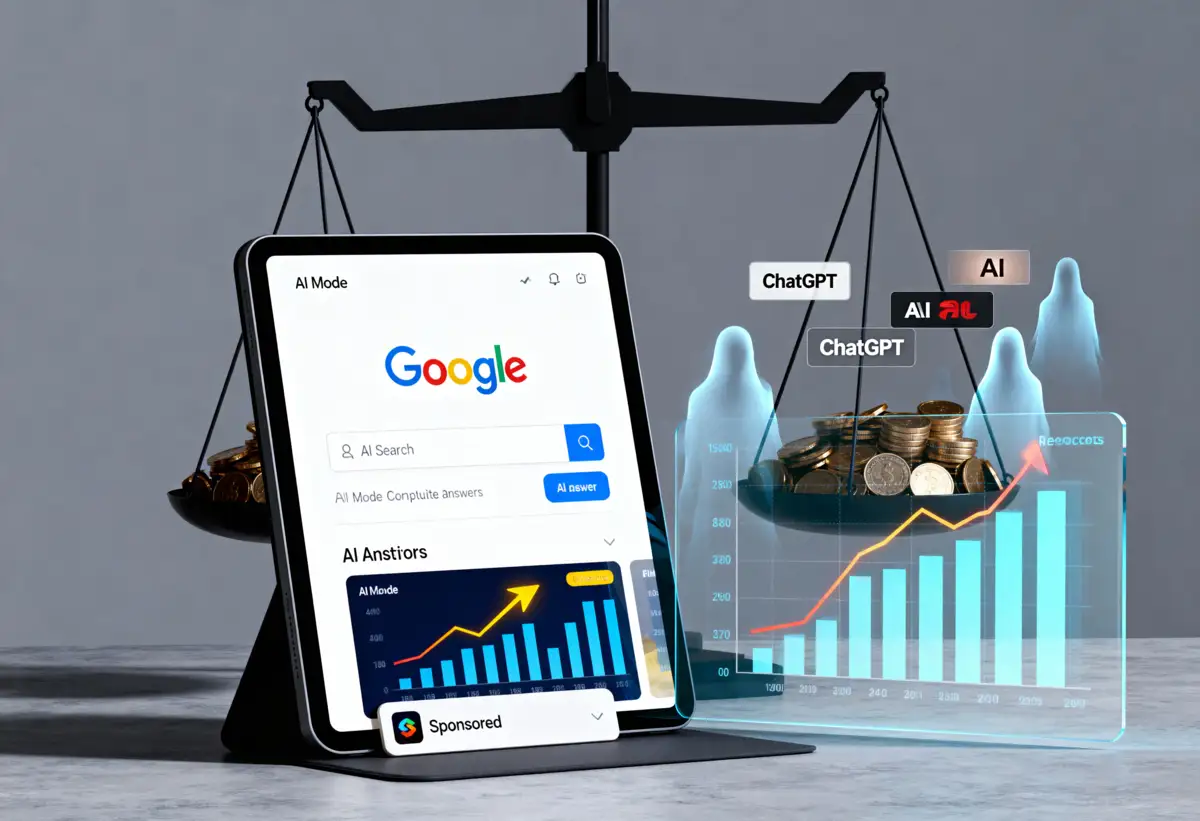
Google's advertising team is running a pilot that dismantles the last twenty years of search engine optimization. The new system, AI Mode, ignores the boolean logic of "best + running shoes + wide toe box." It reads the output of its own generative model, guesses what the human on the other side of the screen actually wants, and serves ads based on that hallucinated intent.
This kills the manual bid. SEO professionals spent decades refining spreadsheets, obsessing over long-tail phrases and negative keyword lists. AI Mode renders that granular control obsolete. The machine synthesizes an answer from a dozen sources and unilaterally decides which commercial message fits the context. You do not optimize for this. You survive it.
The shift arrived quietly. An A/B test spotted by an SEO consultant named Sachin Patel. A toggle in the Google app. Behind that toggle sits Gemini 3, the model that just beat OpenAI's GPT-5 on independent benchmarks and triggered a "code red" memo at ChatGPT headquarters. Sam Altman told his staff to refocus resources. The panic is justified.
The Breakdown
• Google's AI Mode matches ads to its own generated responses, not user keywords, eliminating manual targeting control
• TPU production scales to 7 million chips by 2028, giving Google cost advantages competitors cannot match
• 53% of AI Overview citations don't appear in traditional top-10 rankings, breaking established SEO logic
• Google advises agencies to abandon keyword strategy and surrender targeting decisions to AI-powered tools
The Query Fan-Out
The mechanics are brutal. When a user asks about kitchen renovations, the system doesn't search for "kitchen renovation." It executes a "query fan-out," breaking the request into parallel, invisible searches. Countertop density. Contractor permits in specific zip codes. Current lumber pricing. Appliance energy ratings. It retrieves, mixes, and presents a cohesive answer.
Advertisers cannot target the sub-queries. You cannot buy the "lumber pricing" slot because that search happened inside the black box. Google offers a single solution: surrender. They tell agencies to use "AI-powered solutions," which is corporate shorthand for "give us your budget and stop touching the controls."
Google Senior Director Hema Budaraju says users in AI Mode ask queries "nearly three times longer than traditional searches." Longer queries mean more intent signals. More signals mean finer-grained ad matching decided entirely by the algorithm. The system feeds itself.
Picture the agency owner in Austin or Manchester staring at a dashboard. The metrics she understood for fifteen years no longer connect to outcomes. Impressions up. Clicks flat. Conversions erratic. The client calls asking why. She has no answer because the mechanism between her inputs and the results has gone dark.
Silicon Sets the Rules
Forget the software. Look at the metal.
The TPU project started in 2013. Not as a strategic initiative. Jeff Dean, Google's chief scientist, had a problem. His team ran calculations on what would happen if voice search actually took off. The numbers were ugly. Mass adoption using standard chips would force Google to double its data center footprint overnight. Capital expenditure in the tens of billions. Nobody approved that budget.
"The first slide was: Good news! Machine learning finally works," recalled Jonathan Ross, a hardware engineer on the original project. "Slide two said: Bad news, we can't afford it."
Ross built that first chip with fifteen people. A side project. He happened to sit next to the speech recognition team.
Twelve years later, those chips are weapons. Morgan Stanley predicts Taiwan Semiconductor Manufacturing Company will produce 3.2 million TPUs next year, growing to 7 million by 2028. Google controls the stack from molten silicon to the pixels on your phone. OpenAI pays Nvidia a premium for every compute cycle. Google manufactures its own processors. The unit economics make competition impossible for anyone who doesn't own a foundry relationship.
The Anthropic deal shows how this plays out. One million TPUs. The price tag runs into the tens of billions. Anthropic builds AI that competes with Google's models. Anthropic also buys its compute from Google. That dependency shapes decisions in ways that never appear in press releases. Analysts float potential arrangements with OpenAI itself, with Elon Musk's xAI, with startups like Safe Superintelligence. Nvidia's stock dropped on reports that Meta was negotiating TPU purchases. The chipmaker insists it remains "a generation ahead." But a generation means nothing when your customer can manufacture their own alternative.
The Citation Trap
The new interface introduces "citation cards." As the AI speaks aloud, small links pop up on screen. Google claims this fixes the "trust gap" caused by hallucinations. Publishers should read the fine print.
Independent research found that 53% of websites linked in AI Overview results don't appear in traditional top-ten rankings. The old hierarchy of PageRank is gone. You appear if the AI likes you. You disappear if it doesn't. The rules that governed visibility for two decades no longer apply.
Microsoft's Fabrice Canel offers the new framing: "For marketers, visibility itself is becoming a form of currency." Both companies claim AI referral traffic converts at rates up to three times higher than traditional search.
This is a comforting story for publishers watching their analytics crater. Higher conversion rates don't compensate for dramatically lower volume. The citation card satisfies the user's curiosity without requiring a click. User sees the source, nods, stays on Google. The voice answer feels verified. The publisher's server logs stay empty.
Google calls this "bridging the trust gap." It actually builds a walled garden with better landscaping.
The Automation of Expertise
Google's advice to agencies is blunt: stop acting like media buyers. The company's official guidance tells them to pivot "from manual execution to becoming strategic partners who maximise the value of AI." The diplomatic language obscures a death sentence.
Campaign management used to require human hands adjusting bids, testing copy, analyzing which keywords converted and which bled money. Now Google wants access to the client's CRM. It wants the email list. The purchase history. Site behavior patterns. The company calls first-party data a "foundational pillar." Once the algorithm has that raw fuel, it doesn't need the agency. It barely needs the marketing director.
The skills that defined search marketing are being automated. Keyword research. Bid optimization. Audience segmentation. These were billable hours. They're becoming toggles in a dashboard that Google controls.
Business Insider just announced a pilot using "a custom GPT to help publish quick news stories" trained on their journalists' writing style. Publishers are automating content creation so that Google's automated system has something to read. The snake eats its tail.
And the SEO professionals who spent years mastering Google's ranking signals? They're optimizing for an interface Google is actively deprecating. Every improvement to AI Mode, every percentage point of user adoption, every new feature that keeps users in conversational search longer, erodes the value of their expertise.
The Black Box
Every strategy now depends on a system that refuses to explain itself.
In the keyword era, you could see why a campaign failed. You could trace the line from a specific term to a bounce rate. You could test variations and measure outcomes. The feedback loop was legible.
AI intent matching severs that link. You provide inputs. A result happens. The mechanism in the middle is opaque. Google's own documentation admits that ads in AI Mode "are matched to our understanding of the user intent based on not just the user query but also the content of the AI Mode response." The AI writes an answer, then decides which ads fit what it wrote. Circular logic with your budget at the center.
Google demands trust. It asks advertisers to believe that a system designed to maximize Google's revenue will also prioritize the advertiser's ROI. That requires faith. The algorithm will always choose the path that burns the budget most efficiently. Your interests and Google's align only when spending more happens to work.
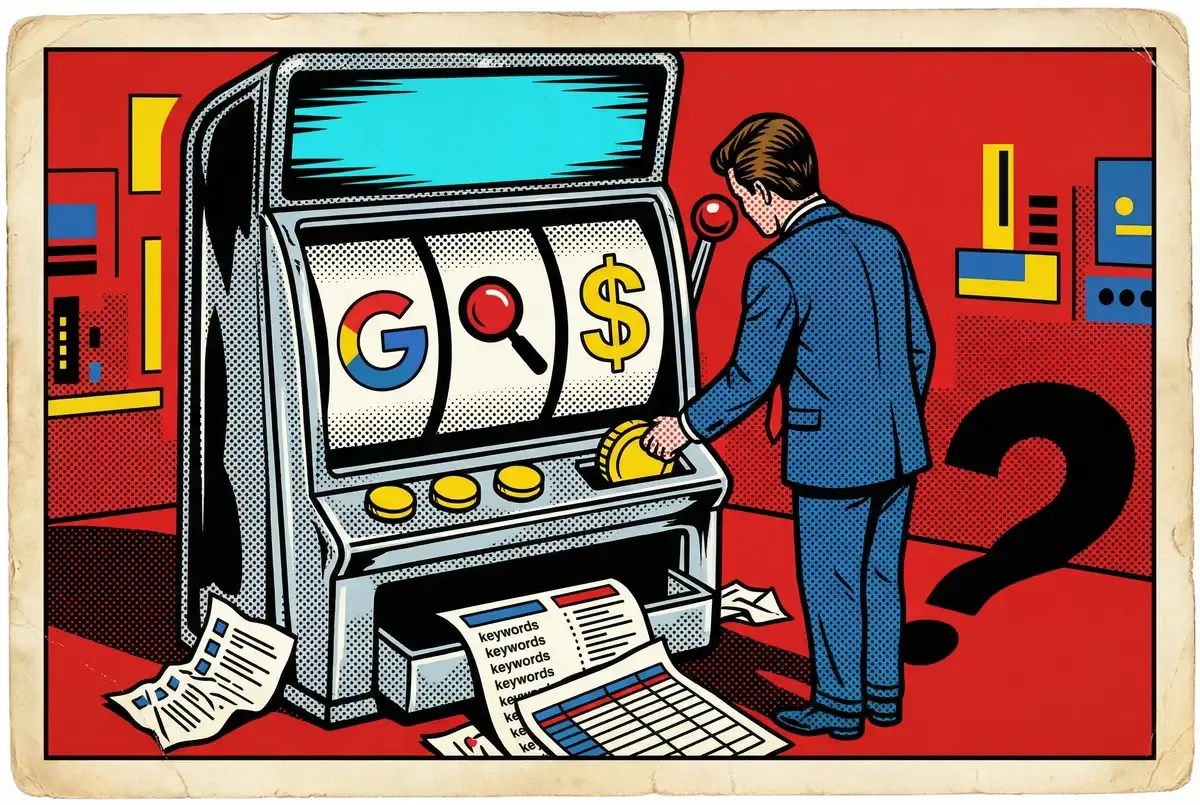
Some marketers will find this liberating. Less manual work. Fewer granular decisions. Focus on strategy. Others will notice what they've lost. The ability to trace cause and effect. The capacity to learn from failure. Without that feedback, you're just pouring money into a slot and watching the reels spin.
What Still Works
Brand recognition matters more when algorithmic intermediaries decide relevance. If Google's AI identifies your company as authoritative in a category, it's more likely to surface your content. Building that recognition requires channels Google doesn't control. Podcasts. Events. Direct relationships.
Conversion infrastructure becomes critical. If traffic volumes decline but intent quality increases, you must capture value from fewer visitors. That means faster load times, clearer calls to action, reduced friction in purchase flows. Wasting high-intent traffic costs more when you get less of it.
First-party data collection feeds the targeting Google recommends. Email addresses. Purchase histories. Behavioral patterns. Companies without robust data compete at a structural disadvantage in AI-matched advertising.
Speed still creates windows. Google's AI Mode prioritizes fresh information. Being first with analysis creates visibility before the system has other sources to synthesize.
But every adaptation depends on Google's platform continuing to work as it currently does. The company can change the rules whenever it wants. You optimize for a moving target controlled entirely by someone else.
Why This Matters
The shift isn't coming. It's here.
Marketing agencies built on keyword research and bid management face a closing window. The core services that generated revenue for two decades are becoming automated functions. Agencies that don't develop new expertise around AI configuration and first-party data strategy will watch their value proposition evaporate.
Publishers watching citation cards won't recover their traffic. Google is building an information layer that captures attention value while distributing minimal referral volume. Subscription models and direct audience relationships matter more than SEO optimization now.
Brands without rich first-party data will bid blind. Customer information becomes the primary competitive asset in AI-mediated advertising. Companies that can feed Google's targeting systems effectively will outperform those buying reach without precision.
Regulators focusing on default search deals miss the structural shift. The DOJ's antitrust remedies address distribution agreements. They don't touch AI Mode's consolidation of advertising control. By the time frameworks catch up, the transition will be irreversible.
There's been no official announcement about the future of traditional search advertising. Google doesn't operate that way. The company simply builds alternatives and waits for adoption curves to do the work. Every AI Mode test, every TPU rolling off the TSMC production line, every citation card popping up during a voice answer, shifts weight toward the new system.
Twenty years of search marketing expertise optimized for an interface Google is methodically replacing. The professionals who recognize this early have time to adapt. The rest will discover it when their campaigns stop working and the dashboard offers no explanation.
❓ Frequently Asked Questions
Q: Is AI Mode available everywhere or just in certain markets?
A: AI Mode advertising is currently a US-only experiment. The conversational search interface itself has broader availability, but the ad-matching system that targets based on AI-generated intent remains limited to American users. Google hasn't announced a global rollout timeline. Previous AI features like AI Overviews took 6-12 months to expand internationally after US launch.
Q: What is "query fan-out" and why does it break traditional ad targeting?
A: Query fan-out breaks a single user question into multiple simultaneous searches. Ask about kitchen renovations, and Google runs parallel queries on countertops, permits, lumber prices, and appliances. Advertisers can't bid on these sub-queries because they happen invisibly inside the system. You only see the synthesized answer, not the dozens of searches that created it.
Q: What are TPUs and why do they matter for advertising?
A: Tensor Processing Units are custom AI chips Google has built since 2013. They power Gemini 3, the model behind AI Mode. Because Google makes its own silicon, it can run AI inference cheaper than competitors who buy Nvidia GPUs. Production scales to 7 million TPUs by 2028. Lower costs mean Google can afford to deploy AI across all searches, accelerating the shift away from keywords.
Q: Can small businesses still compete in Google advertising without sophisticated AI tools?
A: The barrier is shifting from keyword expertise to data quality. Small businesses with strong first-party data, like email lists and purchase histories, can feed Google's AI-powered targeting effectively. Those without robust customer data will struggle. Google's recommended tools (Broad Match, Performance Max, AI Max) don't require technical skill, but they do require surrendering control over targeting decisions.
Q: How is AI Mode different from AI Overviews that already appear in search?
A: AI Overviews summarize information at the top of traditional search results. AI Mode replaces the search interface entirely with a conversational experience powered by Gemini 3. Users ask follow-up questions, and queries run nearly three times longer than traditional searches. The critical difference: AI Mode matches ads to the AI's interpretation of intent, not to keywords the user typed.
 Maria Garcia
 Robert Brown
 Marcus Schuler