 IMPLICATOR
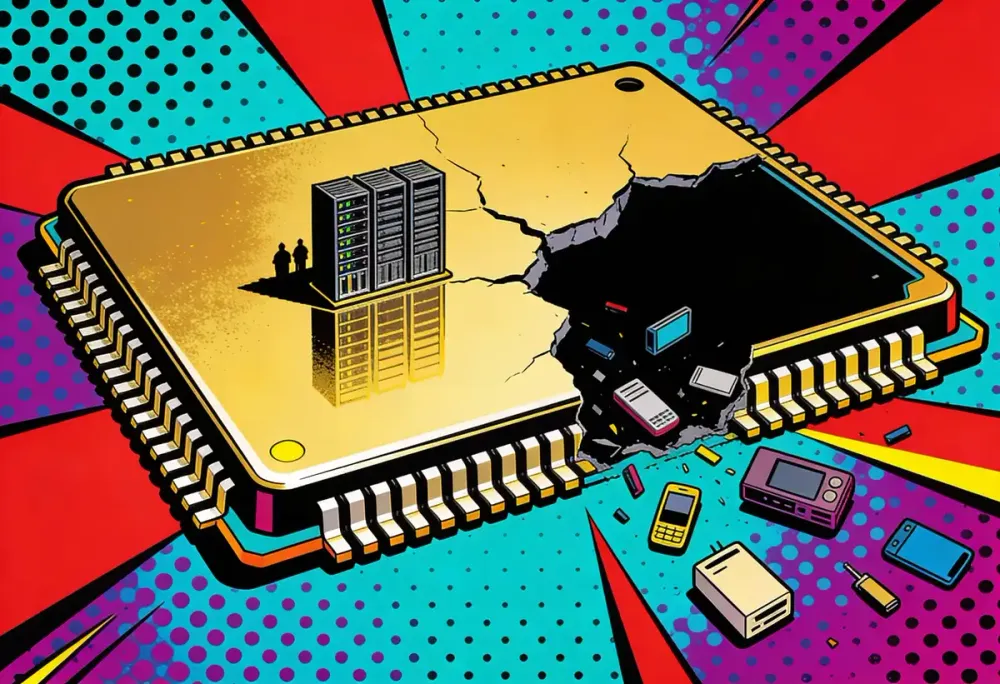
TM Roh took the stage at the Wynn Las Vegas on Sunday evening, January 4th, wearing the confident smile Samsung executives practice for these things. The keynote had been in rehearsal for weeks. Double Gemini-powered devices this year, he announced. Take them from 400 million to 800 million. Start with phones, spread to televisions, and yes, eventually your refrigerator would get smarter too. "One seamless, unified AI experience," he called it. The audience clapped on cue.
What Roh didn't mention was the interview he'd given to Reuters twelve days earlier at Samsung headquarters in Suwon. Different setting, different message. The global memory shortage was "unprecedented," he'd said then. No company was immune. He wouldn't promise to hold prices. Consumers would feel it.
That's the version of CES 2026 that mattered. The keynotes sold transformation. But in quieter settings, the executives who actually run these companies were saying something else: AI was eating the chips their products need, and nobody had a fix.
The Breakdown
• HBM for AI consumes 3x the fab capacity of standard DRAM, creating a zero-sum fight consumer electronics is losing
• DDR5 spot prices jumped from $4.60 to $28 per module in one year; DDR4 climbed 1,800% to $62
• Samsung, SK Hynix, and Micron control 88% of supply and are prioritizing margins over expansion
• New fabs won't deliver meaningful output until 2028; normalized pricing unlikely before 2029
Walk the show floor and you could feel something off. Past the recycled air and sticky carpet, past booths demonstrating laptops that run hot enough to make your thighs sweat. Dell announced the XPS revival with starting prices attached. Lenovo had a rollable gaming laptop that got people talking. Qualcomm was pushing the Snapdragon X2 Elite hard, claiming meaningful performance gains though the benchmarks were still fuzzy. Everyone had an "AI PC" with a neural processing unit. But here's the thing: a lot of manufacturers kept their broader pricing vague, hedging on final configurations until they could see where component costs actually landed. That hedging said more than the keynotes.
Micron's CEO Sanjay Mehrotra, talking to analysts in December ahead of CES, didn't bother with the usual reassurances. His company could fill maybe half to two-thirds of what key customers were asking for. Not in some obscure product line, but across market segments. When a semiconductor CEO admits he's missing that much demand, something has broken. The whole "AI PC" roadmap starts to look shaky when you can't get enough DDR5 and LPDDR5X to actually build the machines.
Framework, the modular laptop company that's built its brand on being straight with customers, had already raised RAM prices 50 percent in December. The company published an explanation: DRAM costs jumped. NAND flash too. The reason? AI data centers are buying everything the factories can produce. Consumer electronics lost the bidding war. When hyperscalers fire up their servers, the rest of the market goes dim.
Here's what that looks like in dollar terms, according to DIGITIMES Research. Spot prices for DDR5 memory went from $4.60 per 16-gigabit module in late 2024 to $28 by early January 2026. That's north of 500 percent. DDR4, which should be getting cheaper as it ages out? It went from $3.20 to $62 per module. An 1,800 percent jump.
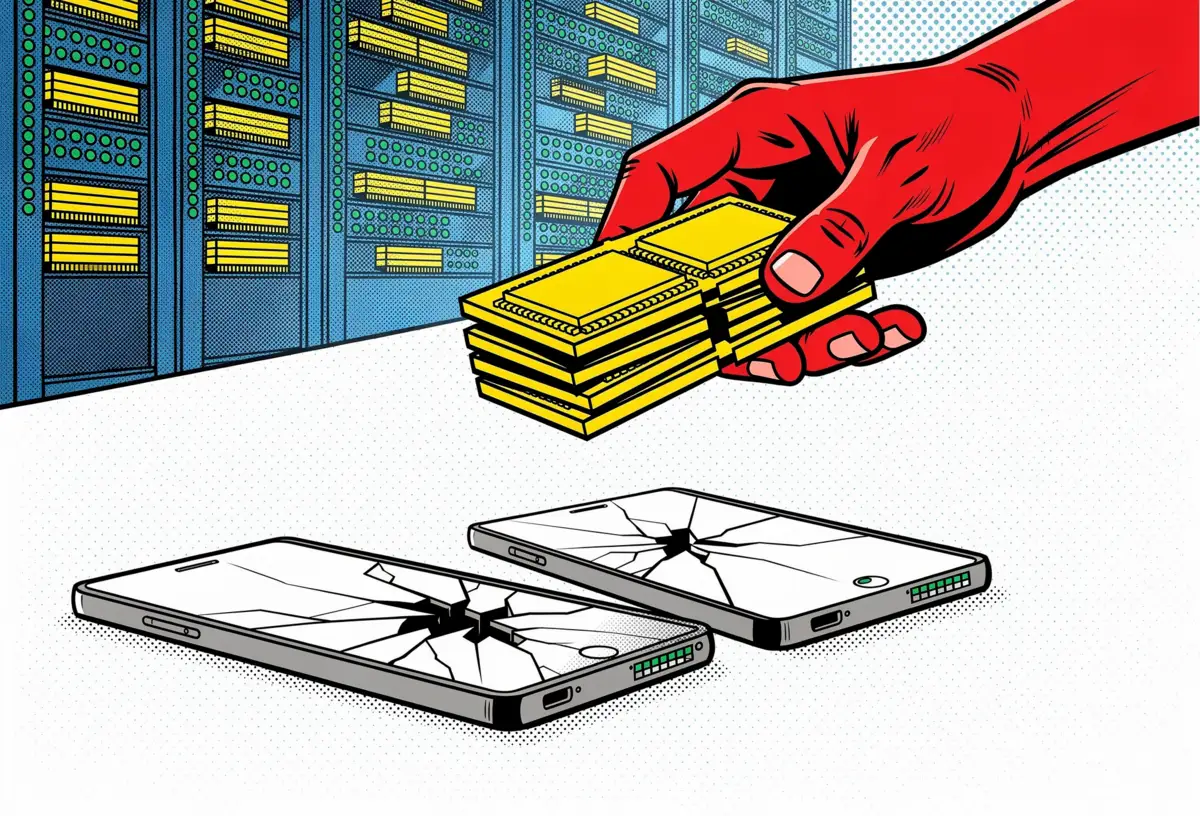
These numbers don't reflect some temporary inventory hiccup. They reflect a market that's been deliberately tightened.
TrendForce, probably the most closely watched analyst firm in the memory business, projects Q1 2026 will see conventional DRAM prices climb 55 to 60 percent quarter-over-quarter. Server DRAM, which cloud providers are stockpiling for AI infrastructure, should spike more than 60 percent. Morgan Stanley went even higher, bumping its full-year 2026 DRAM price forecast to 62 percent. By early January, spot prices were already making those projections look timid.
The market that was
The memory chip business used to be predictable, at least in its broad strokes. Shortages pushed prices up. Manufacturers responded by building more capacity. Oversupply eventually crashed prices. Weaker players dropped out or consolidated. Demand recovered. Then the whole thing started over. This pattern held for decades. Analysts could model it. Investors could time their entries and exits. OEMs could plan procurement cycles around it.
The 2026 shortage broke that rhythm. What's happening now isn't cyclical. It's a structural shift.
The Core Math: TrendForce projects global DRAM bit supply will grow 15 to 20 percent in 2026. Demand? That's running at 20 to 25 percent growth. Server demand alone should jump 40 to 50 percent year-over-year. AI workloads are on track to consume roughly 20 percent of global DRAM wafer capacity this year. The gap isn't closing. It's getting wider.
To understand why, you have to look at where the chips actually end up. High Bandwidth Memory, HBM for short, is what goes into the AI accelerators that hyperscalers use to train and run large language models. NVIDIA's H100 GPU needs 80 gigabytes of the stuff. The next-generation Rubin platform? That's targeting somewhere between 288 gigabytes and a full terabyte per GPU. When Microsoft, Meta, Google, and Amazon order thousands of these chips, the wafers and packaging infrastructure required to build HBM eat into capacity that used to go toward consumer DRAM.
The math here is particularly ugly. HBM is built by stacking DRAM dies on top of each other, eight layers, sometimes twelve, now pushing toward sixteen. Tiny copper pillars called through-silicon vias connect the stack. This vertical architecture delivers the bandwidth AI training requires. It also murders manufacturing throughput. Micron has described a 3-to-1 trade ratio: producing HBM consumes roughly three times the cleanroom capacity of standard DDR5. The ratio gets worse with future generations.
Put differently: for every 10,000 wafers per month going to NVIDIA's supply chain, the global market loses the equivalent of 30,000 wafers for PCs and smartphones. This is how the cannibalization works.
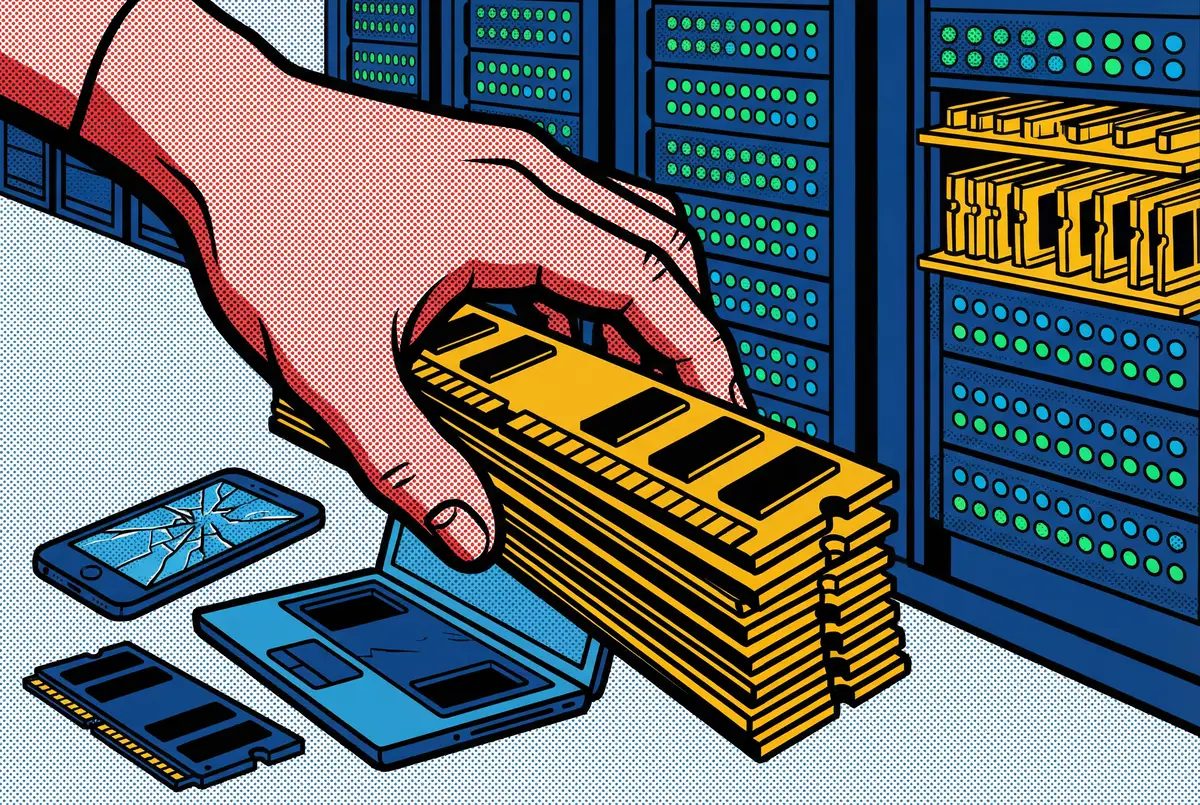
A wafer that becomes an HBM stack for an AI GPU is a wafer that doesn't become the LPDDR5X module in someone's mid-range phone. Consumer electronics and hyperscalers are fighting over the same fixed pool of manufacturing capacity, and one side has much deeper pockets.
What makes this worse is timing. During past downturns, memory makers raced to expand. The thinking was simple: build capacity now, grab market share when demand recovers. But the 2022-2023 price collapse triggered the usual round of cuts, and this time the recovery played out differently. Samsung, SK Hynix, and Micron between them control about 88 percent of DRAM supply. Somewhere along the line, these three companies apparently decided that the risk of building too much outweighed any market share they might grab in a commodity business.
Samsung's investor presentation from November 2025 spelled it out: the company would "prioritize long-term profitability over rapid capacity expansion" and "aim to minimize oversupply risks." SK Hynix, even while committing 30 percent of its 2026 revenue to capex, warned investors that "overcoming the supply shortage will be difficult" despite all that spending. Companies scrambling to fix a shortage don't talk like this. Oligopolists managing scarcity do.
Where the money actually flows
The financial logic all points one direction. HBM carries profit margins three to five times higher than commodity DRAM. If SK Hynix can sell HBM to NVIDIA at those premiums, what's the business case for allocating capacity to PC memory at lower margins? There isn't one.
Micron made this explicit in December 2025 by announcing it would exit its consumer-facing Crucial brand. The company is walking away from the DIY and retail market to focus exclusively on server and AI memory. Data centers pay more. Data centers get the chips.
This shift shows up across all three major producers, though each one is playing it slightly differently. SK Hynix has essentially become an HBM company. They hold roughly 54 percent of that market and have committed their entire 2026 output to high-bandwidth memory. Samsung is chasing them hard, expanding HBM capacity by 50 percent year-over-year. They're talking about tripling their HBM output.
Micron took a different path entirely. They raised their fiscal 2026 capex budget to $20 billion, which sounds enormous until you look at what they're actually building. Total bit shipments? Up maybe 20 percent. The gap between spending and output tells you where the money is going: specialized HBM equipment, not more production lines. They're investing in complexity, not volume.
The result looks strange at first glance. Memory suppliers are posting record revenues and profits while their traditional customers face record shortages. Manish Bhatia, Micron's EVP, offered a surprisingly candid admission on a recent earnings call: this is "the most significant disconnect between demand and supply in terms of magnitude and time horizon that we have experienced in 25 years in the industry." He said this while announcing record profits and raised guidance for the quarters ahead.
These companies are pulling extraordinary margins out of scarcity. Nothing in their behavior suggests they're in any hurry to end it.
The cascade through consumer electronics
The downstream impact is showing up fast. Industry sources and internal memos indicate Dell and Lenovo have warned partners of price increases between 15 and 20 percent across their PC lines. TrendForce reported Dell was resetting quotes in mid-December, with Lenovo's expiring January 1. Jeff Clarke, Dell's COO, put it bluntly: "I have never seen memory-chip costs rise this fast." Framework's 50 percent RAM price hike pushed the company to roughly $10 per gigabyte, way above where prices sat even a year ago.
OEMs are stuck with bad options: raise prices, cut specs, or do some of each. Most are doing both.
Reports circulating during CES suggested some budget laptop configurations might drop to 8GB of RAM. Storage is getting squeezed too. You're seeing a lot more 256GB and 512GB SSDs where, not that long ago, 512GB was the floor and 1TB was common. These aren't improvements. They're cuts driven by what components actually cost.
Smartphones face the same pressure. Samsung's bill of materials for the Galaxy S26 has climbed an estimated 10 to 15 percent because of memory and chipset costs. Industry sources point to a potential $60 price bump on the base model. There's also reporting that negotiations between Samsung's Mobile division and its memory suppliers, including Samsung's own Device Solutions division, have shifted from stable annual contracts to volatile quarterly pricing. One arm of Samsung is making money off a crisis that's squeezing the other arm.
The numbers from analysts are ugly. IDC's downside scenario has the PC market contracting somewhere between 5 and 9 percent in 2026. Smartphones look slightly better on volume, maybe down a couple percent, but average selling prices are climbing close to 7 percent. The auto industry might have it worst. Some OEMs are bracing for DRAM costs to nearly double on their 2026 contracts.
The Disparity in Pain: Apple, with its fat margins and supply chain muscle, can absorb DRAM cost increases or pass them along to customers who'll pay anyway. Mid-tier Android OEMs like Xiaomi, Oppo, and Vivo are fighting for allocation at spot prices that have jumped tenfold. The big cloud providers locked in 2026 capacity through long-term contracts. Everyone else scrambles for what's left.
HP's CEO Enrique Lores warned in an earnings call that expensive memory would hit profit margins in late 2026 by about $0.30 per share, even after mitigation efforts. HP is burning through internal inventory to buy time. That buffer runs out in the second half of 2026. After that, any ongoing shortage hits production directly.
The timeline for relief
So when does this end? The honest answer is: not anytime soon.
New fabs take 18 to 24 months before they affect supply in any meaningful way. Full ramp-up takes years beyond that. Micron's Idaho facility won't produce at scale until the second half of 2028. The company's New York megafab has slipped even further, with production now expected sometime in the 2030s. Leaked internal analysis from SK Hynix suggests commodity DRAM supply stays tight until at least 2028.
Samsung's Taylor, Texas fab tells you everything about the gap between announcements and reality. It was supposed to be a showpiece for U.S. semiconductor independence. Now it's mostly a story about delays. Mass production was originally planned for late 2024. Current timeline? Maybe 2026, maybe later. Yield problems and a shortage of committed customers for advanced nodes have slowed equipment installation to a crawl.
There's no cavalry coming. The U.S. remains dependent on Asian memory production for as long as this crisis lasts. The constraint is structural, and it's geographic. Policy can't fix it on any reasonable timeline.
Goldman Sachs expects double-digit percentage increases quarter-over-quarter through all of 2026 for conventional DRAM. The pessimistic scenario, which looks more plausible by the month, extends the shortage through 2028 or beyond. If AI infrastructure spending stays on its current trajectory, if the big memory makers keep avoiding aggressive expansion, if new fabs keep slipping, then 2029 might be the first year prices actually normalize. Maybe later.
Chen Qing-wen at TeamGroup has been more direct than most about what's coming. Early 2026 gets worse, he's said, not better. Real relief? Maybe late 2027. Maybe 2028. And even that timeline assumes people just stop buying because they can't stomach the prices anymore. It's not a forecast that supply catches up. It's a forecast that demand gives up.
The AI PC trap
There's a particularly absurd collision happening between the "AI PC" marketing push and the memory shortage. Every chip company decided 2026 was the year of the Neural Processing Unit. Intel is pushing it. AMD is pushing it. Qualcomm built their whole Snapdragon X2 pitch around it. Local AI workloads need fast, plentiful RAM. Running a 7-billion parameter model on-device requires 32GB or more.
But because of the pricing crisis, OEMs are configuring these "AI PCs" with 16GB or sometimes just 8GB of RAM to keep prices tolerable. You end up with machines marketed for AI that can't actually run meaningful AI workloads. The industry is selling a capability it can't afford to deliver.
Microsoft quietly cut its Copilot sales quotas in December 2025, according to The Information. After two years of pushing AI PCs with dedicated neural processing units as the future of computing, the company scaled back targets for the AI software those PCs were supposedly built to run.
The gap between AI PC hardware and what it can actually do has been obvious since launch. Every new chip includes a powerful NPU. These aren't optional features. They're baked into the silicon, adding cost and complexity whether anyone uses them or not. Meanwhile, the software ecosystem remains thin. Windows 11's AI features lean heavily on cloud processing. Most productivity apps haven't integrated meaningful local AI capabilities. You click the Copilot button expecting an instant answer from that fancy NPU, and instead you get a spinning wheel while the request routes to a data center in Virginia.
So here's the situation: laptop makers are building and marketing AI PCs that cost more because of memory shortages caused by AI data centers. The AI features consumers can actually use mostly require connecting to those same data centers. People are paying for local processing capability they can't really use, made more expensive by infrastructure that makes local processing beside the point.
The swing producer question
Samsung introduces an unpredictable element here. Unlike SK Hynix, which has dominated HBM with better yields and heat management, Samsung has struggled to get its HBM3E chips qualified for NVIDIA's top tier.
This failure might, paradoxically, be the only thing keeping the consumer market from total collapse. Because Samsung can't sell its HBM3E at premium prices to NVIDIA, the company may end up converting some of those production lines back to standard DRAM just to keep factories running. If you can't get the fat HBM margins due to yield problems, producing DDR5, which is currently commanding 60 percent higher prices than a year ago, beats producing HBM that nobody wants to buy.
Samsung becomes something like a swing producer in oil markets. If the company fixes its HBM yields, expect a pivot toward AI that tightens consumer supply even further. If yields stay problematic, Samsung might end up flooding the market with DDR5 and providing some price relief. Right now, in early 2026, Samsung's yield curve is probably the single biggest variable in global memory pricing.
Worth noting: Samsung representatives have said explicitly that the company won't "tie up volumes with specific customers in a situation where prices are rising rapidly." SK Hynix is also favoring short-term contracts. Companies trying to restore equilibrium don't behave like this. Companies profiting from disequilibrium do.
The geopolitical overlay
Trade policy makes all of this worse. Trump's team has been talking about 100 percent tariffs on imported chips, though with carve-outs for certain companies. Between that threat and the existing export controls, one of the pressure release valves from previous shortages has been squeezed shut.
Chinese memory maker CXMT, which holds roughly 4 percent of global DRAM share, had been producing older-generation DDR4 at competitive prices. That capacity provided some buffer at the margin for budget servers and consumer devices. But with U.S. export controls tightening and tariff pressure mounting, CXMT appears to be shifting focus toward domestic Chinese demand and moving up the value chain. The company is reportedly planning to start HBM packaging by late 2026 to serve Huawei's AI chips.
That low-cost DDR4 option is becoming harder for Western buyers to access. Tariffs and compliance risk push that demand back onto Samsung, SK Hynix, and Micron, which tightens the supply picture further.
China's countermove, restricting exports of rare earth metals and critical minerals used in chip manufacturing, has added a raw material risk premium to every wafer. Even if fabrication capacity existed, the cost floor has risen.
The demand-side risk
The whole pricing supercycle depends on one assumption: that AI demand keeps growing exponentially. But what happens if it doesn't?
Gartner's prediction has gotten a lot of attention: over 40 percent of agentic AI projects will be canceled by the end of 2027. The reasons cited: costs that keep escalating because of memory prices, unclear business value, and the difficulty of deploying AI agents at scale. Running thousands of inference agents requires HBM-equipped servers that cost 60 percent more than they did a year ago.
If Gartner is right, the industry is building capacity for a future that won't arrive. Hyperscalers are currently hoarding HBM based on aggressive adoption forecasts. Should corporate adoption stall because the AI Tax gets too heavy, those hyperscalers could cut orders dramatically.
Memory has always been prone to bullwhip effects. Shortage leads to panic buying and double orders. Manufacturers overshoot on capacity. Demand destruction hits when consumers stop buying expensive products. Then comes the crash, with the big producers sitting on mountains of high-end chips nobody wants.
IDC's projection that the PC market could contract 9 percent in 2026 shows price elasticity at work. Consumers aren't bottomless wallets. Faced with 20 percent higher prices for equivalent performance, people are keeping old devices longer. The AI PC features, while interesting, haven't reached the point where they justify a $300 premium for most buyers.
What actually changes
The executives at CES 2026 understood exactly what's happening. Their public messaging about capacity expansion and supply recovery shouldn't be read as forecasts. It's reassurance meant to prevent panic. What they're actually doing with capital allocation tells a different story about how long they expect this profitable scarcity to last.
For anyone buying electronics or running IT procurement, the takeaway is straightforward: this isn't a disruption that passes. It's a structural reshaping of how memory gets allocated, and it will persist through at least 2027. Price pressure will be substantial throughout 2026.
Memory used to be a commodity. It's become a strategic asset. And like any scarce resource, it's creating a divide between those who can afford it and those who can't. The AI Everywhere vision that CES showcased is technically achievable. Economically, it's becoming something only certain buyers can access.
The gap between what the industry says and what it does isn't accidental. It's a signal that the shortage will outlast the optimism by a considerable margin.
What to watch
The Samsung yield situation deserves close attention. If they get HBM3E qualified with NVIDIA, consumer DRAM tightens further as more production lines convert. But if yields stay problematic, Samsung might accidentally become the market's relief valve. Quarterly earnings calls from the memory division will tip which direction they're headed.
The big cloud companies matter too, obviously. Microsoft, Meta, Google, Amazon. They're the ones driving AI infrastructure demand. If any of them starts talking about "efficiency" or "optimization" in their capex discussions, pay attention. That's how you'll hear about a pullback before it shows up in orders. Any real revision to datacenter buildout plans would ripple through memory markets within a couple quarters.
Keep an eye on the PC and smartphone shipment numbers from IDC and Counterpoint. If Q1 2026 shows demand falling more than 5 percent year-over-year, that's not just a blip. Manufacturers would likely start inventory corrections by Q3. Extended weakness along those lines could flip this whole thing, turning shortage into glut by late 2027.
Enterprise AI adoption rates will tell us whether the demand assumptions hold. If companies start abandoning their agentic AI projects at rates anywhere near Gartner's 40 percent prediction, the math changes completely.
And watch what's happening with Chinese memory production for domestic AI. CXMT, YMTC, any movement on Huawei's Ascend supply chain. If China builds successful domestic AI infrastructure, the global market bifurcates further. Western demand would concentrate even more heavily on the Big Three.
Key Takeaways
- Structural, not cyclical: The 2026 shortage reflects a permanent shift in how silicon capacity gets allocated. The old boom-bust pattern that governed memory for decades has broken.
- The 3:1 wafer penalty: Each wafer of HBM eats cleanroom capacity equivalent to three wafers of standard DDR5, creating direct competition between AI and consumer electronics for fixed manufacturing resources.
- Coordinated scarcity: Samsung, SK Hynix, and Micron are prioritizing margins over volume. None of them are expanding aggressively enough to restore equilibrium.
- Relief timeline extends to 2028+: New fabs won't contribute meaningful supply until 2028 at the earliest. If current trends hold, normalized pricing might not arrive until 2029.
- AI PCs face an economic contradiction: Machines marketed for local AI processing are shipping with reduced RAM because of shortages caused by the same AI infrastructure they're supposed to complement.
- Samsung as swing producer: The company's HBM yield struggles could accidentally provide consumer market relief. But if Samsung fixes those yields, expect an even sharper pivot away from commodity DRAM.
- Demand destruction risk: If Gartner's 40 percent AI project cancellation prediction holds, the current shortage could invert into oversupply by 2027.
Sources & Further Reading
Primary Sources
- Reuters: Samsung Interview with TM Roh — December 2025 interview on AI device targets and shortage impacts
- TrendForce Q1 2026 DRAM Price Forecast — Industry projection showing 55-60% QoQ price increases
- Micron Earnings Call Coverage — CEO Mehrotra's admission of meeting only half to two-thirds of key customer demand
- SK Hynix 2026 Market Outlook — Company guidance on HBM-led supercycle through 2027
- SK Hynix Internal Analysis — Leaked projections on supply constraints through 2028
Research & Analysis
- DIGITIMES Research: DRAM Spot Price Analysis — DDR5 and DDR4 spot price tracking through late 2025
- IDC Global Memory Shortage Analysis — Market impact projections for PC and smartphone sectors
- Tom's Hardware: IDC PC Market Contraction Warning — Analysis of 5-9% projected market decline
- Dr. Robert Castellano: HBM Has Broken the Memory Cycle — Technical analysis of structural market shift
- S&P Global: DRAM Makers and AI Data Centers — Automotive sector impact assessment
Further Reading
- SemiAnalysis: The Rise and Roadmap of HBM — Technical deep-dive on HBM architecture and wafer economics
- Goldman Sachs DRAM Price Research — Investment bank projections for 2026 pricing
- TrendForce: Memory Price Rally Through 2028 — Analysis of conservative capacity expansion strategies
- Framework RAM Price Increase Explanation — OEM transparency on supply chain economics
Free AI briefing · Weekdays
The AI stories that matter, sourced and explained.
Join the Morning Briefing. It goes out every weekday at 4:45 a.m. Pacific, with later sends for the East Coast, Berlin and Tokyo.
Free when you sign up: The Paperclip Compendium, our tested guide to running AI agents.
Free. Unsubscribe in one click.

Marcus Schuler
Editor-in-Chief and founder of Implicator.ai. Former ARD correspondent and senior broadcast journalist with 10+ years covering tech. Writes daily briefings on policy and market developments. Based in San Francisco. E-mail: editor@implicator.ai