Alex Karp stood on a World Economic Forum stage in Davos on Tuesday and told the room that people like him are finished. The Palantir CEO, who holds a doctorate in neoclassical social theory from a German university, who graduated from an elite liberal arts college before Stanford Law, delivered his verdict on the future of work with the confidence of someone whose company just crossed $400 billion in market value.
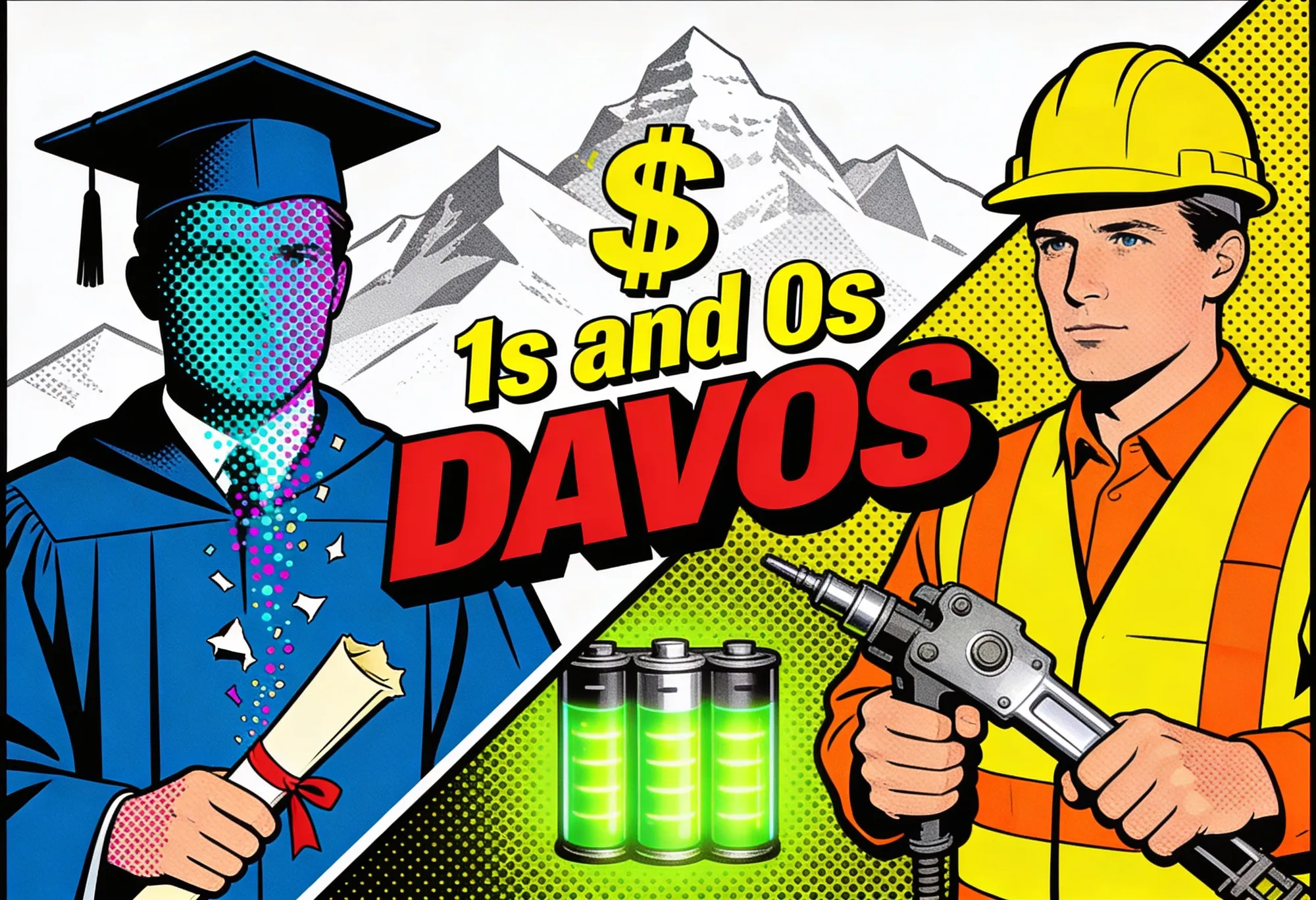
"AI will destroy humanities jobs," Karp told BlackRock CEO Larry Fink, who was moderating the panel.
He used himself as the example. A philosophy degree, a strong education, the whole academic trajectory that once marked someone as accomplished. In the age of artificial intelligence, Karp said, that kind of background will doom you.
Key Takeaways
- Karp's prediction: AI will automate white-collar and humanities work while making vocational jobs more valuable and harder to replace.
- The immigration pivot: If AI eliminates demand for educated workers, Karp argues, mass immigration becomes economically unnecessary.
- The contradiction: Karp calls himself a "card-carrying progressive" while running a company that sells surveillance tools to ICE.
- Davos reality check: Entry-level hiring is already falling at Google DeepMind and Anthropic, but broader job displacement hasn't appeared in employment data yet.
The vocational inversion
Karp's argument runs like this: AI will automate the work that educated white-collar professionals do. Analysis, synthesis, the manipulation of language and ideas. The jobs that require a physical presence, that demand hands on materials, that resist digitization, those will survive. Plumbers and electricians. Battery technicians. The people who fix things in the real world.
Karp pointed to American battery workers doing the same job as Japanese engineers. High school graduates, he said, now "very valuable, if not irreplaceable" because AI can retrain them rapidly.
The phrasing matters. Notice what he said. Not that vocational workers have always been valuable. That AI makes them valuable now. The technology that threatens knowledge work turns out to validate the work that knowledge workers have spent decades condescending to.
And then Karp made the political turn. If AI eliminates the need for large numbers of white-collar workers, he argued, it also eliminates the economic case for large-scale immigration. Nations will have more than enough jobs for their citizens, especially those with vocational training. Mass immigration becomes unnecessary unless someone brings a highly specialized skill.
"I do think these trends really do make it hard to imagine why we should have large-scale immigration," Karp said.
Get Implicator.ai in your inbox
Strategic AI news from San Francisco. No hype, no "AI will change everything" throat clearing. Just what moved, who won, and why it matters. Daily at 6am PST.
No spam. Unsubscribe anytime.
A progressive in Trump's shadow
Karp describes himself as a "card-carrying progressive." He volunteered this on stage, nobody asked. And yet. ICE is one of Palantir's biggest customers. The agency uses the software to build files on people it wants to deport. Homeland security contracts, defense deals with governments on multiple continents. And Peter Thiel, Trump's billionaire advisor during the first term, co-founded the whole thing with Karp.
Karp knows this looks strange. He acknowledged the tension without resolving it. Protests have followed his company, inside and outside its offices. He mentioned them on stage, too. But the business keeps growing. Palantir's stock has risen more than 130% in the past twelve months.
The Davos setting sharpened the contradiction. Near the conference center, McKinsey and Microsoft had taken over an old church and rebranded it USA House. Bunting everywhere, the whole red-white-and-blue treatment, eagles on every sign. Directly across the street? Palantir's own storefront. One block over, some group called the Alliance for Global Good-Gender Equity and Equality had rented a space. It stayed empty most of the week. Attendees walked right past the door, heading for AI panels, cryptocurrency cocktail hours, anywhere with a line.
The forum drew its largest crowd ever this year. Three thousand people from 130 countries, all of them clogging streets built for maybe a tenth that number. Hardly any of them showed up for sessions on refugee care or women's education. They came for the technology storefronts, the AI House, the panels on agentic software and enterprise deployment. President Trump's Wednesday arrival dominated conversations even before he landed.
The counterargument nobody wanted to hear
Not everyone at Davos agreed with Karp's forecast. Finance executives, sounding almost defensive, told Business Insider that liberal arts degrees might become the new hot commodity. As AI takes over hard financial analysis, critical and creative thinking returns to the spotlight. You could hear the hope in the framing: the skill that cannot be automated is the skill that matters.
That hope lasted a few hours. Then Hassabis and Amodei showed up on the same panel, DeepMind and Anthropic side by side, and said what everyone had been avoiding. Junior hiring? Already falling at both shops. Amodei mentioned that software and coding roles at Anthropic were down, junior and mid-level both.
Step back from any single panel and you saw the pattern. Not a debate. A sorting. The companies building AI are cutting their human headcount. The companies buying AI are still figuring out which employees they actually need. And the executives running both types have discovered a new posture: alignment with the incoming administration.
"Part of being a great CEO is being a chameleon," said Daniel Newman, CEO of the Futurum Group, a tech consultancy. "Trump is the most influential voice in the world right now. These CEOs are pleased to be in an environment that's largely right for business."
The molt happened fast. Two years ago these same executives talked constantly about diversity, equity, and inclusion. That language is gone now. Climate sustainability panels got shoved into smaller rooms. What fills the main stages instead? Practical sessions. How to drive ROI from AI spending. Top-down deployment strategies. The mechanics of workforce transformation. The chameleons had changed color.
The jobs that have not disappeared
Svenja Gudell, Indeed's chief economist, offered the most grounded take at Davos. Tech sector jobs have dropped sharply since 2022, yes. But look at the timeline, she told Fortune. That decline started before generative AI took off. The better explanation? Pandemic-era hiring binges followed by the inevitable correction. Nothing to do with robots. Just companies that overbuilt their headcount and are now trimming.
Other industries are not hiring much either, but macroeconomic and geopolitical uncertainty bear more blame than artificial intelligence. The job displacement that Karp and others predict has not shown up yet in employment numbers.
C. Vijayakumar, running HCLTech, put a number on it. His company can hit 3-5% revenue growth without adding a single employee, he told Business Today at Davos. AI makes existing workers more productive. Want to grow faster than 5%? Then yes, you still need bodies.
The word Vijayakumar kept using was "agentic." Jobs will become more agentic with AI, he said, reducing the need for physical assistance. But "agentic" in corporate parlance means something different than it sounds. It means software that plans, decides, and acts with minimal human intervention. It means automation that thinks.
Daily at 6am PST
The AI news your competitors read first
No breathless headlines. No "everything is changing" filler. Just who moved, what broke, and why it matters.
Free. No spam. Unsubscribe anytime.
What Davos revealed
The forum has always been an exercise in performance. Panels on global cooperation, sustainability, shared prosperity. The backstage reality: deal-making, networking, the cultivation of access. This year the pretense dropped faster than usual.
Karen Harris leads Bain's Macro Trends practice. Eight years of Davos trips, so she knows when something shifts. This year felt off to her. The old premise, that NGO leaders gather here to advise world leaders on elevating humanity, just didn't match what she was seeing.
You could see the new hierarchy on the promenade. Meta, Salesforce, Tata occupying the largest storefronts. Qatar and the United Arab Emirates advertising openness for business. The Alliance for Global Good relegated to a mostly empty rental space while the line outside AI House stretched onto the sidewalk.
Jim Hagemann Snabe, chairman of Siemens, told a breakfast session that CEOs need to be "dictators" in identifying where their businesses deploy AI. The bottom-up approach, giving every employee access to ChatGPT or Microsoft Copilot, has been abandoned. Those gains proved hard to quantify. Top-down transformation of core business processes is now the consensus strategy.
Snabe had one more thought, and this one landed harder. Someone asked about AI regulation. He did not hedge. Governments that want AI to respect human values should write that into law, he said. Make it mandatory. And if they are serious about enforcement? Ban any AI business model built on advertising. Ad-supported AI will chase engagement the way social media did. Instagram figured out how to keep teenage girls scrolling until they hated themselves. Now imagine that same optimization logic inside a system that talks back. One that learns exactly where you are vulnerable. One that gets paid to keep you hooked.
Nobody expects that ban to materialize.
The battery workers
Karp's image of the American battery worker doing the same job as a Japanese engineer carries weight because it points at something real. Physical work resists the kind of displacement that threatens analysts, coders, and yes, philosophers. A robot can write an essay. It cannot yet install a solar panel or repair an HVAC system.
But the logic has a limit. Karp's argument assumes AI capability will plateau before it reaches vocational work. It assumes the technology that destroys humanities jobs will spare plumbing and electrical work. That bet might pay off. The timeline might give blue-collar workers a generation of advantage.
Or physical AI, the systems Vijayakumar mentioned, might close the gap faster than anyone expects. Remote surgery. Automated facility management. Robots working mines and ports. This is not some distant speculation. Walk through any industrial trade show and you will see the prototypes.
Karp walked off the Davos stage having delivered his prophecy. The man with the philosophy degree told other philosophy majors to find new skills. The CEO of a surveillance company warned about immigration. The card-carrying progressive made the case that aligned with Trump's agenda.
The battery workers he praised were not in the room. They were somewhere else, doing physical work, unaware that a billionaire in Switzerland had just declared them the future.
Frequently Asked Questions
Q: What did Alex Karp say about AI and jobs at Davos?
A: Karp argued AI will destroy white-collar and humanities jobs while making vocational workers more valuable. He pointed to battery technicians and tradespeople as examples of workers who will become "irreplaceable" because physical work resists automation.
Q: How did Karp connect AI to immigration policy?
A: Karp claimed that if AI eliminates demand for white-collar workers, nations will have enough jobs for their citizens without large-scale immigration. He said mass immigration becomes unnecessary unless someone brings highly specialized skills.
Q: What is Palantir's relationship with immigration enforcement?
A: ICE is one of Palantir's biggest customers. The agency uses Palantir's software to build files on individuals targeted for deportation. The company also holds homeland security and defense contracts with governments worldwide.
Q: Has AI actually caused job losses yet?
A: According to Indeed's chief economist Svenja Gudell, tech job declines since 2022 started before the generative AI boom and reflect post-pandemic right-sizing, not automation. However, Google DeepMind and Anthropic CEOs confirmed entry-level hiring at their companies has already fallen.
Q: What was the broader mood at Davos 2026?
A: The forum drew its largest crowd ever, 3,000 people from 130 countries. Tech companies dominated the promenade while sessions on refugees and women's education sat empty. CEOs shifted away from DEI and climate language toward AI ROI discussions and alignment with the incoming Trump administration.
Related Stories