IMPLICATOR
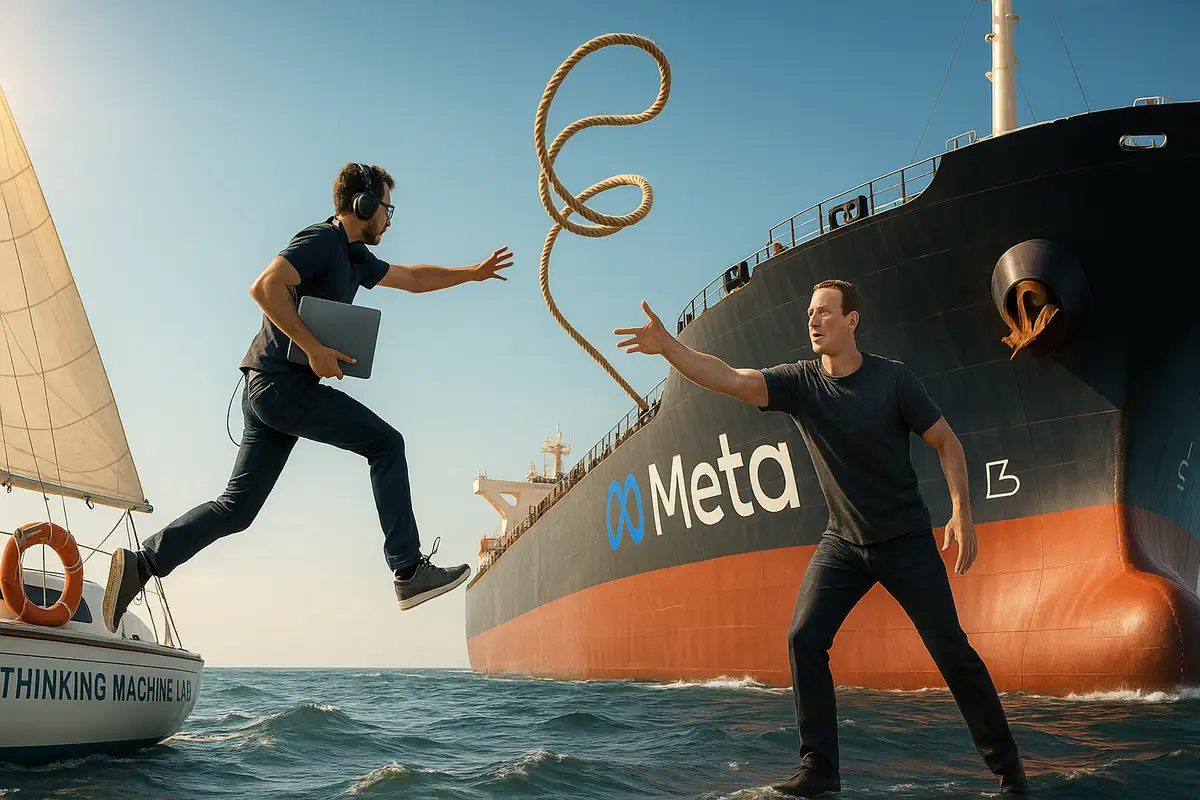
Mira Murati announced at an all-hands on Thursday that Barret Zoph, the man she had recruited to build her startup's technical foundation, was out. "Unethical conduct," according to two sources who spoke to reporter Kylie Robison. The specifics: sharing confidential company information with competitors. Within hours, OpenAI's applications chief Fidji Simo posted a celebratory note welcoming Zoph, cofounder Luke Metz, and researcher Sam Schoenholz back to the company they had left sixteen months earlier.
If you're looking for the tell, it's in the timing. Simo's announcement said the move "has been in the works for several weeks." Murati's statement said nothing about weeks. It said "parted ways." The framing collision tells you everything.
The Breakdown
• Thinking Machines ousted CTO Barret Zoph; he, cofounder Luke Metz, and researcher Sam Schoenholz all returned to OpenAI
• Murati cited "unethical conduct"; OpenAI said it doesn't share those concerns and the move was weeks in the works
• Soumith Chintala (PyTorch creator) takes over as CTO, shifting Thinking Machines toward infrastructure
• All three returning researchers built ChatGPT's core post-training systems at OpenAI before leaving in 2024-2025
The escape velocity failed
Here is the sequence of events, stripped of corporate politeness. Zoph told Murati on Monday he was considering leaving. On Thursday, she fired him. On Thursday, OpenAI announced it was hiring him. The memo from Simo went further: OpenAI doesn't share Murati's concerns about Zoph. That's not a diplomatic aside. That's a direct contradiction of the ethics accusation, distributed to thousands of employees.
AI researcher Susan Zhang called it "the type of character assassination leak you put out when you find out one of your cofounders might be splitting off." Roon compressed the dynamic further: "before cognitive restructuring: important people are leaving. after cognitive restructuring: they're being fired for unethical conduct." Rohan Anil objected to the spectacle itself, calling it "a mess of a field" where reputations get damaged over hearsay from unnamed sources.
He isn't wrong about the mess.
What Murati actually lost
Zoph's departure isn't a routine personnel change. Before leaving OpenAI, he ran post-training as VP, leading the teams that turned GPT-4 from a statistical next-word generator into the conversational product that made the company famous. The RLHF pipelines, the instruction-following, the safety filtering, the part that feels like magic to users. That was his shop.
Join 10,000+ AI professionals
Strategic AI news from San Francisco. No hype, no "AI will change everything" throat clearing. Just what moved, who won, and why it matters. Daily at 6am PST.
No spam. Unsubscribe anytime.
Metz and Schoenholz brought different expertise, but all three shared decade-long track records at Google Brain before OpenAI. Between them, Murati had assembled a team that knew how to make models work, not just how to train them.
All three left with Murati in late 2024 and early 2025. Now all three are gone. Sixteen months of recruiting and equity allocation, evaporated in a single afternoon.
Soumith Chintala inherits a different company
Murati's replacement choice for CTO is Soumith Chintala. His pedigree is real: creator of PyTorch at Meta, over a decade in machine learning infrastructure. "Brilliant and seasoned leader," Murati called him. The praise landed with the weight of someone filling a sudden vacancy.
But Chintala changes the company's DNA. You don't hire the creator of PyTorch to tweak a chatbot's personality. You hire him to build pipes. Zoph and Metz were product people, focused on what happens after training. Chintala's expertise sits lower in the stack, the frameworks and tooling that make training possible in the first place. Thinking Machines just pivoted from a research-to-product play to an infrastructure play, whether Murati intended that or not.
Or maybe she's just trying to keep the lights on while the investor story gets rewritten. The uncertainty itself is the point.
Gravitational capture
Gavin Purcell captured the absurdity: "starting to believe that in ten years there will be only 200 people with jobs and they will just continually move between three companies." The joke lands because it describes reality. The same names cycle through OpenAI, Google DeepMind, Meta, Anthropic, and now Thinking Machines. The talent pool is small. The poaching is relentless.
Daily at 6am PST
Don't miss tomorrow's analysis
No breathless headlines. No "everything is changing" filler. Just who moved, what broke, and why it matters.
Free. No spam. Unsubscribe anytime.
OpenAI lost Jerry Tworek, its VP of research, recently. Now it regains Zoph, Metz, and Schoenholz. Murati left OpenAI as CTO. Sixteen months later, OpenAI reclaims her cofounders. The symmetry feels less like coincidence and more like physics: the mass of OpenAI's compute, capital, and distribution exerting pull that a fifteen-person startup cannot match.
But the ethics accusation hangs. WIRED could not verify the claim that Zoph shared confidential information. Zoph did not respond to requests for comment. What we have instead is dueling narratives: Murati's version, where a cofounder committed a fireable offense, and OpenAI's version, where they're "thrilled to have them join the team" after weeks of negotiations.
Both cannot be true. One company is lying, or at minimum, omitting context that would change the story. The AI industry has reached the scale where billion-dollar research directions hinge on which of twelve researchers is in the building. And apparently, the scale where corporate communications teams wage reputation battles over talent acquisition in real time.
What's left standing
Thinking Machines still exists. Murati still runs it. Chintala will attempt to rebuild technical credibility while the gossip cycle burns through its fuel. But the startup that launched with the promise of Mira Murati plus three OpenAI research pillars now operates under a different thesis entirely.
OpenAI, meanwhile, got what it wanted. Zoph reports to Simo. Metz and Schoenholz report to Zoph. The post-training expertise that helped build ChatGPT is back where it started.
The field won't remember the ethics accusation by next quarter. It rarely does. What sticks is the pattern: startups launch with talent, talent gets pulled back, startups scramble for replacements. The gravitational center holds. Murati escaped OpenAI's orbit for sixteen months before the company recaptured her technical leadership. Now she starts over, with a new CTO and an infrastructure focus she may not have chosen, trying to prove that an AI research lab can survive without the people who knew how to make models talk.
Chintala knows how to build the pipes. Whether anyone's still buying the water is a different question. And by Thursday evening, the three people who could have answered it were already back at OpenAI.
Frequently Asked Questions
Q: Why was Barret Zoph fired from Thinking Machines?
A: According to sources who spoke to reporter Kylie Robison, Zoph was terminated for "unethical conduct," specifically sharing confidential company information with competitors. WIRED could not verify this claim, and OpenAI stated it doesn't share Murati's concerns about Zoph.
Q: Who is Soumith Chintala and why does his appointment matter?
A: Chintala created PyTorch at Meta and has over a decade in machine learning infrastructure. His expertise is in tooling and frameworks, not post-training product work. His appointment signals Thinking Machines may be shifting from a consumer AI play to an infrastructure company.
Q: What did Barret Zoph do at OpenAI before joining Thinking Machines?
A: Zoph served as VP of Post-Training, leading the teams that built ChatGPT's core systems: the RLHF pipelines, instruction-following, and safety filtering that turned GPT-4 from a raw language model into a conversational product.
Q: How many researchers returned to OpenAI from Thinking Machines?
A: Three: Barret Zoph (former CTO), Luke Metz (cofounder), and Sam Schoenholz. All three had left OpenAI in late 2024 and early 2025 to join Murati's startup. Zoph will report to Fidji Simo; Metz and Schoenholz will report to Zoph.
Q: What does this mean for Thinking Machines' future?
A: With new CTO Soumith Chintala (PyTorch creator), Thinking Machines appears to be shifting from consumer AI products toward infrastructure and tooling. The company launched with post-training expertise; now it has a frameworks expert leading technical strategy.

Free AI briefing · Weekdays
The AI stories that matter, sourced and explained.
Join the Morning Briefing. It goes out every weekday at 4:45 a.m. Pacific, with later sends for the East Coast, Berlin and Tokyo.
Free when you sign up: The Paperclip Compendium, our tested guide to running AI agents.
Free. Unsubscribe in one click.

Marcus Schuler
Editor-in-Chief and founder of Implicator.ai. Former ARD correspondent and senior broadcast journalist with 10+ years covering tech. Writes daily briefings on policy and market developments. Based in San Francisco. E-mail: editor@implicator.ai