
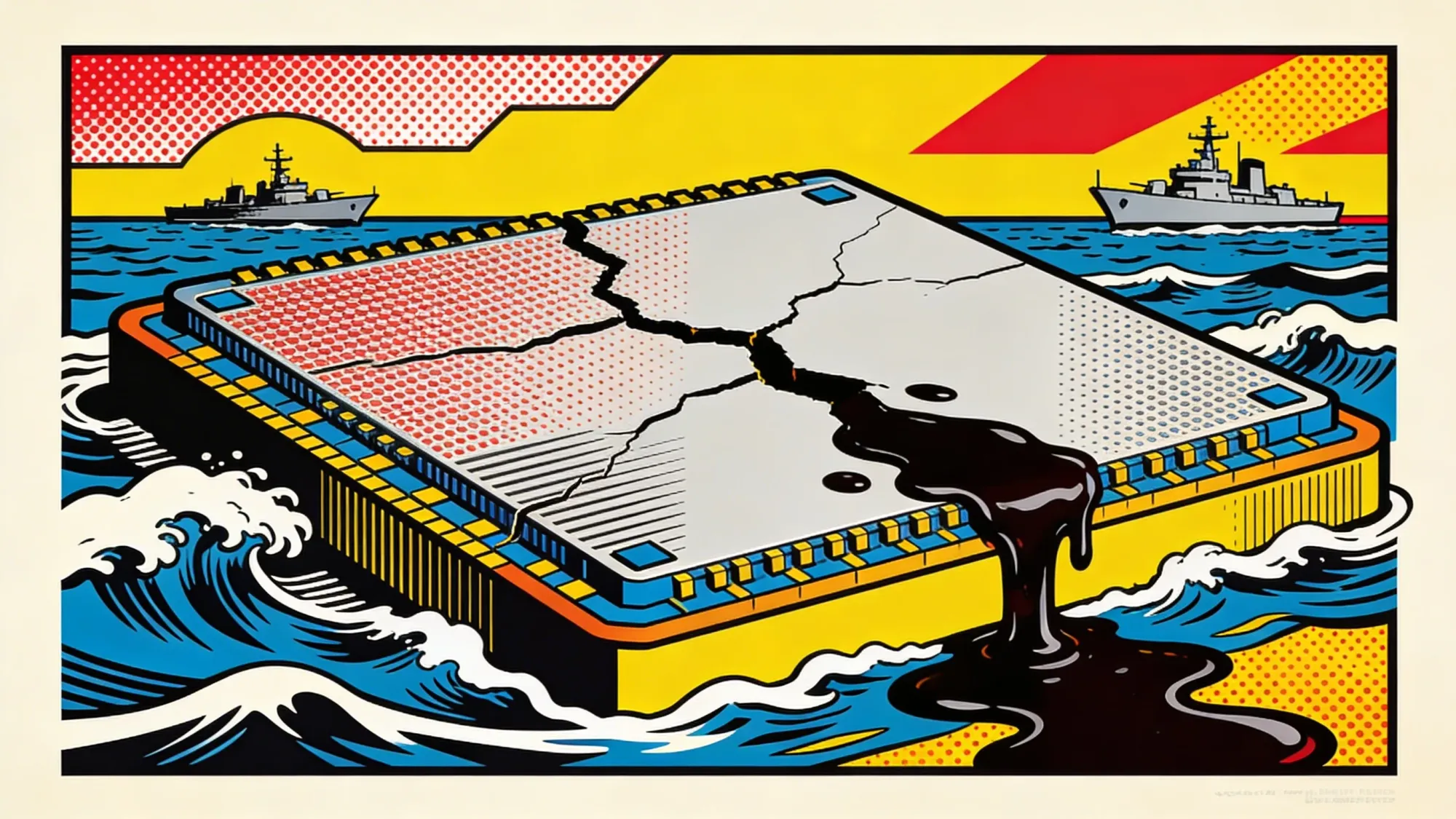
It took eighty-seven days. Washington grabbed a sitting head of state, then launched a full-scale air war against a nuclear-threshold power. The strait through which a fifth of the world's oil moves is now effectively closed.
The Pentagon treats them as separate operations. Operation Absolute Resolve seized Nicolás Maduro from his compound in Caracas on January 3 and deposited him in a Brooklyn detention center to face narcoterrorism charges. Operation Epic Fury hit Tehran, Isfahan, and Bushehr with coordinated U.S.-Israeli strikes on February 28. Khamenei was killed in the opening hours. The IRGC declared Hormuz closed by March 2, and tanker traffic vanished. Major insurers pulled coverage.
Two campaigns separated by 8,000 miles of ocean and two months of calendar. But they share one consequence. Both terminated China's largest sources of discounted crude oil in the same quarter. Venezuelan exports to Asia collapsed 67% in February. Iranian supply now faces physical interdiction in an active war zone. And the real fallout is building not in the Persian Gulf or Caracas but in the boardrooms of Santa Clara County, where companies have collectively committed $690 billion to an AI infrastructure buildout that depends on chips manufactured 100 miles off the Chinese coast.
Oil and military posture pressing on semiconductor supply. Each vector has been covered as its own story. They are not separate stories. They are one geological system, and the fault line runs through TSMC's fabs in Hsinchu.
This article continues below.
Sign up once, read everything for free. No algorithms, no fluff—just the AI intel that actually matters for your work.
Get free access →