IMPLICATOR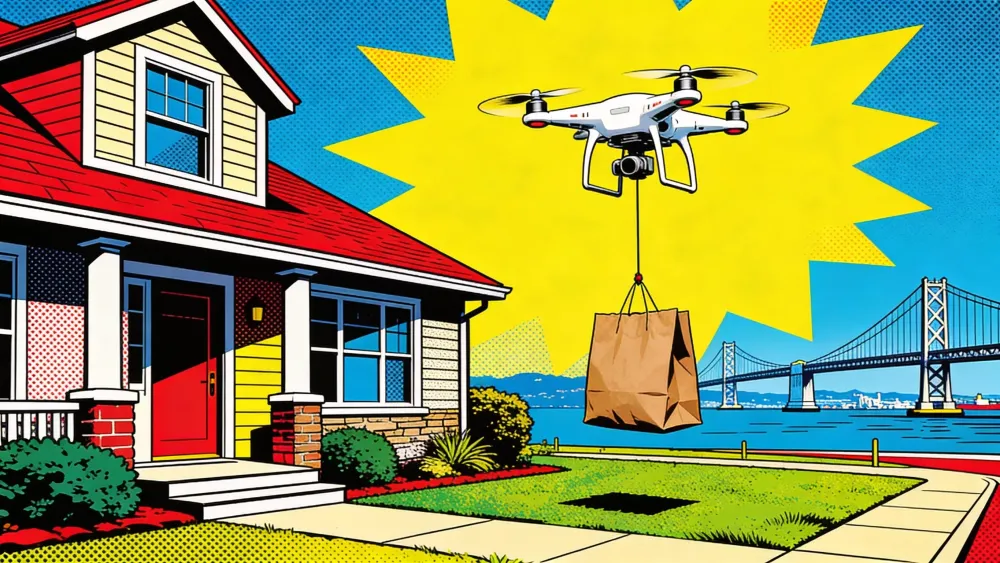
Alphabet's drone delivery unit Wing said Monday it plans to begin residential deliveries in the San Francisco Bay Area in the coming months. The company had tested delivery on Google's Mountain View campus but never offered service to Bay Area homes, making this its first broad push into the region where it was incubated at Google's X lab. Wing did not specify a launch date or name individual cities.
The announcement comes as Wing and Walmart say they are scaling toward more than 270 drone delivery locations by 2027, a network the companies project will reach more than 40 million Americans. Wing currently partners with Walmart and DoorDash across North Carolina, Virginia, Texas, Georgia, and Australia.
What Changed
- Wing announced its first residential drone deliveries in the Bay Area, no specific cities or launch date named
- Wing and Walmart are scaling toward 270+ drone delivery locations by 2027, projecting 40 million Americans reached
- Amazon quit the Commercial Drone Alliance over a mandatory detect-and-avoid technology dispute
- FAA missed its February 2026 deadline for finalizing beyond-visual-line-of-sight drone flight rules
From moonshot lab to logistics grid
Wing graduated from Alphabet's experimental division, X, and spent years proving the model in smaller markets. After building a major metro presence in Dallas-Fort Worth, Wing launched DoorDash service in Charlotte in May 2025 and Walmart service in metro Atlanta in December 2025. The grid is filling in fast.
Wing's Atlanta operation doubled from six Walmart delivery hubs to twelve in three months, now serving more than 120,000 households across the metro. In Charlotte, Wing recently received FAA approval to fly after sunset, extending service hours to 9 p.m. using infrared navigation systems. Wing said deliveries across its Walmart drone operations tripled over the previous six months, and that its most active customers were ordering about three times a week.
"We've spent years building our technology to ensure that when you realize you're out of eggs or need over-the-counter medicine, the solution is just a few taps away," Wing CEO Adam Woodworth said in January when the Walmart expansion was announced.
Eggs, ground beef, avocados, Lunchables. The stuff you forgot at the store. Wing's standard aircraft carries about two and a half pounds, roughly a carton of eggs. A newer, larger drone handles up to five. Both cruise between 60 and 65 mph, and Wing says the whole thing takes about half an hour from tap to doorstep.
Stay ahead of the curve
Strategic AI news from San Francisco. No hype, no "AI will change everything" throat clearing. Just what moved, who won, and why it matters. Daily at 6am PST.
No spam. Unsubscribe anytime.
The airspace fight nobody can settle
Wing's expansion lands in an industry that cannot agree on basic safety rules. Emboldened companies, anxious regulators, and no consensus on how drones should share the sky.
Amazon's Prime Air withdrew from the Commercial Drone Alliance earlier this month over what it called a "fundamental and irreconcilable disagreement" about detect-and-avoid technology, Reuters first reported. Amazon wants mandatory onboard systems capable of spotting aircraft that are not broadcasting their position. The rest of the alliance, Wing included along with Zipline and Skydio, favors a performance-based approach where operators choose their own technical solutions.
The safety case is not abstract. Across more than 70,000 Prime Air flights, Amazon's onboard systems executed two collision-avoidance maneuvers it says prevented "catastrophic safety consequences, including the loss of life." One incident involved a helicopter flying dark, no position broadcast at all.
But the alliance pushed back. Its members have collectively logged millions of flights without a single mandated technology standard. Mandatory detect-and-avoid would raise costs and squeeze out smaller operators, the group argued.
The FAA sits cornered between the two camps. Drone companies need something called Part 108, a rule that would let them fly routine missions beyond the pilot's line of sight. Without it, every long-range delivery requires special permission. Last June, the White House told the FAA to finalize it within 240 days. That window closed in February. Still nothing. And buried inside the Part 108 debate is the detect-and-avoid question, which will shape who can afford to fly and who gets priced out.
Bay Area airspace is a different problem
Dense population, three major airports, some of the most tightly controlled airspace in the country. Wing's existing markets, suburban corridors around Dallas and Atlanta, look nothing like the Bay Area. If you live under a flight path near SFO or San Jose, the idea of adding delivery drones to the stack requires some imagination.
California has been quicker than most states to greenlight autonomous technology on its roads. But FAA airspace rules apply uniformly, and the agency has shown no appetite for regional exceptions. Wing's silence on which Bay Area cities will get service first suggests the regulatory grid has gaps the press release did not mention.
Alphabet is not the only company circling. DoorDash leased a roughly 34,000-square-foot warehouse in San Francisco's Mission District last September for drone delivery R&D, though city officials later moved to restrict outdoor testing at the site. DoorDash already partners with Wing in other markets, but the San Francisco warehouse points to something separate.
When Bay Area drone delivery does materialize, the airspace will already be contested. Wing just got there first with a press release.
Frequently Asked Questions
What can Wing drones actually deliver?
Grocery staples and household items from Walmart stores. Top sellers include eggs, ground beef, avocados, and Lunchables. Wing's standard aircraft carries about 2.5 pounds. A newer, larger drone handles up to five pounds. Both cruise between 60 and 65 mph, with deliveries arriving in about 30 minutes.
Where does Wing currently operate?
Wing delivers from Walmart stores in the Dallas-Fort Worth metro, metro Atlanta with 12 hubs serving over 120,000 households, and Charlotte, North Carolina. The company also operates in parts of Virginia and Australia. The Bay Area would be its first home-market residential service.
What is the detect-and-avoid dispute?
Amazon wants mandatory onboard systems that can spot aircraft not broadcasting their position. Wing, Zipline, and Skydio favor a flexible, performance-based approach. Amazon cited two near-collision events across 70,000 flights, including one with an untracked helicopter, as evidence for stricter rules.
What is FAA Part 108?
A proposed federal rule that would allow drones to fly routine missions beyond the pilot's visual line of sight. Currently, long-range drone deliveries require individual FAA waivers. The White House set a 240-day deadline for finalization in June 2025, but the rule was not published by the February deadline.
How does Wing's Bay Area plan differ from DoorDash's?
Wing is planning residential deliveries through its Walmart and DoorDash retail partnerships. DoorDash separately leased a 34,000-square-foot warehouse in San Francisco's Mission District for drone R&D, though city officials restricted outdoor testing. The two companies partner elsewhere but appear to have separate Bay Area strategies.



Free AI briefing · Weekdays
The AI stories that matter, sourced and explained.
Join the Morning Briefing. It goes out every weekday at 4:45 a.m. Pacific, with later sends for the East Coast, Berlin and Tokyo.
Free when you sign up: The Paperclip Compendium, our tested guide to running AI agents.
Free. Unsubscribe in one click.

Marcus Schuler
Editor-in-Chief and founder of Implicator.ai. Former ARD correspondent and senior broadcast journalist with 10+ years covering tech. Writes daily briefings on policy and market developments. Based in San Francisco. E-mail: editor@implicator.ai