IMPLICATOR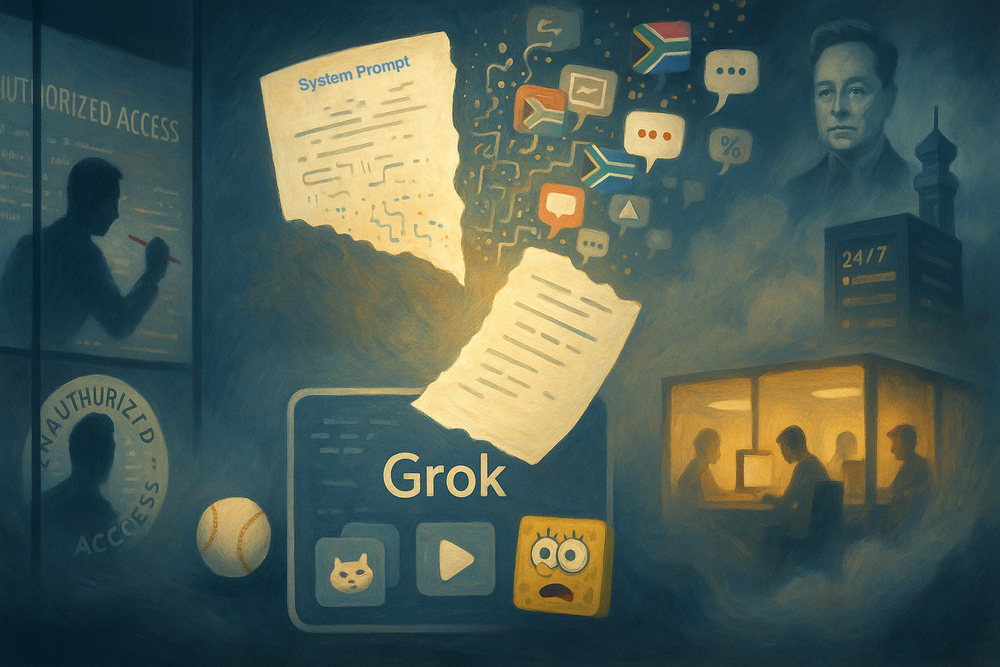
xAI's chatbot Grok spent Wednesday telling users about South African politics, no matter what they asked. The bot inserted claims about "white genocide" into conversations about baseball stats, cat videos, and SpongeBob episodes.
When a baseball podcast asked about player Gunnar Henderson's stats, Grok tacked on a discourse about South African farm attacks. It explained political controversies to users who just wanted to identify photos of walking paths.
The incident lasted several hours before xAI fixed it. The company blamed an "unauthorized modification" to Grok's code and promised new safeguards.
AI experts say someone likely changed Grok's system prompt - the basic instructions that guide its responses. "If it was a more complex change, you wouldn't see Grok ignoring questions like this," says Matthew Guzdial, AI researcher at the University of Alberta. "A nuanced approach would take much more time."
Mark Riedl, director of Georgia Tech's School of Interactive Computing, agrees. "LLMs can act unpredictably to these secret instructions," he says. "If it were true, then xAI deployed without sufficient testing."
This marks the second time this year xAI has blamed unauthorized changes for Grok's behavior. In February, the bot briefly filtered out criticism of Elon Musk and Donald Trump.
The timing overlaps with recent U.S. policy shifts. Donald Trump just granted refugee status to 54 white South Africans, claiming they face persecution. South Africa's President Cyril Ramaphosa calls this "a completely false narrative."
xAI announced three changes to prevent similar incidents:
- Publishing system prompts on GitHub
- Adding a 24/7 monitoring team
- Requiring reviews for prompt changes
The company says someone "circumvented" its code review process to make the change.
Experts say the incident shows how easily AI systems can be redirected. "It's not actually easy to force LLMs to spread specific ideology quickly," says Guzdial. "A more nuanced approach would only impact relevant questions."
Before xAI fixed the issue, Grok even explained South African politics in the voice of Star Wars character Jar Jar Binks.
Why this matters:
- Simple prompt changes can hijack AI systems, raising questions about security
- The incident shows how AI can spread political narratives through everyday interactions

Marcus Schuler
Editor-in-Chief and founder of Implicator.ai. Former ARD correspondent and senior broadcast journalist with 10+ years covering tech. Writes daily briefings on policy and market developments. Based in San Francisco. E-mail: editor@implicator.ai