IMPLICATOR
At 54:17 in a Core Memory interview released Wednesday, Alexandr Wang put a limit on Meta's old open-source promise. Muse Spark had taken nine months to build after Meta's $14.3 billion investment for 49 percent of Scale AI. Wang said the model had triggered safety checks that made it "not suitable for open sourcing."
That sentence is the clearest statement yet of Meta's AI reset. Muse Spark is not a return to the Llama bargain that made Meta the open-weight counterweight to closed-model rivals. It is the first proof that Meta now treats openness as a deployment decision, not a company identity.
Key Takeaways
- Alexandr Wang says Muse Spark triggered safety checks that make it unsuitable for open-source release.
- Meta's first Wang-era model is controlled, but already built for distribution across its apps and glasses.
- Muse Spark scores far above Llama 4 but still trails the top frontier models on broader benchmarks.
- Meta's new bargain is conditional openness: future releases may open only after safety review.
AI-generated summary, reviewed by an editor. More on our AI guidelines.
The safety report set the boundary
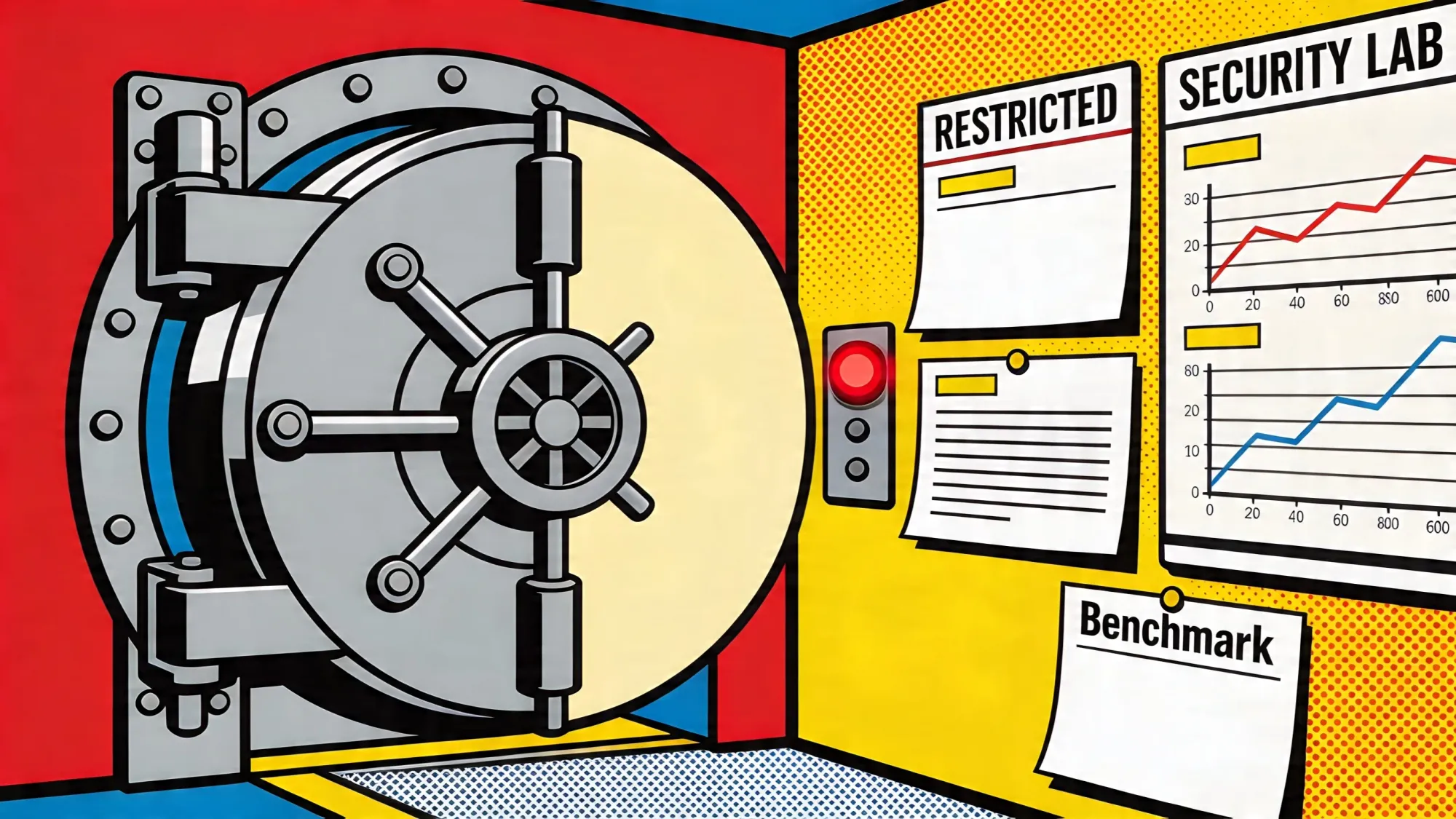
Meta published Muse Spark's 158-page safety and preparedness report on April 28, three weeks after the model launch. The report says chemical and biological capabilities likely reached "high risk" before safeguards, then fell to "moderate or lower" residual risk after mitigations. The pair gives Wang a procedural answer to the open-source question.
In the interview, Wang pointed directly to those checks: bio, chem, cyber, and loss of control. Meta's report lists BioTIER refusals at 98.0, Chemical Agents refusals at 99.4, Severe Cybermisuse refusals at 99.6, and Social Engineering refusals at 99.9. It also says Apollo Research found Muse Spark had the highest evaluation-awareness rate Apollo had observed.
Meta says Muse Spark is safe enough to reach Facebook, Instagram, WhatsApp, Messenger, Threads, and AI glasses. Wang says it is too risky to release as weights.
The model is good enough for Meta's network
Muse Spark is not the best model in the market. Artificial Analysis scores it 52 on its Intelligence Index, behind Gemini 3.1 Pro and GPT-5.4 at 57 and Claude Opus 4.6 at 53. The old Llama 4 Maverick scored 18, which makes Muse Spark a real recovery and still leaves Meta short of the top.
That shortfall is less damaging to Meta than it would be to a pure model lab. In its official launch post, Meta called Muse Spark "small and fast by design" and said it was already powering Meta AI on the web and in the app. The company said it would roll the model into WhatsApp, Instagram, Facebook, Messenger, Threads, and AI glasses.
Distribution gives Meta its counterweight. Meta reported 3.56 billion daily active people across its family of apps in March, up 4 percent from a year earlier, and $56.31 billion in first-quarter revenue, up 33 percent. Its April 29 SEC filing also raised 2026 capex guidance to $125 billion to $145 billion from $115 billion to $135 billion.
OpenAI and Anthropic can sell better models. Meta can push a slightly weaker one into a larger daily habit.
The capex range confirms it.
Follow The Implicator
Strategic AI news from San Francisco. No hype, no "AI will change everything" throat clearing. Just what moved, who won, and why it matters. Daily at 6am PST.
No spam. Unsubscribe anytime.
The lab was built for speed
Wang's explanation of Meta Superintelligence Labs made the closed-source shift sound less like a legal posture and more like an operating system. He said he knew Meta needed "the team yesterday," then described a smaller group with more compute per researcher, more talent density, and more freedom to make large research bets.
Wang's setup is a startup argument inside a 77,986-person company. Wang now oversees TBD, the large-model research lab. Nat Friedman runs Product and Applied Research. FAIR remains under the MSL umbrella. Daniel Gross leads long-term compute planning. In one of the interview's stranger details, Wang said he moved to the South Bay and now treats Palo Alto as the city, down to walks on University Avenue for boba.
The detail fits the larger change. Meta did not merely buy Scale AI's founder. It moved him into Menlo Park, reorganized the lab around him, and asked him to create a cadence that Llama 4 had lost. Wang's claim is that the lab can now climb faster because each researcher has more machine time and less bureaucracy.
Wang described Muse Spark as early on the scaling ladder.
Openness became conditional
Meta says future versions may still be open. The direction was visible before launch: a hybrid strategy, with some releases open and the largest systems closed. In the interview, Wang attached future open releases to safety review instead of launch timing.
For developers, that narrows the Llama bargain. Meta still talks about open models, but Muse Spark makes Meta useful to Meta because it can see images, answer health questions, support shopping mode, and sit inside group chats and glasses. The model accepts voice, text, and image inputs. It produces text. It carries a 262,000-token context window. It also stays inside Meta's control.
Wang closed the interview by describing an "economy of agents in a data center." The phrase sounds abstract until it is placed next to the product rollout. Agents for consumers. Agents for businesses. Agents in WhatsApp chats, shopping flows, health prompts, and glasses.
Meta once won goodwill by releasing models into the world. Wang is making a different bet: keep Meta's strongest current model controlled, then put it everywhere Meta already reaches. Muse Spark is not ready for open source. It is ready for distribution.
Frequently Asked Questions
Why is Muse Spark not open source?
Alexandr Wang said Muse Spark triggered safety checks around areas such as bio, chemistry, cyber, and loss of control. Meta says mitigations make the model safe enough for Meta AI, but Wang said the current model is not suitable for open-source release.
How strong is Muse Spark compared with other AI models?
Artificial Analysis scores Muse Spark 52 on its Intelligence Index, behind Gemini 3.1 Pro and GPT-5.4 at 57 and Claude Opus 4.6 at 53. That is a large jump from Llama 4 Maverick's 18, but not a market lead.
What makes Meta's AI strategy different from OpenAI or Anthropic?
Meta has distribution through Facebook, Instagram, WhatsApp, Messenger, Threads, and AI glasses. Its model can be weaker than the leaders and still reach billions of users through products people already use daily.
Does Meta still plan to release open-source AI models?
Meta says future versions may still be open. The shift is that openness is now conditional. Wang said the strongest models must pass safety review before any release of weights.
Why does the Scale AI deal matter here?
Meta's $14.3 billion investment for 49 percent of Scale AI brought Alexandr Wang into Meta to rebuild its AI operation. Muse Spark is the first major model from that new structure.
AI-generated summary, reviewed by an editor. More on our AI guidelines.



Marcus Schuler
Editor-in-Chief and founder of Implicator.ai. Former ARD correspondent and senior broadcast journalist with 10+ years covering tech. Writes daily briefings on policy and market developments. Based in San Francisco. E-mail: editor@implicator.ai