Implicator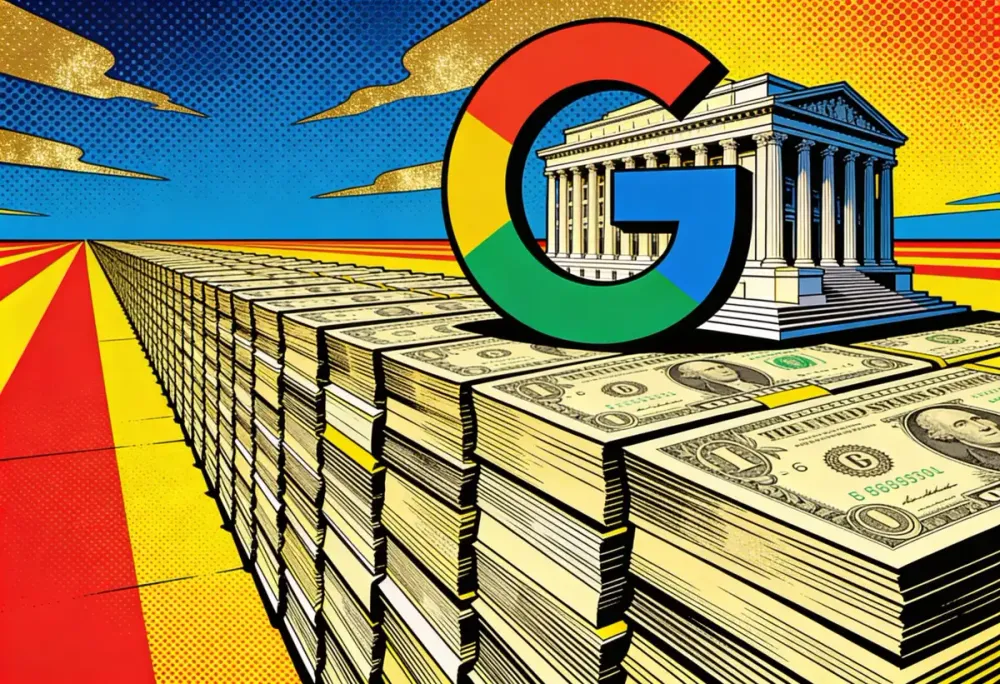
Google is about to borrow money it won't have to pay back until 2126. A century bond, denominated in British pounds, part of a borrowing spree that already raised $20 billion in dollars on Monday alone. The last tech company to try something like this was IBM, in 1996, back when the internet still ran on dial-up.
In the sterling market, the only institutions that have ever gone out 100 years are Oxford, the Wellcome Trust, and EDF, the French state energy company. Centuries-old or sovereign-backed, every one of them. Google is 28.
The dollar deal alone drew over $100 billion in orders, making it one of the most oversubscribed corporate bond offerings in history. A company that started in a Stanford dorm room is now borrowing on the same timeline as medieval universities and sovereign-backed utilities.
That fact deserves more attention than it's getting. Not because of what it says about Alphabet's credit rating, which is fine. Because of what it says about what these companies have become. The century bond is a flag planted in the ground. Silicon Valley's largest companies are no longer cash-rich software operators that occasionally dip into debt markets. They are becoming debt-funded infrastructure states, and the bond market is treating them accordingly.
When tech companies start acting like utilities
For most of its existence, Alphabet held less than $15 billion in long-term debt. Less than a year ago, that number sat below $11 billion. By the end of last year, it had quadrupled to $46.5 billion. After Monday's deal, it will sit well above $60 billion.
The Breakdown
• Alphabet raised $20 billion in US bonds Monday, with $100 billion+ in orders, and is planning a rare 100-year sterling bond.
• The company's long-term debt jumped from under $11 billion to over $60 billion in 18 months, matching utility and railroad financing patterns.
• Alphabet's own SEC filing warns AI could cannibalize its ad business, even as it borrows on a century timeline to build AI infrastructure.
• Morgan Stanley expects hyperscalers to borrow $400 billion this year, potentially pushing US investment-grade issuance to a record $2.25 trillion.
The speed of this transformation is hard to overstate. Alphabet went from a company that barely needed to borrow to one of the most active issuers in the investment-grade bond market, all within 18 months. And it has plenty of company. Oracle raised $25 billion last week. Meta sold $30 billion in bonds in October. Amazon did $15 billion in November. Morgan Stanley now expects hyperscalers to borrow $400 billion this year, up from $165 billion in 2025.
These are not the financing patterns of software companies. Software companies generate enormous free cash flow and return it through buybacks. Alphabet has been cutting its repurchases. These are the financing patterns of utilities, railroads, and power companies. Entities that spend decades building physical infrastructure and finance it over the useful life of the assets.
The comparison isn't flattering to anyone who bought the stock for its capital-light business model. But it's accurate. Alphabet told investors last week it plans to spend between $175 billion and $185 billion on capital expenditures this year. Nearly double its 2025 total of $91 billion. About 40% goes to physical data center construction. The rest buys servers and AI chips. On last week's earnings call, an analyst asked CEO Sundar Pichai what keeps him up at night. His answer was two words. "Compute capacity."
You don't issue century bonds because you're swimming in cash. Alphabet had $127 billion in cash at year-end. You issue them because you expect to need capital at this scale for decades, and you want to lock in today's rates before the market figures out how much paper is coming.
The $3 trillion bet that hasn't paid off yet
Here's what makes the century bond so revealing. Alphabet is borrowing on a 100-year timeline while simultaneously telling the SEC, in its annual financial report, that AI might wreck its own business model.
The company added new risk language last week acknowledging that generative AI could reduce search usage, which would directly hit its advertising revenue. "There is no assurance that we will adapt effectively and competitively to meet this shift," the filing reads. That's not boilerplate. The language reads defensive, almost apologetic. Google is admitting, in legal prose, that the technology it's spending $185 billion to build could cannibalize the advertising machine that funds everything else.
Join 10,000+ AI professionals
Strategic AI news from San Francisco. No hype, no "AI will change everything" throat clearing. Just what moved, who won, and why it matters. Daily at 6am PST.
No spam. Unsubscribe anytime.
And Alphabet isn't alone in this contradiction. Bloomberg Intelligence estimates that AI-related capital spending will reach $3 trillion in aggregate by 2029. The four largest US hyperscalers, Alphabet, Amazon, Meta, and Microsoft, are projected to spend roughly $650 billion this year. That's the combined GDP of Sweden, Norway, and Denmark.
Infrastructure spending at this scale changes what a company is. You can't spend $185 billion in a year on data centers and then pivot if the economics don't work. Those are 20-year leases, custom-built facilities, long-duration commercial contracts. Alphabet's own SEC filing warns that these commitments could lead to "excess capacity" and increased "liabilities and obligations in the event of nonperformance." The company is locking itself in.
Wavelength Capital Management's Andrew Dassori put it bluntly to Bloomberg. "Clearly we're not in a typical capex cycle, and after previously being net savers, the companies involved are now going deep into the well for financing to secure the resources to compete."
Going deep into the well. That's the language of wartime mobilization, not quarterly earnings. And it's the right frame. These companies are not spending for next quarter. They are building for the next thirty years and financing it over a hundred.
Why the bond market doesn't care about the risk
If you're a bond investor, the math on Alphabet still looks comfortable. Net income hit $132 billion last year, with ad revenue climbing 13.5% in Q4 and Google Cloud growing 48%. Even if AI dents search volumes over time, the cash flow is enormous relative to the debt load.
But something stranger is happening beneath the math. Impax Asset Management bought Alphabet bonds last year. This time, portfolio manager Tony Trzcinka told the Financial Times he skipped the offering. Not because of credit risk. Because of overexposure. "We've been very conscious of our exposure to these hyperscalers and their capex budgets," he said. The anxiety in that sentence is quiet but real.
That's the tell. When professional bond investors start talking about concentration risk from tech companies, you're not in a normal corporate debt market anymore. You're watching a sector become too big to diversify around.
The interest rates confirm this. On the 50-year dollar bond Alphabet sold in November, the company paid roughly one percentage point above Treasuries. For context, the US government usually borrows for a maximum of 30 years. Alphabet got an extra 20 years at barely more cost. The three-year tranche on Monday priced at just 0.27 percentage points above Treasuries, tightening from 0.6 during initial discussions. Investors were fighting to lend Google money at rates that make the company's borrowing costs look nearly sovereign.
A banker involved in the deal told the FT that the multi-currency strategy exists because Alphabet can't keep tapping the same investor pool. "There might be a supply-demand imbalance if you were to try to come back to the US dollar market over and over again," the banker said. Read that sentence twice. A company with $127 billion in cash is worried about running out of willing lenders in the world's deepest capital market. That's how much borrowing is coming.
Business Insider's Alistair Barr made the uncomfortable comparison explicit. Google, he wrote, "is now considered about as safe a bet as an entity that oversees the world's largest economy, operates the most powerful military on earth, and can print US dollars to pay back what it owes."
That's hyperbole. Slightly. A federal judge in September effectively preserved Google's search monopoly after the DOJ's antitrust case produced remedies that left the company mostly intact. Google gets monopoly pricing power without monopoly regulation. No utility commission sets its ad rates. No public service obligation constrains its investment decisions. It has the permanence the bond market demands without the constraints that normally come with it.
What century bonds tell you about the next decade
The century bond is not about the next hundred years. Nobody buying it expects to hold it that long. Pension funds and life insurers will trade in and out based on rate movements and portfolio needs. The bond's real function is to signal permanence, to tell the market that Alphabet considers itself a forever institution with forever infrastructure needs.
That signal matters because it reshapes how you think about the entire sector. If the hyperscalers are borrowing like sovereign entities and spending like wartime governments, then the investment framework for tech needs to change. These are no longer growth stocks that might or might not hit their revenue targets. They are infrastructure states with multi-decade capital programs, and the appropriate comparisons are Aramco, EDF, and national rail systems.
For investors, that means lower returns and lower risk. Competitors face something worse. The barriers to entry just got a century taller, and no startup is borrowing at sovereign rates. Regulators, meanwhile, are running out of time to impose structural constraints. You don't break up a company that's 20 years into a 100-year bond program. The financial entanglement runs too deep.
Morgan Stanley's Vishwas Patkar thinks the AI borrowing wave will push total US investment-grade issuance to a record $2.25 trillion this year, and he's drawing comparisons to 1997 and 2005. Both were periods when corporate borrowing ran hot and credit spreads eventually widened. Nobody went bankrupt. But plenty of people lost money.
And then there's the software sector, already reeling. Bond spreads for major software companies widened by 14 basis points in recent weeks as investors processed what happens when AI eats the business models that debt was supposed to finance. The hyperscalers borrow to build the machine. The machine destroys the value of everyone else's software. The wreckage shows up in someone else's credit spreads.
Alphabet will be fine. Somewhere in Oregon or South Carolina, concrete is being poured for data centers that won't finish construction until 2028, financed by bonds that won't mature until 2126. The company that borrows like a country will be treated like one, for better and worse. The question is what happens to everyone standing in the shadow of a century-long bet they didn't get to make.
Frequently Asked Questions
Q: Why is Alphabet issuing a 100-year bond?
A: Alphabet needs to finance up to $185 billion in capital expenditures this year, nearly double its 2025 spending. A century bond in sterling lets the company tap a different investor pool, including pension funds and life insurers that buy long-duration assets. It also locks in current interest rates before the expected flood of hyperscaler borrowing pushes costs higher.
Q: How does Alphabet's borrowing cost compare to the US government?
A: On its 50-year bond sold in November, Alphabet paid roughly one percentage point above US Treasuries but got 20 extra years to repay. Its three-year tranche on Monday priced at just 0.27 points above Treasuries. Bond investors are treating Alphabet's credit as nearly sovereign.
Q: What are hyperscalers expected to spend on AI in 2026?
A: The four largest US hyperscalers, Alphabet, Amazon, Meta, and Microsoft, are projected to spend roughly $650 billion on capital expenditures this year. Bloomberg Intelligence estimates total AI-related capital spending will reach $3 trillion in aggregate by 2029.
Q: Why did Alphabet add new AI risk language to its SEC filing?
A: Alphabet acknowledged that generative AI could reduce search usage, directly threatening its advertising revenue. The filing also warns that large infrastructure commitments could lead to excess capacity and increased liabilities if demand doesn't materialize as expected.
Q: How is the AI borrowing boom affecting other sectors?
A: Bond spreads for major software companies widened by 14 basis points in recent weeks as investors priced in the risk that AI disrupts traditional software business models. Morgan Stanley's credit strategist compared the current setup to 1997 and 2005, when corporate borrowing ran hot before spreads widened.



Maria Garcia
Bilingual tech journalist slicing through AI noise at implicator.ai. Decodes digital culture with a ruthless Gen Z lens—fast, sharp, relentlessly curious. Bridges Silicon Valley's marble boardrooms, hunting who tech really serves.