IMPLICATOR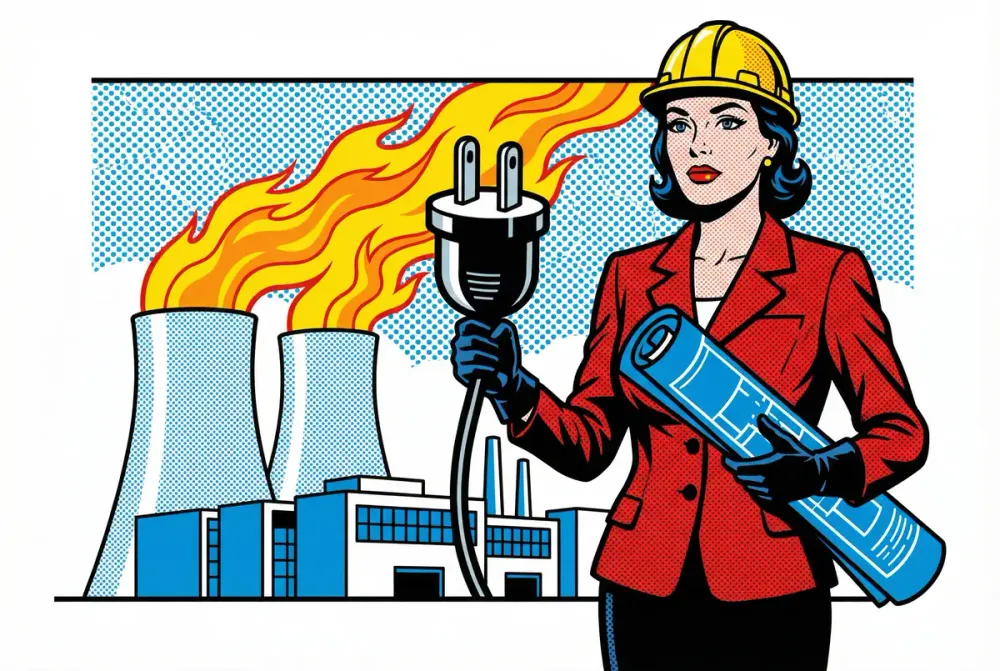
The job posting didn't ask for an engineer.
On Monday, Meta named Dina Powell McCormick as president and vice chairman, a role that will put a Goldman Sachs veteran and former Trump administration official at the center of the company's artificial intelligence ambitions. Not running model training. Not optimizing inference. Her job is handshakes in Riyadh and zoning hearings in Nevada. Building relationships with governments and sovereign wealth funds that can finance infrastructure that no private company can build alone.
Read that job description again. Build. Deploy. Invest. Finance. Four verbs, and not one of them involves writing code.
Mark Zuckerberg announced the appointment hours before unveiling Meta Compute, a new initiative to construct "tens of gigawatts" of data center capacity this decade and "hundreds of gigawatts or more over time." The company has committed $600 billion in US infrastructure investment by 2028. Last year alone, capital expenditures hit $72 billion.
Those numbers are so large they've stopped being about AI. They're about something else entirely.
The Breakdown
• Meta hired a Goldman Sachs banker—not an engineer—to lead its $600 billion AI infrastructure buildout through 2028.
• Powell McCormick's husband chairs the Senate energy subcommittee; ethics groups are already calling for his recusal.
• Llama 4 underperformed against competitors, yet Meta spent $72 billion on infrastructure in 2025 alone.
• The appointment signals AI has become a capital and political problem, not a technical one.
The model that doesn't work
If Llama 4 had been a world-beater, this appointment would look like a victory lap. Instead, it looks like a pivot.
Meta's flagship open-source model launched to what industry observers politely called "a muted response." Translation: it underperformed. Google's Gemini and OpenAI's models remain the benchmarks. Meta's most advanced AI isn't leading the pack.
And yet, the spending continues. $72 billion in 2025 alone, the vast majority flowing toward data centers that will house models struggling to justify the investment.
This is the central tension Zuckerberg isn't addressing publicly: Meta is building infrastructure for AI capabilities it hasn't yet demonstrated. The company operates the world's largest social networks. It generates billions in advertising revenue. But its actual AI products—the ones that would consume all this compute—remain works in progress.
Powell McCormick's job, translated from corporate speak, is to keep the capital flowing while the engineers figure out what to do with it.
The Goldman Sachs solution
The hiring logic becomes clearer when you stop thinking about AI as a technology problem and start thinking about it as a capital allocation problem.
Powell McCormick spent sixteen years at Goldman Sachs. She served on the firm's Management Committee. She led its Global Sovereign Investment Banking business—the division that manages relationships with government wealth funds and nation-states looking to deploy hundreds of billions of dollars.
Jamie Dimon, JPMorgan's CEO, offered an unsolicited endorsement: "She is a better banker and has more or better relationships than many big finance CEOs."
That's not a compliment about her views on transformer architectures.
Powell McCormick isn't a hire. She's a permit. You don't bring in a sovereign wealth banker to manage a product roadmap. You bring her in to rezone the neighborhood.
What does Meta actually need to pull this off? Land. Power. Political cover. Good luck getting any of those without working through governments, utilities, and local communities that have grown tired of Big Tech showing up with demands and leaving them with the electric bill.
Get Implicator.ai in your inbox
Strategic AI news from San Francisco. No hype, no "AI will change everything" throat clearing. Just what moved, who won, and why it matters. Daily at 6am PST.
No spam. Unsubscribe anytime.
Data centers have become flashpoints. Towns worry about water consumption. Residents complain about electricity rates. Environmental groups raise questions about carbon footprints. Every new facility requires permits, negotiations, and the kind of relationship management that engineers don't learn in graduate school.
Powell McCormick's Rolodex solves these problems. Her relationships with sovereign wealth funds can unlock financing structures that don't appear on Meta's balance sheet. Her connections to Republican officials—including her husband, Senator David McCormick of Pennsylvania, who chairs the Senate subcommittee responsible for energy policy—provide access to the regulatory levers that will determine where and how quickly Meta can build.
The Sheryl Sandberg playbook, reversed
Zuckerberg has tried this move before. Sheryl Sandberg played the same role for a decade—trading on her Democratic connections to keep Washington off Facebook's back during Obama and the first Trump term. She was the acceptable face of Facebook in rooms where Zuckerberg couldn't or wouldn't go.
But Sandberg was playing defense. Her job was to protect existing businesses from regulatory interference. Powell McCormick is playing offense. Her mandate is to enable expansion at a scale that makes Facebook's earlier growth look modest.
The distinction matters. Sandberg was managing relationships with politicians who wanted to constrain Meta. Powell McCormick will be cultivating relationships with governments that Meta needs as partners—entities that can provide land, power, and capital for infrastructure that no private company can build alone.
This is the new economics of AI. The models might be open-source, but the physical infrastructure required to train and run them at scale is becoming a strategic asset that rivals sovereign investment in complexity and cost.
The Trump variable
Minutes after Meta announced the appointment, President Donald Trump posted congratulations on Truth Social, calling Powell McCormick "a fantastic, and very talented, person" who served his administration "with strength and distinction."
The timing wasn't coincidental.
Meta has spent the past year realigning itself with the Trump administration in ways that would have been unthinkable during the company's earlier era. It scrapped its US fact-checking program. It elevated Republican Joel Kaplan as chief global affairs officer. It ended diversity programs. It hired former Trump trade adviser C.J. Mahoney as chief legal officer.
Each move, taken individually, could be explained as corporate pragmatism. Together, they represent a comprehensive repositioning toward an administration that controls regulatory agencies, infrastructure permits, and the political climate in which Meta will spend its $600 billion.
Powell McCormick's appointment is the capstone. She brings credibility with exactly the constituencies Meta needs: Republican officials who will approve permits, conservative donors who influence policy, and sovereign wealth funds from Gulf states and Asia that might co-invest in data center development.
The conflict of interest is structural. Her husband chairs the Senate subcommittee on energy—an area in which she will be directly involved at Meta. Senator McCormick's spokesperson said he will "continue to comply with all U.S. Senate ethics rules." But the Tech Oversight Project, an industry watchdog, called for him to recuse himself from any vote involving Meta's business.
He probably won't. And Meta is counting on it.
What compute actually costs
The numbers Zuckerberg announced Monday deserve scrutiny.
Here's the math on "tens of gigawatts." The Hoover Dam? That's two gigawatts. Meta wants to consume the equivalent of dozens of Hoover Dams. Not produce. Consume.
The Department of Energy estimates that US data center electricity consumption will double by 2030. Meta alone could eat a big chunk of that growth. And the infrastructure doesn't stop at data centers. You're talking power plants. Transmission lines. Cooling systems. None of it exists yet at the scale Zuckerberg is describing.
Building this takes more than engineering talent. You need regulators at FERC and the EPA on your side. You need utilities—already struggling to keep the lights on—to somehow find you more capacity. And you need political cover from officials who will catch hell from voters when electricity rates spike. None of that shows up in a GitHub repo.
Powell McCormick's job is to secure all of this. Not to make the AI better. To make the AI buildable.
Daily at 6am PST
Don't miss tomorrow's analysis
No breathless headlines. No "everything is changing" filler. Just who moved, what broke, and why it matters.
Free. No spam. Unsubscribe anytime.
The open-source paradox that isn't
Meta releases its Llama models as open-source software. Anyone can download the weights and run inference. The company positions this as democratization—AI for everyone.
But the infrastructure story tells a different tale.
If the models are open, the competitive advantage must come from somewhere else. For Meta, that somewhere is the physical layer: the data centers, the custom silicon, the power contracts, and the political relationships that enable construction at a pace competitors can't match.
Google has its own data centers and TPU chips. Microsoft has its Azure infrastructure and partnership with OpenAI. Amazon has AWS. What Meta is building with Powell McCormick's help is not a better model—it's a better machine for deploying models at global scale.
The strategy resembles what Intel attempted in an earlier computing era. The chips were the product, but the fabs—the fabrication facilities that cost billions to build and required government partnerships to site—were the moat. Meta is betting that AI infrastructure will work the same way. Open models running on closed infrastructure, with the infrastructure owners capturing most of the value.
Powell McCormick understands this game. She spent her career financing exactly these kinds of capital-intensive, politically dependent investments. The only difference is that her clients used to be governments building power plants. Now her client is a company that wants to become a power plant.
What the appointment tells us
When a company hires a banker to lead its flagship technical initiative, the company is telling you something about what that initiative actually requires.
Meta doesn't need better AI researchers. It has those. What it needs is someone who can convince sovereign wealth funds to co-invest in facilities that cost more than many countries' GDP. Someone who knows how to work a permitting process that takes years. Someone who can call a senator's office and get a meeting the same day.
The appointment tells you something else about Zuckerberg's thinking. He's given up on the idea that Llama 5 or 6 will suddenly vault ahead of Google or OpenAI. The bet now is different: build faster, build bigger, and hope that sheer scale eventually converts to capability.
Call it what it is. This is defense dressed up as offense. The models aren't good enough yet, so the play is to flood the zone with infrastructure. If you can't win on quality, win on deployment.
Powell McCormick's presence on the management team signals that this phase of AI development isn't about breakthroughs. It's about logistics, capital, and political access. The scientific frontier has given way to the construction frontier.
Zuckerberg is hiring accordingly.
Frequently Asked Questions
Q: Who is Dina Powell McCormick?
A: A Goldman Sachs veteran who spent 16 years at the firm, including leading its Global Sovereign Investment Banking business. She served as deputy national security adviser under Trump and is married to Senator David McCormick (R-Pa.), who chairs the Senate energy subcommittee.
Q: What is Meta Compute?
A: A new initiative announced alongside Powell McCormick's appointment. Meta plans to build "tens of gigawatts" of data center capacity this decade and "hundreds of gigawatts" over time. For context, the Hoover Dam produces about two gigawatts.
Q: How much is Meta spending on AI infrastructure?
A: Meta has committed $600 billion in US infrastructure investment by 2028. Capital expenditures hit $72 billion in 2025 alone, with the vast majority going toward data centers for AI.
Q: What's the conflict of interest concern?
A: Powell McCormick's husband chairs the Senate subcommittee on energy policy—the same area she'll be working on at Meta. The Tech Oversight Project called for Senator McCormick to recuse himself from any vote involving Meta's business.
Q: Why hire a banker instead of an AI researcher?
A: Meta's AI challenge has shifted from model development to infrastructure deployment. Building data centers at this scale requires land, power, permits, and political relationships—exactly what a sovereign wealth banker knows how to secure.

Free AI briefing · Weekdays
The AI stories that matter, sourced and explained.
Join the Morning Briefing. It goes out every weekday at 4:45 a.m. Pacific, with later sends for the East Coast, Berlin and Tokyo.
Free when you sign up: The Paperclip Compendium, our tested guide to running AI agents.
Free. Unsubscribe in one click.

Marcus Schuler
Editor-in-Chief and founder of Implicator.ai. Former ARD correspondent and senior broadcast journalist with 10+ years covering tech. Writes daily briefings on policy and market developments. Based in San Francisco. E-mail: editor@implicator.ai