IMPLICATOR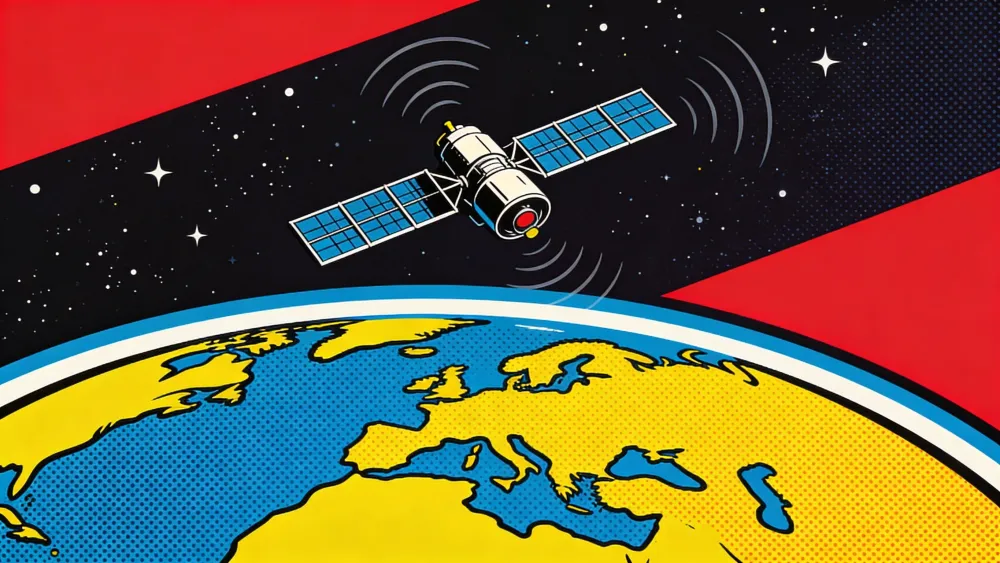
Amazon agreed Tuesday to acquire satellite operator Globalstar for $11.57 billion, offering $90 per share in cash or 0.3210 Amazon shares, the company said in a statement. The deal hands Amazon control of Globalstar's L-band and S-band spectrum, roughly two dozen operational satellites, and the ground infrastructure powering Apple's iPhone Emergency SOS feature. Shareholders representing 58% of Globalstar's voting power have already approved the transaction, which is expected to close in 2027 and would fold the target into Amazon Leo, the low-earth-orbit network Amazon is racing to deploy against SpaceX's Starlink.
What Changed
- Amazon agreed to buy Globalstar for $11.57 billion in cash or stock, a 23.5% premium over Monday's close, with Globalstar holders representing 58% of voting power already approving.
- The deal folds Globalstar's L-band and S-band spectrum, roughly 24 satellites, and 20-plus ground gateways into Amazon Leo, the service formerly known as Project Kuiper.
- A parallel agreement with Apple preserves iPhone Emergency SOS and guarantees Apple 85% of existing network capacity, clearing the main obstacle to closing.
- Even with Globalstar folded in, Amazon arrives at its mid-2026 commercial launch with a constellation roughly one-fortieth the size of Starlink's.
AI-generated summary, reviewed by an editor. More on our AI guidelines.
The deal, broken apart
The $90 offer represents a 23.5% premium over Globalstar's Monday close. Cash elections are capped at 40% of outstanding shares. Total consideration can shrink by as much as $110 million if Globalstar misses agreed operational milestones before closing, according to the filings. Globalstar shares rose more than 9% in premarket trading. Amazon shares ticked up 1.1%.
Amazon is also signing a parallel agreement with Apple, which holds a 20% equity stake in Globalstar from a $1.5 billion investment made in late 2024. Apple retains rights to 85% of Globalstar's network capacity for its emergency satellite services. The new agreement commits Amazon to continue supporting every iPhone and Apple Watch model currently relying on Globalstar's fleet, and opens the door for future Apple features to ride on the combined Amazon Leo network.
That is the peace treaty Amazon needed. Without Apple's sign-off, the acquisition was effectively dead.
Capital for time
Amazon's satellite business, rebranded from Project Kuiper to Amazon Leo last November, is cornered by the calendar. The FCC requires Amazon to have roughly 1,618 satellites in orbit by July 30, 2026. As of early April, between 212 and 241 units were flying, depending on the count. Amazon asked the commission in January for a two-year extension.
Globalstar brings something money cannot manufacture on a deadline: infrastructure that actually works today. You get roughly two dozen satellites currently overhead, with an Apple-backed expansion slated to push that number toward 54. More than twenty ground gateway stations, already built. International spectrum licenses for direct-to-device service, already cleared. The company even managed to turn a profit in 2025, pulling in $273 million of revenue against $7.4 million of operating income. Not huge. The numbers are the wrong thing to look at anyway.
Get Implicator.ai in your inbox
Strategic AI news from San Francisco. No hype, no "AI will change everything" throat clearing. Just what moved, who won, and why it matters. Daily at 6am PST.
No spam. Unsubscribe anytime.
What Amazon is buying is a shortcut. The L-band and S-band frequencies Globalstar controls are finite, strategically valuable, and impossible to replicate by launching more hardware. They enable satellite-to-phone service without specialized equipment, and analysts describe the move as "trading capital for time." If you are Andy Jassy, you are buying time, not satellites.
The Starlink gap
The scale problem? Still ugly. Musk has roughly 10,000 satellites flying and something like nine million paying subscribers, and Bloomberg's analysts figure Starlink clears nine billion this year in revenue. Amazon's cupboard is thinner by an order of magnitude. Sure, Leo's terminal lineup looks fine on paper, a 100-megabit Nano at the entry level, a gigabit Ultra at the top. Sure, the company just bought itself another 22 rides on SpaceX, Blue Origin, ULA and Arianespace rockets. None of that closes the gap fast enough. Officially, commercial launch remains mid-2026. Unofficially, the timeline keeps creaking. Pull out a calculator, add Globalstar to every Leo satellite Amazon currently has or plans to ship this year, and the combined constellation still clocks in at roughly one-fortieth the size of what Musk has circling overhead right now.
Jassy is betting on performance over volume. In his annual shareholder letter, he claimed Amazon Leo would deliver "six to eight times better on uplink, and two times better on downlink" than the incumbent at lower prices. He defended the spending directly: "We're not investing approximately $200 billion in capex in 2026 on a hunch." Goldman Sachs was less persuaded. Analyst Eric Sheridan trimmed Amazon's price target from $280 to $275 this week, flagging the Globalstar deal and Leo's commercialization timeline as the year's biggest question marks.
What Amazon has not bought
Direct-to-device service is where Amazon expects the deal to pay off, and the timeline is unforgiving. The company says it plans to deploy its direct-to-device satellite system for voice, data, and messaging to regular cellular phones beginning in 2028. Starlink's direct-to-cell service with T-Mobile is already live; Amazon will arrive years behind. Apple's emergency traffic still gets priority access on the combined network. Amazon's own enterprise customers, Delta and JetBlue among them, are not expecting cabin wifi until 2027 or 2028 anyway.
Globalstar makes the problem tractable. It does not make it small. Amazon Leo's commercial launch arrives mid-2026 with a constellation still measured in hundreds. The spectrum licenses are in hand. The satellites are not. What Jassy bought today is runway, measured in Apple handshakes and orbital filings and the twenty-odd ground stations Globalstar has been quietly running while the bigger players argued over rockets.
Frequently Asked Questions
How much is Amazon paying for Globalstar?
$11.57 billion in cash or stock. Globalstar shareholders can elect $90 per share in cash or 0.3210 Amazon shares, with cash elections capped at 40% of outstanding shares. The offer represents a 23.5% premium over Globalstar's Monday closing price.
Why does Amazon want Globalstar?
Spectrum and time. Globalstar holds internationally-cleared L-band and S-band licenses that enable satellite-to-phone service without specialized equipment, plus two dozen operational satellites and 20-plus ground gateways. Amazon is racing to hit an FCC deadline requiring 1,618 satellites in orbit by July 30, 2026.
What happens to Apple's iPhone Emergency SOS?
It stays. Apple, which owns 20% of Globalstar from a $1.5 billion investment, retains rights to 85% of the network's capacity. Amazon signed a separate agreement committing to support current iPhone and Apple Watch satellite features and collaborate on future services running on Amazon Leo.
How far behind Starlink is Amazon Leo?
Dramatically. Starlink operates more than 10,000 satellites serving over nine million users, while Amazon Leo has between 212 and 241 satellites in orbit as of early April 2026. CEO Andy Jassy is betting on performance per satellite rather than raw count, claiming six-to-eight-times-better uplink speeds.
When will the Amazon-Globalstar deal close?
Amazon expects the transaction to close in 2027, subject to regulatory approval and Globalstar meeting certain operational milestones before closing. Total consideration can be reduced by up to $110 million if those milestones slip.
AI-generated summary, reviewed by an editor. More on our AI guidelines.

Free AI briefing · Weekdays
The AI stories that matter, sourced and explained.
Join the Morning Briefing. It goes out every weekday at 4:45 a.m. Pacific, with later sends for the East Coast, Berlin and Tokyo.
Free when you sign up: The Paperclip Compendium, our tested guide to running AI agents.
Free. Unsubscribe in one click.

Marcus Schuler
Editor-in-Chief and founder of Implicator.ai. Former ARD correspondent and senior broadcast journalist with 10+ years covering tech. Writes daily briefings on policy and market developments. Based in San Francisco. E-mail: editor@implicator.ai