IMPLICATOR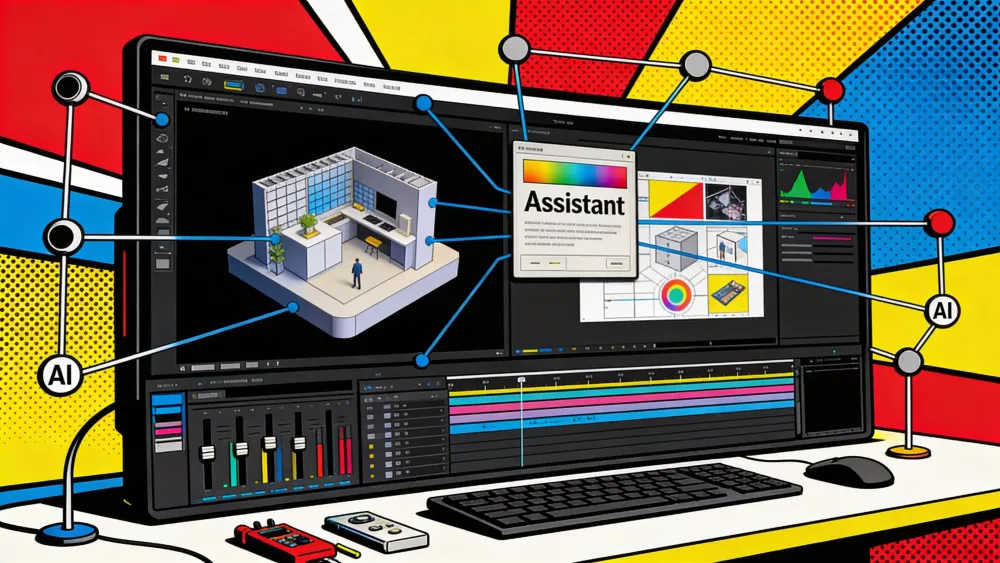
Anthropic said Tuesday it is releasing nine Claude connectors for creative software, including Blender, Autodesk, Adobe, Ableton and Splice across design, music and 3D work. The connectors let Claude read product documentation, operate through APIs, search creative catalogs and help users build scripts inside the tools where teams already keep project files. The release arrives as OpenAI and Google push creative AI through ChatGPT, Gemini, Search, Photos and Google Workspace.
Key Takeaways
- Anthropic announced nine Claude connectors for creative tools including Blender, Adobe, Autodesk Fusion, Ableton and Splice.
- OpenAI is pushing Images 2.0 inside ChatGPT while winding down Sora web, app and API surfaces.
- Google is distributing Gemini through Nano Banana 2, Photos personalization and Workspace Intelligence.
- The comparison centers on where creative work starts and where project context already lives.
AI-generated summary, reviewed by an editor. More on our AI guidelines.
The creative-tool connectors
Anthropic described the release as a way to put Claude alongside the software creative workers already use. The company called the connectors "tools that let Claude work alongside the software creative professionals rely on."
The list includes Ableton for Live and Push documentation, Autodesk Fusion for conversational 3D modeling, Blender for access to its Python API, Splice for sample search and SketchUp for 3D model starting points. Anthropic said the Adobe connector draws from more than 50 Creative Cloud tools, including Photoshop, Premiere and Express.
Blender provides a detailed connector example in Anthropic's release. The Blender developers created the Model Context Protocol connector, and Anthropic said 3D artists can use it to analyze scenes, debug setups and build scripts that batch-apply changes across objects. Anthropic also said the connector can use Blender's Python API to add tools to Blender's interface.
The company joined the Blender Development Fund as a patron. Anthropic said the Blender connector is built on MCP, which makes it accessible to other large language models in addition to Claude.
OpenAI's image stack
OpenAI introduced ChatGPT Images 2.0 on April 21, one week before Anthropic's creative connector launch. OpenAI's product page centers on images produced inside ChatGPT, including posters, product grids, comics and multilingual text.
OpenAI's deployment safety card says Images 2.0 improves world knowledge, instruction following and dense text. It also says the model's thinking mode adds reasoning and tool use to image generation, including live web search. In adversarial testing cited by OpenAI, the Images 2.0 safety stack caught 658 of 685 violative outputs, or 96.1%.
OpenAI's Help Center shows a Sora shutdown timeline in the same period. It says the Sora web and app experiences were discontinued on April 26, while the Sora API is scheduled to end on September 24. Users can export Sora content through a sunset page, and OpenAI says purchased ChatGPT and Sora credits can still be used for Codex.
OpenAI's public documents now direct creators to ChatGPT Images 2.0 for images and to a sunset page for Sora exports. Anthropic's materials point users back into applications that already hold project files.
Google's Gemini layer
Google DeepMind launched Nano Banana 2 on February 26 as Gemini 3.1 Flash Image. Google said the model combines Nano Banana Pro capabilities with Gemini Flash speed and is available across Gemini, Search and Ads.
Get the AI platform map before it hardens
Strategic AI news from San Francisco. No hype, no "AI will change everything" throat clearing. Just what moved, who won, and why it matters. Daily at 6am PST.
No spam. Unsubscribe anytime.
Google's page describes image generation beyond quality claims. The company said Nano Banana 2 can use real-time information and images from web search, create infographics and turn notes into diagrams. Google also said it continues to pair SynthID with C2PA Content Credentials.
On April 16, Google added a more personal route for image generation. The company said Gemini can use Personal Intelligence with Nano Banana 2 and Google Photos, allowing users to create images from connected photo libraries and stated preferences. Google said users can refine outputs or swap reference photos, and said it does not train models on private photo libraries.
Google also tied Gemini to Workspace data on April 22. Workspace Intelligence, announced that day, grounds Gemini tasks in Workspace data across Gmail, Chat, Calendar and Drive. A related Sheets feature, Fill with Gemini, can populate data 9 times faster than manual entry on 100-cell tasks, according to a 95-participant Google study.
The distribution routes
Their product pages now describe different creative AI routes. Anthropic is adding connectors to professional tools and using MCP as the interface layer. OpenAI is putting image reasoning inside ChatGPT while closing the Sora web and app surfaces. Google is distributing Gemini through Search, Photos and Workspace.
PYMNTS reported last week that Anthropic's broader Claude connector directory had grown to more than 200 integrations since launching in July. The same report framed the connector push as Anthropic entering the same consumer terrain as OpenAI and Google, with discovery inside the Claude conversation.
Anthropic's Tuesday launch expands its connector strategy into production software. The Adobe connector draws from more than 50 Creative Cloud tools, Blender uses an open connector that other models can access, and Autodesk Fusion brings Claude into 3D design. Anthropic's release describes value around project conventions inside professional software.
The next rollout points
Anthropic said art and design programs at Rhode Island School of Design, Ringling College of Art and Design, and Goldsmiths, University of London will get access to Claude and the new connectors. The company said feedback from those students and faculty will shape future expansion.
Google's next dated Workspace milestone is May 6, when Fill with Gemini begins scheduled rollout for Scheduled Release domains. OpenAI's next dated Sora milestone is September 24, when API access is scheduled to end. Anthropic gave no date for the next creative connector wave. Its Claude Design announcement said more integrations would arrive "over the coming weeks."
Frequently Asked Questions
What did Anthropic announce?
Anthropic announced nine Claude connectors for creative software, including Blender, Autodesk Fusion, Adobe, Ableton, Splice and SketchUp. The connectors let Claude work with product documentation, APIs, catalogs and project tools used by creative professionals.
How is Anthropic's approach different from OpenAI's?
Anthropic is putting Claude inside existing creative tools. OpenAI's current creative push centers on ChatGPT Images 2.0, while its Sora web and app experiences ended on April 26, 2026 and the Sora API is scheduled to end on September 24.
Where does Google fit in the comparison?
Google is distributing Gemini through Nano Banana 2, Google Photos and Workspace Intelligence. Its approach ties image generation and work tasks to Search, Photos, Gmail, Chat, Calendar and Drive rather than to one standalone creative app.
Why does the Blender connector matter?
Blender shows how Anthropic wants Claude to enter production software. The connector uses Blender's Python API and is built on MCP, which Anthropic says makes it accessible to other large language models as well as Claude.
What are the next dated milestones?
Google's Fill with Gemini starts scheduled rollout for Scheduled Release domains on May 6, 2026. OpenAI's Sora API is scheduled to end on September 24, 2026. Anthropic said more Claude Design integrations are coming over the next weeks.
AI-generated summary, reviewed by an editor. More on our AI guidelines.
Free AI briefing · Weekdays
The AI stories that matter, sourced and explained.
Join the Morning Briefing. It goes out every weekday at 4:45 a.m. Pacific, with later sends for the East Coast, Berlin and Tokyo.
Free when you sign up: The Paperclip Compendium, our tested guide to running AI agents.
Free. Unsubscribe in one click.

Marcus Schuler
Editor-in-Chief and founder of Implicator.ai. Former ARD correspondent and senior broadcast journalist with 10+ years covering tech. Writes daily briefings on policy and market developments. Based in San Francisco. E-mail: editor@implicator.ai