IMPLICATOR
Apple used Monday's WWDC keynote to preview Siri AI and the next generation of Apple Intelligence, saying in a Business Wire release that the products run on a new privacy architecture. MacRumors reported that the architecture centers on Apple Foundation Models built in collaboration with Google using technologies behind Gemini, and Reuters reported that investors marked the day by sending Apple shares down 1.9% to $301.54.
The thesis is that Apple's most important WWDC announcement was not the new Siri interface, the standalone app or the list of iOS 27 features. The bet is that Apple's AI advantage now depends on converting a Google-aided model stack into a private iPhone service.
That makes the keynote both a product test and a trust test. The Implicator wrote in May that Gemini could be the teacher model while Apple kept the interface and privacy boundary. Monday gave that premise new support, while Apple continued to present the finished system as Apple Foundation Models running behind its own interface and privacy boundary.
Key Takeaways
- Apple made Google-aided Foundation Models central to its Siri AI reset.
- The WWDC pitch turns Gemini technology into an Apple privacy and product story.
- Analysts treated Siri AI as credible but not yet a breakthrough.
- EU, China and beta timing remain the first deployment tests.
AI-generated summary, reviewed by an editor. More on our AI guidelines.
The Google model line
The sources draw a narrow line around the Google role. Business Insider quoted Craig Federighi saying the two companies worked together on the models: "Together, we created the next generation of Apple Intelligence models." AppleInsider reported that AFM Core and AFM Core Advanced run on device, AFM Cloud handles heavier requests through Private Cloud Compute, AFM Cloud Image supports image generation and editing, and AFM Cloud Pro uses Google cloud infrastructure and Nvidia GPUs while remaining Private Cloud Compute certified.
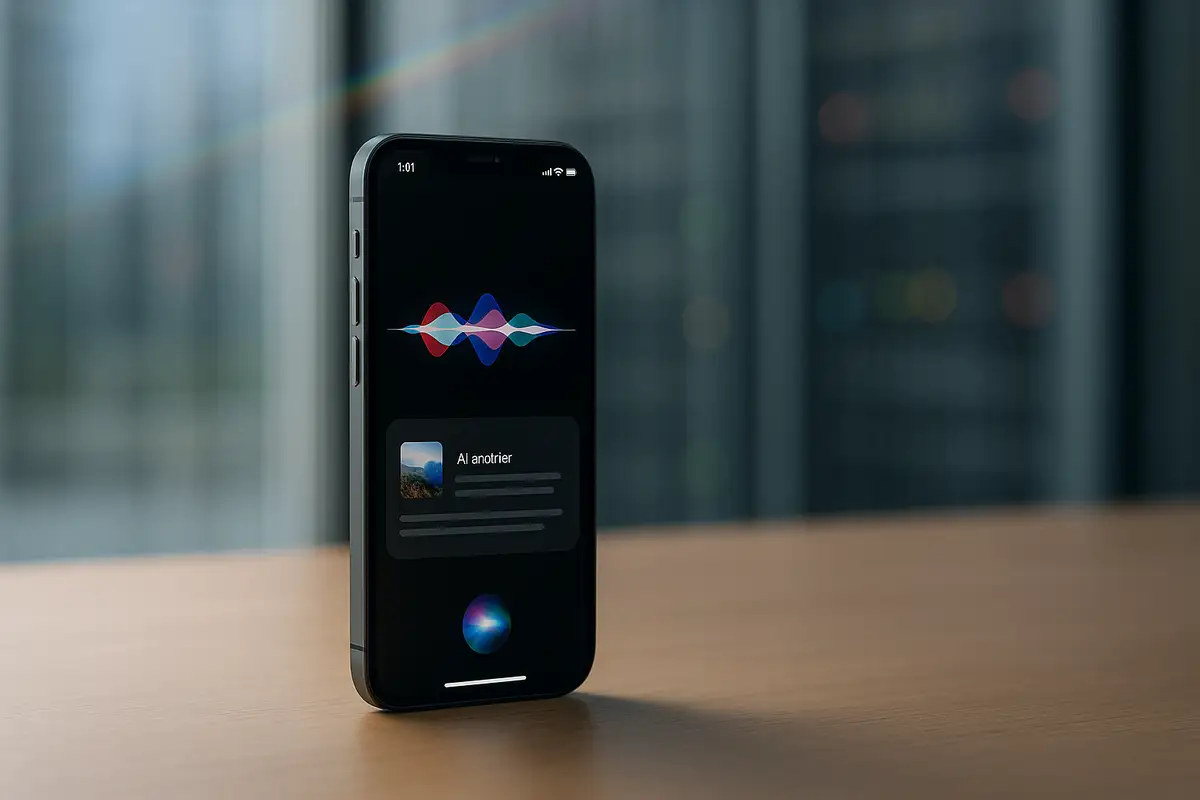
The product line matters because Apple is not presenting Gemini as the assistant. Its pitch is that Apple Foundation Models and Siri AI mediate requests across a user's screen, messages, photos and apps. MacRumors wrote that the architecture includes a system orchestrator that tailors responses to the active app and the user's task. Apple said Siri AI can search messages, emails and photos, answer questions about what is on screen and bring web information into a reply.
Abner Li at 9to5Google supplied the platform comparator. He described the Siri shift as Apple moving toward the kind of Gemini app experience Android users already know: personal context, app actions, screen awareness and conversational follow up.
The 2024 Siri debt
The harder part of Monday's pitch is that Apple has made a version of it before. Engadget noted that Apple showed a more personal Siri at WWDC 2024, then delayed the core features after development problems. Business Insider reported that Apple agreed last month to pay $250 million to settle a class action over the availability of AI enhanced Siri features.
Mike Rockwell, Apple's vice president of Siri engineering, tried to reset that record from the stage. "Today, we are introducing an entirely new version of Siri, Siri unlocked by Apple Intelligence," he said, according to Business Insider. "We call it Siri AI."
Outside analysts were more restrained. Reuters quoted TECHnalysis Research president Bob O'Donnell saying the product "finally delivers on the promise of Siri from 15 years ago" and calling it "AI for the masses; it's not really agentic." MoffettNathanson analyst Craig Moffett told Reuters the updates were not "earth-shaking" but should make Siri "a credible chatbot and possibly a credible agent." Taken together, the analyst comments framed the keynote as Apple's attempt to make the assistant credible again.
Follow the AI platform shift
Strategic AI news from San Francisco. No hype, no "AI will change everything" throat clearing. Just what moved, who won, and why it matters. Daily at 6am PST.
No spam. Unsubscribe anytime.
The privacy trade-off
Apple framed the architecture around privacy. The company said most processing happens on device or through Private Cloud Compute, with user data used only to complete the request and unavailable to Apple or third parties. Federighi contrasted Apple's approach with companies that "appear to be racing forward, seemingly pursuing AI for the sake of AI," Reuters reported.
The feature list complicates that framing. Siri AI is supposed to understand personal context, answer questions about what is on screen, search messages and emails, and take actions across apps. Paolo Pescatore of PP Foresight told Reuters that this "creates an inevitable tension between convenience and privacy." WIRED quoted Marshini Chetty, a University of Chicago computer scientist, saying it "does make the privacy issue a little bit more murky."
Regulators are already part of that story. MacRumors reported that Siri AI will not ship on iOS or iPadOS in the European Union at launch, and that Apple proposed a Trusted System Agent plus an 18 month rollout plan before the European Commission rejected its approach. Siri AI and the other new Apple Intelligence features will also not be available in China while Apple works through local regulatory requirements.
Know someone who'd find this useful? ✉️ Email it to a friend in one click, or they can subscribe free here.
The beta calendar
Apple's release placed the AI reset inside a broader software year. The company said iPhone and iPad apps launch up to 30% faster, photos load up to 70% faster after being taken, AirDrop transfers are up to 80% faster and iPad file work with an external drive is up to 5x faster. Apple said it tested the 5x claim in April and May on an 11 inch M4 iPad Pro, comparing iPadOS 26.4.2 with prerelease iPadOS 27, using an APFS formatted USB4 external SSD and 10,000 JPG files for copying and browsing in Files. Siri AI now needs that same kind of proof.
Simon Willison wrote after the keynote that he is holding to an "I'll believe it when I see it" standard after the 2024 Siri miss, although he said the new features look feasible with today's vision language models and a custom Gemini derived model running on Private Cloud Compute. Apple says developers can start testing the new software now; Siri AI is available for developer testing on iOS, iPadOS, macOS and visionOS, with watchOS to follow, and will reach users in beta later this year on supported devices set to English. The next evidence will come from developer testers now and from the English-language consumer beta Apple says will arrive later this year.
Frequently Asked Questions
What did Apple announce at WWDC 2026?
Apple previewed Siri AI, the next generation of Apple Intelligence, iOS 27 and related platform updates, including a Siri app and personal-context features.
Is Siri AI just Google Gemini?
No. Reports say Google Gemini technology helped build or polish Apple Foundation Models, while Apple presents the running system as Apple-controlled and tied to Private Cloud Compute.
Why does the Google role matter?
It shows Apple is pairing outside model technology with its own device stack, interface and privacy boundary rather than trying to match every frontier model alone.
When will Siri AI be available?
Apple says developer testing starts now on supported platforms, while users will get Siri AI in beta later this year on supported devices set to English.
Why are the EU and China excluded at launch?
Apple says Siri AI will not initially ship on iOS and iPadOS in the EU, and will not be available in China, while it works through regulatory requirements.
AI-generated summary, reviewed by an editor. More on our AI guidelines.

Marcus Schuler
Editor-in-Chief and founder of Implicator.ai. Former ARD correspondent and senior broadcast journalist with 10+ years covering tech. Writes daily briefings on policy and market developments. Based in San Francisco. E-mail: editor@implicator.ai