IMPLICATOR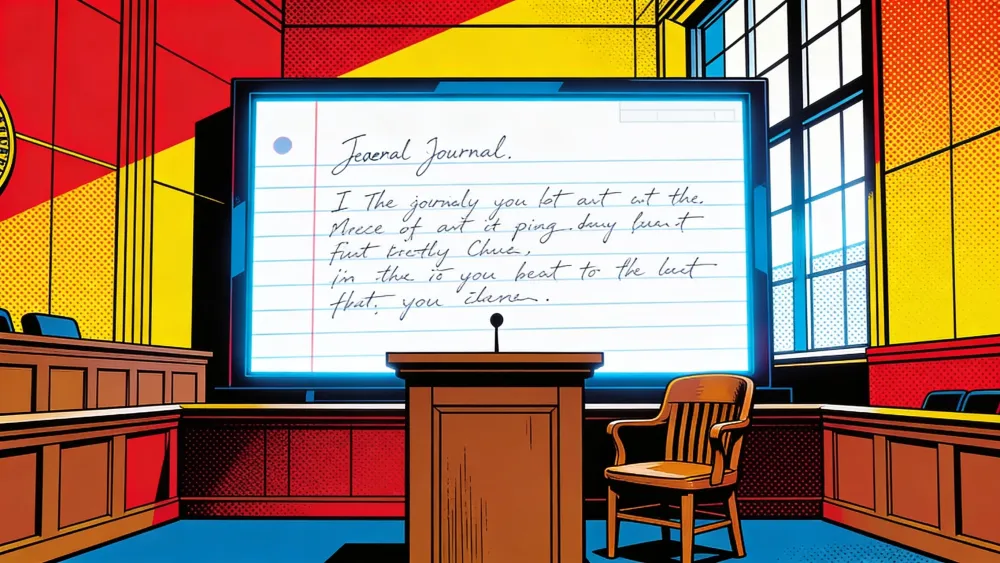
Greg Brockman walked into Oakland court Monday, May 4, holding Anna's hand. Blue suit. Outside, protesters sang hymns over lawyers' press conferences. Later that day, Musk's attorney Steven Molo had pulled Brockman's journal up on a courtroom screen and read aloud a 2017 entry: "Financially what will take me to $1B?" Brockman's stake in OpenAI's for-profit is now worth roughly $30 billion. His unpaid pledge was $100,000.
The case Musk and Altman brought to nine jurors now rests on two claims: breach of charitable trust and unjust enrichment. The thesis is plain: Musk's case gets smaller when 2017 becomes evidence, not backstory. Two days before trial, CNN reported, Musk texted Brockman: "By the end of this week, you and Sam will be the most hated men in America. If you insist, so it will be."
Key Takeaways
- Brockman's 2017 journal became Exhibit 161 on day five of the trial, with the November 6 entry reading: 'the true answer is that we want him out.'
- Brockman's stake in OpenAI's for-profit is now worth roughly $30 billion; his unpaid pledge to the nonprofit was $100,000.
- Shivon Zilis, mother of four of Musk's children, testified Musk wanted OpenAI folded into Tesla in 2017 and offered Sam Altman a Tesla board seat.
- Day 8 closed with Musk's nonprofit-governance expert testifying OpenAI gave up significant value in the 2023 Microsoft deal and 2025 recapitalization.
AI-generated summary, reviewed by an editor. More on our AI guidelines.
The journal made motive legible
Molo's set piece was Exhibit 161, a November 6, 2017 entry. "cannot say that we are committed to the non-profit," Brockman had typed before a meeting with Musk. "the true answer is that we want him out." After the meeting: "it'd be wrong to steal the non-profit from him. to convert to a b-corp without him. that'd be pretty morally bankrupt."
In a "theatrical baritone," MIT Technology Review reported, Molo asked why Brockman had not donated the $29 billion of his stake above the $1 billion his journal said would be enough. Brockman had no straightforward answer. "Solving for the mission has always been my primary motivation," he said.
"It's not just journal-maxxing," David Sacks said on the All-In podcast. "It's discovery-maxxing."
Control was the missing promise
In the summer of 2017, after OpenAI beat top Dota 2 players, Musk hosted a celebration at his "Haunted Mansion." Confetti and cups on the floor. Amber Heard served whiskey, Brockman told the jury. "Time to make the next step for OpenAI. This is the triggering event," Musk wrote. Over the next six weeks, the cofounders negotiated equity in a for-profit subsidiary. By August, Ilya Sutskever arrived at one meeting carrying a painting of a Tesla as a "token of goodwill."
When Brockman and Sutskever proposed equal equity for the cofounders, Musk fell silent, then said, "I decline." He stood up and "stormed around the table." "I actually thought he was going to hit me," Brockman testified. Musk grabbed the painting and walked out.
Musk wanted majority equity, board control and the CEO seat, Brockman testified. He watched Musk ask for ownership. He watched him ask for the board. He watched him ask to run the company. Brockman said Musk told him he needed roughly $80 billion to finance "a city on Mars." OpenAI is now racing toward an IPO at a target valuation approaching $1 trillion, MIT Technology Review reported, and Musk is asking the court for up to $134 billion in damages against the company and Microsoft. "The one thing we could not accept," Brockman testified, "was to hand him unilateral, absolute control."
Tracking the trial that could reshape AI
Strategic AI news from San Francisco. No hype, no "AI will change everything" throat clearing. Just what moved, who won, and why it matters. Daily at 6am PST.
No spam. Unsubscribe anytime.
The Tesla alternative weakened the complaint
Shivon Zilis took the stand Wednesday, May 6, in a black jacket and black jeans. She has four children with Musk and served on OpenAI's board from 2020 to 2023.
During the 2017 negotiations, she testified, Musk wanted OpenAI folded into Tesla and offered Altman a Tesla board seat. The four cofounders discussed corporate structure "ad nauseam," she said, including "several different for-profit options." OpenAI's lawyer Sarah Eddy pulled up a 2017 draft FAQ Zilis had emailed a Tesla colleague: "Tesla is building a world leading AI lab(?) which will rival the likes of Google/DeepMind and Facebook AI Research."
Musk testified he was not actively luring OpenAI employees. His own 2018 text to Zilis: "There is little chance of OpenAI being a serious force if I focus on TeslaAI." When Zilis asked that February how to handle the OpenAI team, he replied: "Close and friendly but we are going to actively try to move three or four people from OpenAI to Tesla." The August before, she had flagged a "funding freeze" Musk had imposed without telling his cofounders: $5 million for the quarter. Asked her loyalty, Zilis said, "I had an allegiance to the best outcome for AI for humanity."
The remedy shrank with the record
Day 8 closed with David Schizer, Columbia's former law dean and Musk's nonprofit-governance expert, who had billed $300,000 to $375,000 at $1,500 an hour for his first expert testimony. Earlier the jury heard from former OpenAI safety employee Rosie Campbell and from Natasha McCauley, the former board member who voted to fire Altman in 2023. Schizer testified that OpenAI's 2023 Microsoft deal brought in $10 billion, and that the 2025 recapitalization expanded Microsoft's claim on AGI revenue, while the nonprofit gave up significant value without adequately evaluating the return.
On cross, OpenAI's Randall Jackson noted the nonprofit's stake in the for-profit is now estimated at roughly $200 billion. Was there any "aspect of its mission that OpenAI cannot pursue because it doesn't have enough money?" If the board had done its job, Schizer answered, the nonprofit would have had more. He also said he did not need AI expertise to judge nonprofit governance.
That is the case the lawyers will argue next week, before the jury begins deliberating the week after. Prediction markets give Musk long odds in the fight, the Wall Street Journal reported. Brockman wrote his journal for himself, he testified Tuesday. By the time the jury deliberates, Exhibit 161 will have done the opposite: made Musk's charitable-trust theory smaller.
Frequently Asked Questions
What did Brockman's diary actually say?
Three entries became central. Aug 21, 2017: 'Financially what will take me to $1B?' Sept 12, 2017: Brockman fighting Musk's 'steamrolling' of Altman. Nov 6, 2017 (Exhibit 161): 'the true answer is that we want him out,' followed by 'it'd be wrong to steal the non-profit from him. to convert to a b-corp without him. that'd be pretty morally bankrupt.'
What did Shivon Zilis testify about Tesla?
Zilis said Musk wanted OpenAI folded into Tesla in 2017 and offered Sam Altman a Tesla board seat. Texts produced as evidence showed Musk planned to 'actively try to move three or four people from OpenAI to Tesla' in February 2018, contradicting his testimony that he was not luring OpenAI staff.
How much is Brockman's OpenAI stake worth?
Roughly $30 billion in OpenAI's for-profit. Musk's lawyer Steven Molo pressed Brockman on why he had not donated the $29 billion above the $1 billion his journal said would be enough. Brockman testified his 'primary motivation' remains OpenAI's mission.
When does the trial end?
Closing arguments are scheduled for next week after testimony from Ilya Sutskever and Microsoft CEO Satya Nadella. Jury deliberation begins the week after, with an advisory verdict guiding Judge Yvonne Gonzalez Rogers's final ruling on the two remaining claims: breach of charitable trust and unjust enrichment.
Who is favored to win?
Prediction markets give Musk long odds, the Wall Street Journal reported. The advisory jury verdict is non-binding; Judge Gonzalez Rogers will issue the final liability ruling, after which a separate remedies phase determines damages and structural remedies if liability is found.
AI-generated summary, reviewed by an editor. More on our AI guidelines.

Marcus Schuler
Editor-in-Chief and founder of Implicator.ai. Former ARD correspondent and senior broadcast journalist with 10+ years covering tech. Writes daily briefings on policy and market developments. Based in San Francisco. E-mail: editor@implicator.ai