IMPLICATOR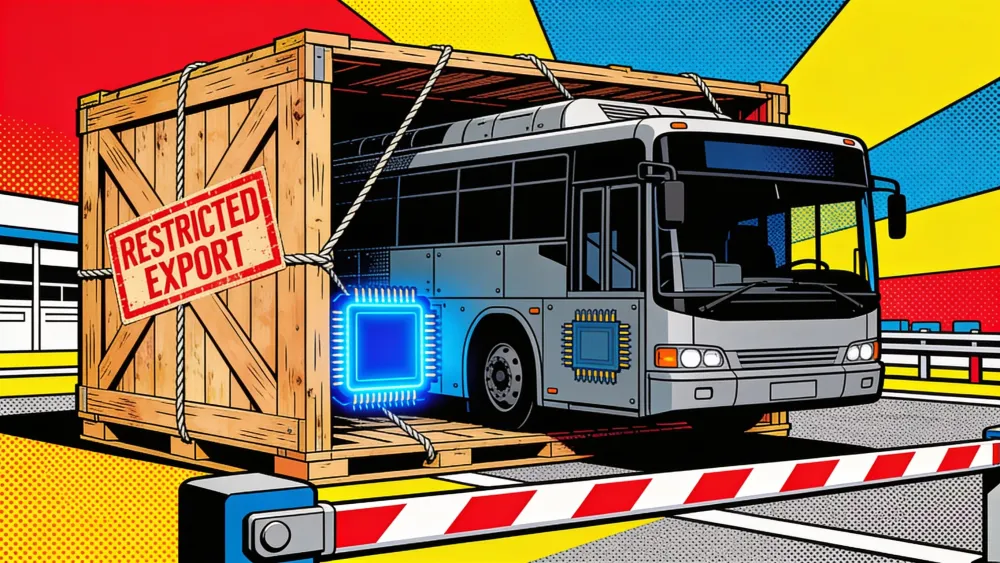
U.S. Commerce Secretary Howard Lutnick told ASML Holding NV's senior leaders in a series of recent meetings that one of the company's most advanced lithography machines may have reached China in violation of export restrictions, Bloomberg reported Thursday, citing people familiar with the talks. The machines at issue, extreme ultraviolet systems known as EUV, are the only tools capable of printing the most advanced chips, and ASML has been barred from shipping them to China since curbs imposed during the first Trump administration. ASML denied that any EUV system is in China, and its shares fell as much as 2.7% in Amsterdam on Friday.
ASML pushed back on Lutnick's suggestion, telling officials that none of its EUV tools are in China, the people said, speaking on condition of anonymity to describe private conversations. The systems weigh about 180 tons, are roughly the size of a school bus, are built in limited quantities, and require constant upkeep from ASML employees. A company spokesperson said ASML has never shipped an EUV machine to China, nor any component, module, or equipment specially designed to be used in one.
Key Takeaways
- Commerce Secretary Howard Lutnick told ASML one of its EUV machines may have reached China, violating US export curbs. ASML denies any EUV is there.
- ASML's Washington document counts 314 EUV machines worldwide, 26 decommissioned, none in China; the 180-ton systems need constant ASML upkeep to run.
- Senior Trump officials claim evidence of EUV-related component shipments to China but declined to produce it; the Commerce Department did not respond to queries.
- ASML expects about 20% of 2026 revenue from permitted DUV sales to China; a bipartisan bill would curb those too. Shares fell 2.7% Friday.
AI-generated summary, reviewed by an editor. More on our AI guidelines.
After the April meeting with Lutnick, the Dutch firm created a document titled "No indication of any ASML EUV System in China" and began circulating it in Washington. The presentation, reviewed by Bloomberg, counted 314 EUV machines in operation worldwide and 26 that have been decommissioned, none of them in China. ASML can automatically detect "any interruption, abnormal behavior, or loss of connectivity" across its EUV fleet, the document said, and customers "cannot remove, transport and relocate EUV systems without ASML involvement."
Senior Trump administration officials, speaking anonymously, told Bloomberg they have evidence that ASML is not acting in good faith, including exports to China of specialty gear used to transport EUV machines and other components that could be used in the systems. The officials declined repeated requests to produce that evidence, citing its sensitivity, and would not say whether they have seen an actual EUV system in China. The Commerce Department did not respond to queries, including on whether it holds evidence of a machine on Chinese soil.
A Dutch foreign ministry representative said the Netherlands takes seriously the responsibility that comes with its role in the semiconductor industry. Any investigation would fall to the Dutch customs service, Foreign Trade Minister Sjoerd Sjoerdsma told reporters in The Hague on Friday, adding that the government has not opened any action over the U.S. allegations. He said the current export rules are "extremely strict, perhaps the strictest in the entire world."
Stay ahead of the curve
Strategic AI news from San Francisco. No hype, no "AI will change everything" throat clearing. Just what moved, who won, and why it matters. Daily at 6am PST.
No spam. Unsubscribe anytime.
China's lack of access to EUV tools is one of the toughest constraints on Huawei Technologies Co., the country's leading rival to Nvidia in AI chips; Huawei's semiconductor chief recently touted progress in making advanced chips without ASML's machines in a rare English-language public appearance. Reuters reported in December that Chinese scientists had developed a prototype EUV machine built by a team of former ASML engineers, an effort described as China's version of the Manhattan Project. If an EUV system had reached China, it would rank among the largest known breaches of the U.S.-led controls meant to keep advanced AI capability away from Beijing's military.
Know someone who'd find this useful? ✉️ Email it to a friend in one click, or they can subscribe free here.
Bloomberg Intelligence analyst Masahiro Wakasugi wrote that the U.S. concerns may reflect Chinese engineering progress rather than any lapse in ASML's compliance, and may have little effect on the company's sales. ASML Chief Executive Christophe Fouquet, in a TechCrunch interview six weeks before the report, said the company tracks every machine it has shipped and walls off its China-based staff from EUV technology, documentation, and training. ASML expects about 20% of its 2026 revenue to come from already-permitted sales of older deep ultraviolet, or DUV, tools to China, a business it would jeopardize over a single illegal EUV sale.
Separately, Lutnick's Commerce Department agreed late last year to put up to $150 million into xLight, a startup developing next-generation light-source technology that could bear on ASML's EUV monopoly over the long term, though xLight says it sees itself as an ASML partner rather than a rival. Nothing public ties that investment to the EUV questions Lutnick raised with ASML. Peter Thiel, who has ties to Trump's political orbit, has backed Substrate, a separate startup pursuing its own EUV-rival technology.
A bipartisan bill moving through Congress would reach beyond the EUV question, calling for an effective ban on shipments of all types of ASML's immersion DUV tools to China. The measure cleared a key congressional committee in April, and the Trump administration has not taken a formal position on it. U.S. Ambassador to the Netherlands Joe Popolo recently said a favorable U.S.-EU trade deal would "take some pressure off" the bill.
Frequently Asked Questions
What is an EUV machine and why does it matter?
Extreme ultraviolet lithography systems are the only tools capable of printing the most advanced chip circuits. Every cutting-edge processor from TSMC, including those for Nvidia and Apple, depends on them, and ASML is the sole maker. That monopoly is why a single machine reaching China would matter for the global AI buildout and for US export-control policy.
Has ASML ever shipped an EUV machine to China?
ASML says no. A spokesperson said it has never shipped an EUV machine to China, nor any component, module, or equipment designed for one. The machines have been barred from China since curbs imposed during the first Trump administration. ASML says it tracks every system it has shipped and walls off its China-based staff from EUV technology by design.
What evidence have US officials shown?
None publicly. Senior Trump administration officials told Bloomberg they have evidence of ASML shipping EUV-related transport gear and components to China, but declined repeated requests to produce it, citing sensitivity. They would not say whether they have seen an actual EUV system in China. The Commerce Department did not respond to Bloomberg's queries.
How much business does ASML do in China?
ASML expects about 20% of its 2026 revenue from already-permitted sales of older deep ultraviolet (DUV) tools to China. A bipartisan bill in Congress would impose an effective ban on all of ASML's immersion DUV shipments to China. It cleared a key congressional committee in April; the Trump administration has not taken a formal position.
Why is the startup xLight relevant?
Lutnick's Commerce Department agreed late last year to put up to $150 million into xLight, a startup developing next-generation light-source technology that could bear on ASML's EUV monopoly over time. Nothing public ties that investment to the EUV questions Lutnick raised with ASML. xLight says it sees itself as an ASML partner, not a rival.
AI-generated summary, reviewed by an editor. More on our AI guidelines.

Marcus Schuler
Editor-in-Chief and founder of Implicator.ai. Former ARD correspondent and senior broadcast journalist with 10+ years covering tech. Writes daily briefings on policy and market developments. Based in San Francisco. E-mail: editor@implicator.ai