IMPLICATOR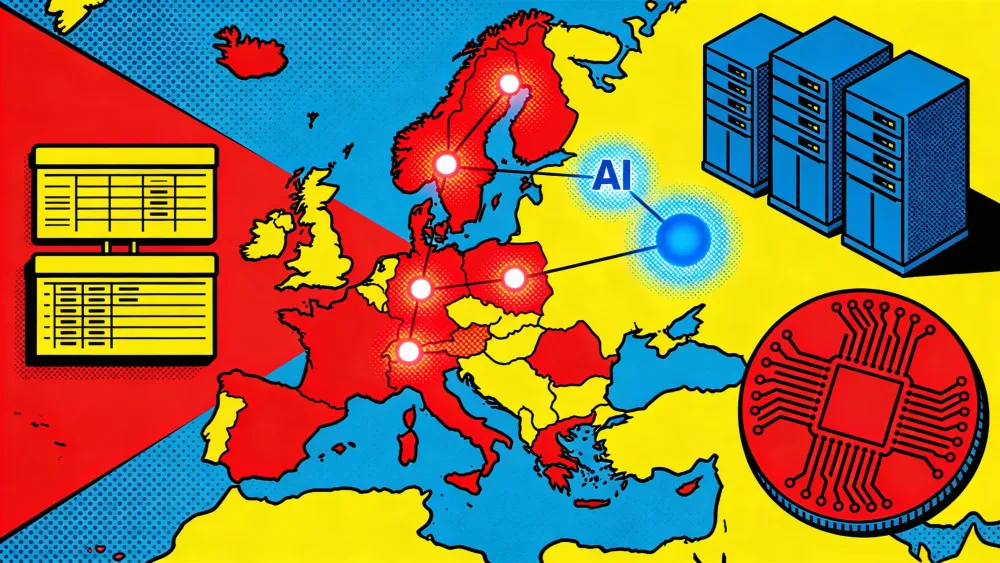
Denmark leads the European Union in business adoption of artificial intelligence, where 42.03% of enterprises used AI in 2025 against an EU-wide rate of 20%, up from 13.5% a year earlier, according to Eurostat. Finland, Sweden, Belgium, Luxembourg and the Netherlands also cleared 33%. The United Kingdom, France and Germany hold Europe’s deepest AI funding and most of its frontier companies, yet they trail those adoption leaders, a split that separates where AI capital concentrates from where the technology is reaching everyday business.
The two leaderboards measure different things. Enterprise adoption tracks where companies have put AI into daily operations, the metric Eurostat reports. Market capacity tracks investment, research output and compute, the measures that rank the United Kingdom, France and Germany highest. GOV.UK’s business survey put UK business use at about 16%, measured on a national-survey basis that is not directly comparable to Eurostat’s enterprise figure.
Key Takeaways
- Europe has two AI leaderboards: market power and measured adoption.
- Denmark leads enterprise AI use; the UK leads the composite capacity model.
- EuroHPC AI Factories make compute a public-policy lever.
- Company profiles need ownership caveats, not only headquarters labels.
AI-generated summary, reviewed by an editor. More on our AI guidelines.
The table moved north
The enterprise-adoption leaders cluster in the north and the Benelux, not in Europe’s largest economies. France registered 18.16%, below the bloc’s 20% average; Germany reached 25.97%. Both countries, together with the UK, carry the sharper frontier-company and investment stories, but none of the three tops the enterprise-adoption table used here.
Individual use of generative AI tilts the same way. On the Eurostat/OWID measure, Norway ranks highest at 56.32%, ahead of Denmark at 48.44%, Switzerland at 47.02% and Finland at 46.27%, while Germany and France trail at 32.25% and 37.46%. A single continental average hides that spread.
Denmark answers a usage question. Paris and London answer a frontier-company question.
| # | Country | Composite | Enterprise AI use | Individual GenAI use |
|---|---|---|---|---|
| 1 | United Kingdoma | 81.0 | 16.0% | 35.0% |
| 2 | Finland | 78.0 | 37.82% | 46.27% |
| 3 | Netherlands | 77.5 | 33.21% | 44.7% |
| 4 | France | 76.7 | 18.16% | 37.46% |
| 5 | Germany | 75.8 | 25.97% | 32.25% |
| 6 | Switzerlandb | 75.6 | 34.0% | 47.02% |
| 7 | Sweden | 75.4 | 35.04% | 42.01% |
| 8 | Denmark | 75.3 | 42.03% | 48.44% |
| 9 | Norway | 69.7 | 28.89% | 56.32% |
| 10 | Spain | 68.6 | 20.27% | 37.88% |
| 11 | Luxembourg | 65.6 | 33.61% | 42.54% |
| 12 | Belgium | 65.2 | 34.54% | 42.01% |
| 13 | Estonia | 61.2 | 23.4% | 46.64% |
| 14 | Austria | 60.2 | 29.95% | 39.42% |
| 15 | Ireland | 59.2 | 19.64% | 44.93% |
Bold marks the leading value in each column. Composite is a capacity model; enterprise and individual figures are adoption rates. a UK values are national-survey proxies, not comparable Eurostat enterprise data. b Switzerland’s enterprise figure is an SME-survey proxy.
The market still runs through the power centers
Stanford HAI’s 2025 AI Index reports $4.5 billion in UK private AI investment in 2024, against $109.1 billion in the United States. It also gives Europe its harsher comparison: U.S. institutions produced 40 notable AI models in 2024, while Europe produced three. Those pairs help explain why the UK ranks first in this composite model while trailing Denmark, Finland and the Netherlands on enterprise adoption.
France’s company story centers on Mistral, now tied through its September financing to ASML, the lithography-equipment maker at the center of advanced chipmaking. ASML chief executive Christophe Fouquet said the deal should “generate clear benefits for ASML customers through innovative products and solutions enabled by AI.”
Germany’s stack runs deeper than its adoption rate suggests. JUPITER anchors public compute; Helsing builds defence AI; Black Forest Labs makes image models; DeepL handles language; and SAP and Siemens push AI through enterprise and industrial channels. Adoption is uneven, but the industrial base is real.
Get the AI adoption map before it moves
Strategic AI news from San Francisco. No hype, no "AI will change everything" throat clearing. Just what moved, who won, and why it matters. Daily at 6am PST.
No spam. Unsubscribe anytime.
| Question | Strongest countries | Evidence |
|---|---|---|
| Who is using AI inside companies? | Denmark, Finland, Sweden, Belgium, Luxembourg, Netherlands | Eurostat enterprise AI use puts Denmark at 42.03%, Finland at 37.82% and the Netherlands at 33.21%. |
| Who has frontier-company and capital depth? | United Kingdom, France, Germany | Stanford, Tortoise, Atomico/Sifted, Crunchbase and company funding evidence point to the UK first, with France and Germany next. |
| Who has the strongest public-sector machinery? | United Kingdom, Estonia, Denmark, Spain, Netherlands | UK chest X-ray deployment, Estonia Bürokratt, Denmark taskforce, Spain AESIA and Dutch Algorithm Register. |
| Who is building sovereign compute? | Germany, Finland, France, Spain, Luxembourg, United Kingdom | JUPITER, LUMI, EuroHPC AI Factories, MeluXina-AI, Isambard-AI and Nscale infrastructure. |
Compute became policy
The European Commission says 19 AI Factories and 13 antennas are now operational or selected across the EuroHPC network. The phrase sounds bureaucratic until you read the job description. Each factory is meant to give startups, SMEs and researchers access to AI-optimised computing, technical staff and training. EuroHPC called the model a “one-stop shop nationally.”
That lifts Finland above its market size. LUMI is already one of Europe’s main supercomputing assets, and Finland is inside the AI Factory network meant to give startups, SMEs and researchers access to AI-optimised compute and support. Germany gets JUPITER. Spain gets MareNostrum and a regulatory agency. Luxembourg gets MeluXina-AI, a small-country bet on finance, space, cybersecurity and energy.
The UK is outside the EU machine and still scores high. It has Isambard-AI on the public side and Nscale on the private side. One route runs through Brussels. The other runs through London, Microsoft, NVIDIA and OpenAI.
Ownership is the footnote that matters
ASML’s September release calls Mistral “Headquartered in France and independent.” Mistral said it raised €1.7 billion at an €11.7 billion post-money valuation; ASML holds approximately 11% on a fully diluted basis after a €1.3 billion check and gets a strategic committee seat, with chief financial officer Roger Dassen taking the role in addition to his existing job.
That is the ownership problem in miniature. DeepMind is London-centered and Alphabet-owned. Isomorphic Labs is London-based and Alphabet-linked. Silo AI is Finnish capability now inside AMD after a roughly $665 million acquisition, about half ASML’s €1.3 billion Mistral check. European talent and European control keep separating.
| Company | Country anchor | Label | Why the label matters |
|---|---|---|---|
| Mistral AI | France | Independent European with strategic shareholder | ASML invested €1.3B and holds about 11%, so it is independent but strategically tied to Dutch semiconductor infrastructure. |
| Google DeepMind | United Kingdom | Foreign-owned European lab | London-centered research power, but Alphabet owns it. |
| Silo AI | Finland | European-origin, foreign-owned | AMD bought Silo AI for about $665M, so it is Finnish capability rather than Finnish control. |
| Isomorphic Labs | United Kingdom | Alphabet-linked biotech AI | London-based and DeepMind-linked, but Alphabet remains central. |
| Helsing | Germany | European defence AI | Large German defence-AI company with a reported €12B valuation. |
| Nscale | United Kingdom | AI infrastructure provider | UK-based compute story tied to Microsoft, NVIDIA, OpenAI and Aker-linked infrastructure. |
| Lovable | Sweden | Nordic software platform | Raised $330M at a $6.6B valuation, giving Sweden a high-growth AI software case. |
Denmark does not solve that problem by leading Eurostat’s adoption table. The Netherlands does not solve it by holding ASML. The UK does not solve it by leading the market. But the ranking changes what should be measured. If the question is who can build or fund frontier AI, start in the UK, France and Germany. If the question is where AI is entering normal business life, start farther north.
The September funding note showed who could bankroll Europe’s AI race. The Eurostat table shows where the other race has already begun.
Frequently Asked Questions
Why does the UK rank first if Denmark uses AI more?
The ranking is a composite. The UK scores high on investment, research, compute, public-sector deployment and company depth. Denmark leads the enterprise-use table, but it has a smaller frontier-company and venture-capital base.
Which country leads enterprise AI adoption in Europe?
Denmark leads the Eurostat enterprise AI table used here, at 42.03% in 2025. Finland, Sweden, Belgium, Luxembourg and the Netherlands also sit above 33%.
Why are the UK and Swiss numbers caveated?
The UK and Switzerland are outside the Eurostat enterprise table used for EU and EEA comparison. The article uses a UK business survey and a Swiss SME survey as proxies.
What are AI Factories?
AI Factories are EuroHPC-linked compute hubs meant to give startups, SMEs and researchers access to AI-optimised supercomputing, technical support and training.
Why do company ownership labels matter?
European AI strength is not always European control. DeepMind is Alphabet-owned, Silo AI is now AMD-owned, and Mistral has ASML as a major strategic shareholder.
AI-generated summary, reviewed by an editor. More on our AI guidelines.
Free AI briefing · Weekdays
The AI stories that matter, sourced and explained.
Join the Morning Briefing. It goes out every weekday at 4:45 a.m. Pacific, with later sends for the East Coast, Berlin and Tokyo.
Free when you sign up: The Paperclip Compendium, our tested guide to running AI agents.
Free. Unsubscribe in one click.

Marcus Schuler
Editor-in-Chief and founder of Implicator.ai. Former ARD correspondent and senior broadcast journalist with 10+ years covering tech. Writes daily briefings on policy and market developments. Based in San Francisco. E-mail: editor@implicator.ai