IMPLICATOR
San Francisco | Thursday, June 25, 2026
Repo Radar leads today because the agent story has moved from demo clips to the plumbing teams can actually run. The five projects worth watching this week point to live web access, safer sandboxes, persistent memory, cleaner diffs and local inference.
Anthropic adds the policy fight: it says Alibaba-linked Qwen operators ran 28.8 million Claude exchanges through fake accounts. Qualcomm adds the hardware marker, with Meta named as a 2028 customer for its Dragonfly C1000 CPU.
The pattern is less glamorous than the model-release cycle, and more useful. Agents now need rails, rivals are testing access controls, and chipmakers are asking buyers to reserve capacity years before the parts ship.
Stay curious,
Marcus Schuler
Repo Radar Tracks Five Agent Projects Built for Production Work
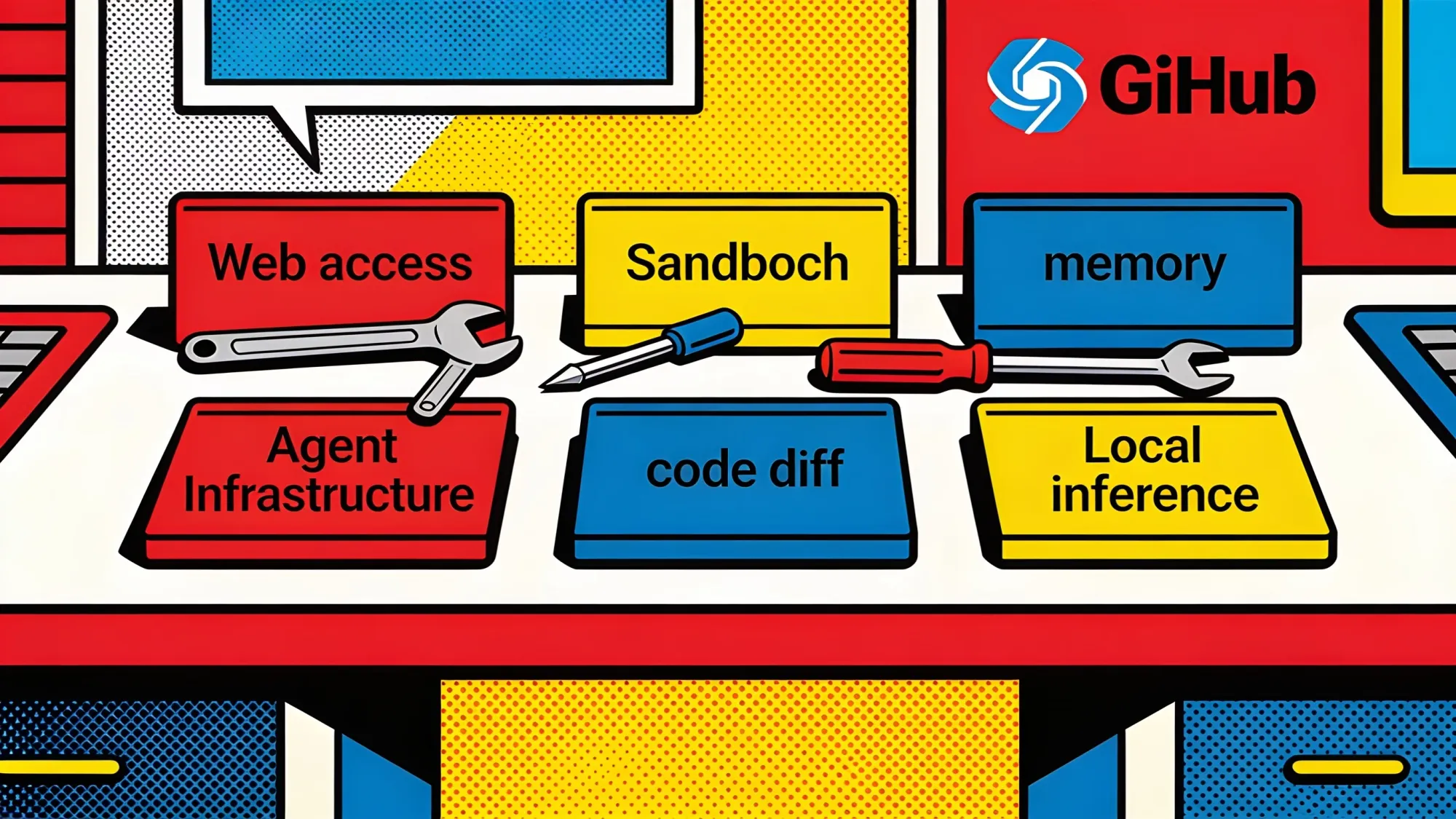
Repo Radar’s latest five GitHub picks show agents becoming infrastructure rather than theater. The projects center on live web access, default sandboxing, persistent memory, disciplined diff review and local inference.
That mix matters because agent adoption is no longer blocked only by model quality. Teams need the boring layers that keep an agent from touching the wrong file, forgetting context or shipping a bad change after a convincing demo.
The week’s GitHub signal is practical: developers are building around constraints instead of pretending they do not exist. That is where production software usually begins.
Why This Matters:
- Agent tooling is moving toward safety, memory and review layers that companies can audit.
- The next useful agent wave may come from infrastructure repos before it comes from model launches.
Reality Check
What's confirmed: The five projects surfaced in Repo Radar are gaining attention around agent infrastructure, not consumer chatbot polish.
What's implied (not proven): GitHub interest is a proxy for developer demand, not proof of enterprise deployment.
What could go wrong: Many agent repos still fail once permissions, latency and cost meet real company workflows.
What to watch next: Look for customers publishing internal policies around sandboxed agent execution.
The One Number
$2.8 billion: what DeepSeek founder Liang Wenfeng committed from his own capital in the lab's first external funding round, about 40 percent of the $7.4 billion total.
The round closed June 16 at a valuation above $50 billion, with Tencent, CATL and China's state AI fund among external backers. The outside investors received no voting rights or freedom from a five-year lock-up.
💰 Fresh Funding
💰 Fresh Funding
Raises $34M: Probook brings AI dispatch to home-services shops
AlleyWatch reported Wednesday that Probook raised a $34 million Series A led by Andreessen Horowitz, with Sequoia Capital participating. The New York company sells an AI operating system for home-services businesses, automating dispatch, customer communications and scheduling workflows for contractors that still run much of the job calendar by phone and spreadsheet.
Visit Probook →Raises $30M: Runlayer builds governance rails for enterprise AI agents
Runlayer raised a $30 million Series A led by Felicis, with Khosla Ventures joining, according to AlleyWatch. The company, founded in 2025 by Andrew Berman, Tal Peretz and Vitor Balocco, gives enterprises a centralized control layer for deploying and managing AI agents across departments.
Visit Runlayer →Raises $17M: JustAI turns marketing operations into AI workflows
YourStory reported Wednesday that San Francisco-based JustAI raised more than $17 million in a Series A led by Base10, with Y Combinator and Peak XV Partners participating. The company describes itself as an AI-native marketing platform, with strategic backers from Anthropic, Chime, HubSpot, Eppo and Vapi.
Visit JustAI →Anthropic Says Alibaba Ran 28.8 Million Claude Exchanges

Anthropic says Alibaba-linked Qwen operators ran 28.8 million Claude exchanges through nearly 25,000 fake accounts. The alleged campaign ran from April 22 to June 5 and targeted software engineering and agentic reasoning skills.
The claim is larger than Anthropic's February allegations against DeepSeek, Moonshot AI and MiniMax combined. It also lands inside Washington's active debate over sanctions for model extraction, with Anthropic already sharing attack data with OpenAI and Google through the Frontier Model Forum.

AI Image of the Day

Prompt: A cinematic close-up portrait of a young woman during golden hour, warm sunlight illuminating her face with soft golden highlights, her skin has natural texture with visible pores and subtle imperfections, her hair catches the sunlight with natural movement, background is softly blurred with warm bokeh, shot on 85mm lens, natural skin tones, realistic photography style, 8K resolution
Qualcomm Names Meta CPU Customer in $15B AI Push

Qualcomm now says data centers can top $15 billion in revenue by fiscal 2029. Meta is the first named customer for Dragonfly C1000 CPUs scheduled for production in the second half of 2028.
The pitch gives Qualcomm a public AI-infrastructure story beyond smartphones, but the timeline is the risk. Modular is supposed to close in late 2026, AI250 sampling follows in 2027, and Meta production does not begin until 2028.

🧰 AI Toolbox
How to Create Polished Presentations Without Opening a Design Tool Using Chronicle 2.0
Chronicle 2.0 is an AI presentation tool that pairs an opinionated design system with an agent that drafts, designs, and refines slides in one place. Start from a prompt or a doc, pick a style, and Chronicle generates a deck with consistent typography, animation, and layout. Edit by chatting ("merge slides 4 and 5", "make the data slide a chart") or by clicking directly on any element. Free tier available, with paid plans for advanced collaboration.
Tutorial:
- Go to chroniclehq.com and sign in with Google or email
- Describe your deck: "A 12-slide investor update covering revenue, retention, product roadmap, and the ask for our Series B"
- Pick a design system or upload your brand kit so Chronicle uses your colors and fonts
- Review the first draft in seconds, then chat with the agent: "Cut slide 6, add a chart on slide 8 using these numbers, move the CTA to the end"
- Click directly on any element to edit text, swap images, or adjust spacing without leaving the presenter view
- Use "Animate" to add subtle transitions to charts and bullet reveals without learning a separate motion tool
- Present from Chronicle live, or export to PDF, PowerPoint, or Google Slides for distribution
URL: chroniclehq.com
What To Watch Next
Quantum.Tech World 📍 Boston · 🔬 Quantum computing · Jun 25 The Boston event is a near-term read on quantum hardware, error correction and enterprise pilots. Watch for whether vendors frame quantum as a research budget or as infrastructure that cloud buyers should start reserving beside AI compute. |
VidCon Anaheim 📍 Anaheim, CA · 🎥 Creator economy · Jun 25 Creator platforms are pushing AI editing, dubbing and ad tools into the same market that once treated authenticity as the product. Watch the sponsor booths and creator panels for where AI is accepted as workflow and where it is still reputationally radioactive. |
AI Engineer World's Fair 📍 San Francisco · 💻 Developer conference · Jun 29 The agent-tooling crowd gathers in San Francisco as coding assistants, eval platforms and workflow agents compete for developer attention. The useful signal is which vendors can show production use cases with cost controls, not another demo that stops at a generated pull request. |
GITEX AI Europe 📍 Berlin · 🌐 AI conference · Jun 30 Europe's AI-showcase circuit moves to Berlin with sovereignty, procurement and industrial deployment on the agenda. Watch whether buyers talk about model choice as a compliance issue, a cost issue, or a way to keep U.S. and Chinese vendors honest. |
ICML 2026 📍 Seoul · 🧠 Machine learning · Jul 6–11 ICML opens at Seoul's COEX in July, and the accepted-paper list is the academic baseline for the next model cycle. Watch for work on inference efficiency, synthetic data and evaluation, the three topics enterprise buyers will hear repackaged as products before year-end. |
💡 5-Minute Skill
The meeting ended with six people saying "sounds good" and nobody agreeing what changed. You have the Zoom transcript, a few chat messages, and a calendar invite for the follow-up. Before the thread turns into fog, make the AI force the conversation into decisions, owners and dates.
Your raw input:
Paste the meeting transcript, the chat log and the calendar title. Add the attendee list and any deadline that was mentioned out loud.
The prompt:
Turn this meeting into a decision memo. Separate confirmed decisions from suggestions. For every action item, name the owner, deadline, dependency and exact sentence in the transcript that supports it. If an owner or deadline is missing, mark it MISSING instead of guessing. End with the three clarifying questions I should send today.
The output:
Confirmed decision: Move the beta from July 8 to July 15. Supported by Priya at 22:14: "Let's push one week and keep the customer list fixed."
Action item: Marco sends revised onboarding copy by Friday. Dependency: final pricing page. Supported by 31:06. Owner confirmed; deadline confirmed.
Missing: Security review owner. Mentioned twice, never assigned.
Send today: "Who owns security review, and do they have authority to block launch?"
Why this works:
Most meeting summaries sand down whether a decision was actually made. This prompt makes the model cite the transcript and label uncertainty, so you do not turn a polite suggestion into a committed plan.
What to use:
Claude handles long transcripts best and is stricter about missing owners. ChatGPT is faster if the transcript is under 20 minutes. Ask for citations every time; without them, the summary will sound more certain than the meeting was.
📖 AI Alphabet
J |
📖 AI Alphabet Jailbreak A jailbreak is a prompt or tactic designed to get an AI system to ignore its safety rules. It is a common red-teaming method and a persistent problem for public-facing AI tools. |
AI & Tech News
Google Gemini Researchers Plan Anthropic Moves
Bloomberg reported that Google AI researchers Jonas Adler and Alexander Pritzel, both linked internally to Gemini, plan to leave for Anthropic. The move adds another senior-talent signal around Anthropic while frontier labs compete for people who have already shipped large model systems.
Kalshi Eyes a $40 Billion Valuation
The Financial Times reported that prediction-market company Kalshi is in talks for a new round at about $40 billion. The valuation would nearly double the level from a $1 billion raise one month earlier, putting event contracts deeper into the territory once held by exchanges and sportsbooks.
SambaNova Seeks a $10 Billion Valuation
The Information reported that Intel-backed SambaNova is preparing to raise $800 million to $1 billion at a valuation near $10 billion. The proposed round would mark a fivefold jump from four months earlier as buyers hunt for Nvidia alternatives.
Micron Reports a Record AI Memory Quarter
CNBC reported that Micron posted fiscal third-quarter revenue of $41.46 billion, up 346% from a year earlier and above Wall Street estimates. The company also guided above expectations for the current quarter as DRAM and NAND demand stay tied to AI infrastructure spending.
Amazon Sellers Describe Paid Access Market for Staff Favors
Bloomberg reported that middlemen on encrypted messaging apps are selling claimed access to Amazon employees who can restore suspended seller accounts or secure favorable treatment. Amazon said it is investigating and that employee misconduct violates company policy.
Trase Raises $107 Million for Regulated AI Agents
Axios reported that Trase raised a $107 million seed round led by Arch Venture Partners. The startup is building AI-agent infrastructure for regulated sectors such as healthcare and defense, where deployment requires controls beyond a standard workflow agent.
AI Comments Flood Energy Proceedings
Bloomberg reported that advocacy firms are using AI to generate and submit large volumes of public comments on local energy projects. Officials in states including California and North Carolina say the submissions are straining public-participation systems built for human-scale input.
Cloudflare and Browser Makers Push Bot Verification Protocol
The Register reported that Cloudflare, Google, Microsoft and Mozilla are working on PACT, a protocol for distinguishing welcome visitors from abusive automation. The project aims to give sites a privacy-preserving way to verify traffic without exposing sensitive identifiers.
Former Infosys CEO Launches AI Services Startup
TechCrunch reported that former Infosys chief Vishal Sikka launched Hang Ten Systems with $32 million in seed funding led by Mayfield. The company wants to automate enterprise software maintenance and customization, the same work that built the traditional IT services industry.
Utah Data Center Fight Takes Down Senate Leader
The New York Times reported that Utah Senate President J. Stuart Adams lost a Republican primary after backlash over a data center complex near the Great Salt Lake. The result is an early political warning that data center water use can become a ballot issue.
🚀 AI Profiles: The Companies Defining Tomorrow
Mark is the AI-powered physical bookmark that lets you highlight passages and record thoughts while reading paper books, then builds a searchable knowledge base from what you captured. The Mark II launch raised $1 million on a viral release video that crossed 6 million views in 48 hours, putting the device in the small but real category of AI hardware that solves an actual reader's problem. 📖
Founders
Mark was founded by a small product team focused on the intersection of reading and personal knowledge management. Specific founder names were not detailed in the initial coverage; the product launched out of a hardware-focused accelerator.
Product
The Mark II is a highlighter-shaped device that scans text from physical books, captures spoken notes through a built-in microphone, and syncs everything to a companion app that organizes captures by book, theme, and date. The app's AI clusters related highlights from different books, surfaces patterns in what you have been thinking about, and answers questions across your entire reading history. The device works offline; sync happens when it next connects.
Competition
The closest competitors are Readwise, the Boox e-reader line and a long line of failed digital pens. Mark's wedge is being purpose-built for paper books and pairing the capture device with a serious AI organization layer.
Financing 💰
Mark raised $1 million around the Mark II launch in May 2026, on the strength of a viral release video. Specific investors were not detailed in the coverage.
Future ⭐⭐
Hardware on a $1 million round is a difficult path: manufacturing, returns and distribution eat margin even when the product is loved. Mark's upside is a defensible niche and the chance to become the canonical capture device for a generation of book annotators. The downside is the long list of beautiful note-taking hardware that never scaled past first-batch buyers. 🔖
🤨 Yeah, But...
Reuters reported Tuesday that the Trump administration is pressing Meta to agree to voluntary government reviews of its frontier AI models, citing a New York Times report based on four people familiar with the request. Reuters said Meta is the only major U.S. AI developer that has not reached such an agreement, while OpenAI and Anthropic already work with the government on unreleased model testing and Google, xAI and Microsoft provide early access for national-security evaluations. Meta said it shares the administration's goal of "secure frontier AI" and hopes to finalize an agreement soon. The request follows President Trump's June 2 executive order creating a voluntary framework for developers to submit covered frontier models for up to 30 days before release to trusted partners.
(Reuters, June 23, 2026; Engadget, June 24, 2026)
Our take: Meta has spent a decade arguing that it can police its own systems at global scale, then building the moderation department that proved how expensive that promise was. Now Washington wants the same company to show its frontier models before release, and Meta is the lone major holdout while OpenAI, Anthropic, Google, Microsoft and xAI have already stepped into the review line. The legal phrasing is voluntary, but the Anthropic order earlier this month showed what happens when a voluntary model-review regime meets national-security authority. Meta can sign and complain about delay, or refuse and become the test case for whether a "voluntary" framework stays voluntary after the government thinks a model is dangerous. The useful tell is that Meta, of all companies, is now defending the right to ship first and explain later.

Marcus Schuler
Editor-in-Chief and founder of Implicator.ai. Former ARD correspondent and senior broadcast journalist with 10+ years covering tech. Writes daily briefings on policy and market developments. Based in San Francisco. E-mail: editor@implicator.ai