IMPLICATOR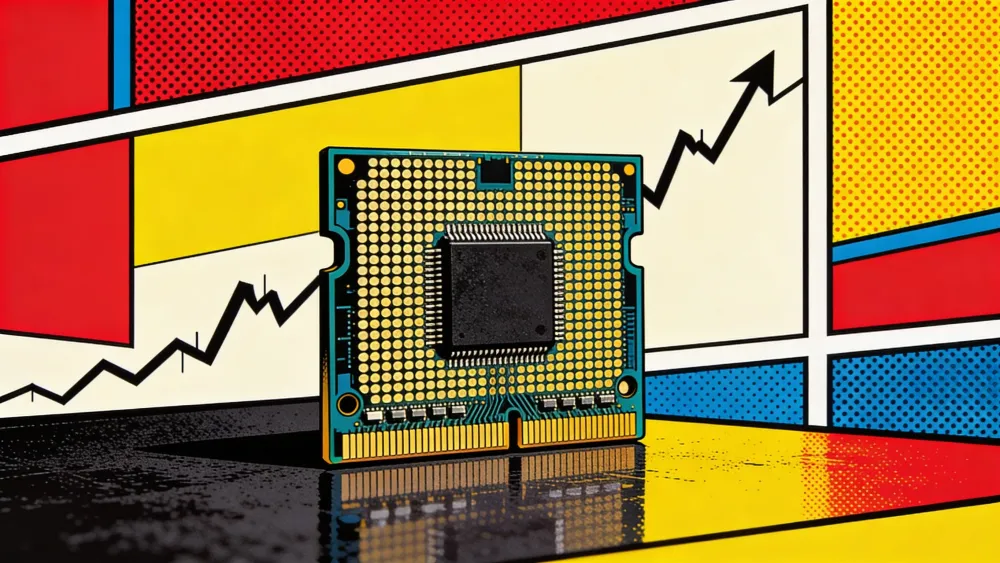
Micron Technology closed above $1 trillion in market value for the first time on Tuesday, its best day since 2011. The stock rose 19% after UBS analyst Timothy Arcuri tripled his price target to $1,625 from $535, the highest of the 46 brokerages covering the company, according to LSEG data. Micron took 48 days to climb from a $500 billion valuation to $1 trillion, according to Dow Jones Market Data; Nvidia took 490.
The milestone rests on one claim, pressed by UBS and supported by Micron's supply commentary, that AI has turned memory from a boom-and-bust commodity into infrastructure that earns a higher multiple. The market has only partly agreed. Even after Tuesday's jump, Micron traded at about 8.4 times expected earnings, against roughly 26 for the Nasdaq 100, according to LSEG data, and below the multiple Arcuri says it deserves. Closing that gap is the premise of his $1,625 target.
Key Takeaways
- Micron closed above $1 trillion for the first time Tuesday, up 19%, after UBS tripled its price target to $1,625 from $535.
- It went from $500 billion to $1 trillion in 48 days; Nvidia took 490 days for the same jump.
- Micron trades at about 8.4 times earnings, a third of Nvidia's multiple, showing the market only partly buys the re-rating.
- The chips Trump praised at Manassas are legacy DDR4 for cars and defense, not the sold-out HBM driving the valuation.
AI-generated summary, reviewed by an editor. More on our AI guidelines.
The case for a permanent premium
"Micron for years was considered just a commodity play. They make very basic, fairly simple things," said Michael Rosen, chief investment officer at Angeles Investments. Now, he added, "Micron is the poster child." The memory shortage tied to the AI data-center buildout has given the company pricing power it rarely held through the DRAM and NAND cycles that whipsawed its earnings for years. Fiscal first-quarter revenue reached $13.64 billion, up 57% from a year earlier, and non-GAAP earnings of $4.78 a share beat the $3.94 consensus, the company reported.
Arcuri's argument is that AI demand and long-term contracts will damp those swings. He projected earnings above $100 a share through at least 2029 and more than $400 billion in cumulative free cash flow from 2027 through 2029, citing supply agreements that lock in volumes and partially fix prices. "We believe the market will start to put a more 'normal' multiple on the stock," he wrote, adding that he saw "no reason why MU should trade a whole lot differently than NVDA in terms of P/E." Chief Executive Sanjay Mehrotra has said Micron is meeting only about half to two-thirds of key customers' medium-term demand for high-bandwidth memory, and that its entire 2026 HBM output is already sold out.
Why the multiple stays cheap
Not everyone reads the cheap multiple as a buying signal. "Memory chipmakers have been irrationally undervalued, but we are now seeing the trend of recovery in their valuation gap," said Kang DaeKwun, chief investment officer at Life Asset Management in Seoul, who expects the rally to run further. At 8.4 times expected earnings, less than a third of Nvidia's multiple, Micron still carries the valuation of a company the market expects to face another downcycle.
Get Implicator.ai in your inbox
Strategic AI news from San Francisco. No hype, no "AI will change everything" throat clearing. Just what moved, who won, and why it matters. Daily at 6am PST.
No spam. Unsubscribe anytime.
Arcuri built that risk into his own note. If high-bandwidth memory demand weakens, he wrote, the stock could fall to $250, less than a third of where it closed Tuesday. The durability of the long-term agreements "remains unproven outside management commentary," the financial site 24/7 Wall St. noted, adding that short interest had reportedly risen even as analyst targets climbed and that recent insider activity skewed toward selling. "UBS's tripled price target might be a bit much," wrote Anders Bylund of the Motley Fool in a skeptical note. The objection is not that the shortage is fake. It is that a five-year contract signed during a shortage may say little about pricing once rivals add the capacity they are now spending to build.
The chips Trump praised aren't the chips driving the rally
Days before the milestone, President Trump name-checked the company at a rally in Suffern, New York. "Micron, boy Micron's great, they're investing hundreds of billions," he said Friday. That morning, Micron had started production of 1-alpha DRAM at its Manassas, Virginia plant, which it called the most advanced memory ever made in the United States. Trump bought between $50,000 and $100,000 of Micron stock in March, and traders on the prediction market Polymarket put the odds of a U.S. government stake in the company this year at 34%, Business Insider reported Tuesday.
The Manassas chips are not the ones the valuation is built on. By Micron's own description, the line makes 1-alpha DRAM in DDR4 and LP4 form, a long-lifecycle memory for automakers, defense contractors and industrial gear, with qualified output not expected until late 2026. The high-bandwidth memory that drove the re-rating is a scarcer product, and Micron is its smallest major maker. It held 21% of the HBM market by revenue in the fourth quarter of 2025, behind Samsung's 22% and SK Hynix's 57%, according to Counterpoint Research. SK Hynix crossed $1 trillion of its own on Wednesday in Seoul.
The re-rating depends on a product Micron has sold out through 2026 and a pricing structure that, for now, exists mostly in management's telling. The terms of its multi-year supply agreements have not appeared in a filing. 24/7 Wall St. called Micron's next quarterly report the moment the bull case "could either firm up or start to wobble."
Frequently Asked Questions
Why did Micron stock jump 19% on Tuesday?
UBS analyst Timothy Arcuri tripled his price target to $1,625 from $535, the highest of the 46 brokerages covering Micron, arguing AI has structurally changed the memory market and projecting earnings above $100 a share through at least 2029. The rally pushed Micron's market value above $1 trillion for the first time.
How fast did Micron reach $1 trillion?
It took 48 days after Micron was first valued at $500 billion, according to Dow Jones Market Data. Nvidia took 490 days to make the same jump, making Micron's the fastest run to that threshold on record.
Why does Micron still trade so cheaply?
At about 8.4 times expected earnings, roughly a third of Nvidia's multiple, Micron is priced like a company investors expect to face another downcycle. The low multiple reflects memory's history of boom-and-bust pricing, which UBS argues AI has now changed.
How are the Manassas chips different from HBM?
Micron's Manassas, Virginia plant makes 1-alpha DRAM in DDR4 and LP4 form, long-lifecycle memory for automotive, defense and industrial uses. The high-bandwidth memory driving the AI re-rating is a separate, scarcer product Micron has sold out through 2026. Micron holds 21% of the HBM market, behind SK Hynix's 57% and Samsung's 22%.
Could the U.S. government take a stake in Micron?
President Trump praised Micron on Friday and bought between $50,000 and $100,000 of its stock in March. Traders on Polymarket put the odds of a government stake this year at 34%, Business Insider reported. No stake has been announced.
AI-generated summary, reviewed by an editor. More on our AI guidelines.

Free AI briefing · Weekdays
The AI stories that matter, sourced and explained.
Join the Morning Briefing. It goes out every weekday at 4:45 a.m. Pacific, with later sends for the East Coast, Berlin and Tokyo.
Free when you sign up: The Paperclip Compendium, our tested guide to running AI agents.
Free. Unsubscribe in one click.

Marcus Schuler
Editor-in-Chief and founder of Implicator.ai. Former ARD correspondent and senior broadcast journalist with 10+ years covering tech. Writes daily briefings on policy and market developments. Based in San Francisco. E-mail: editor@implicator.ai