IMPLICATOR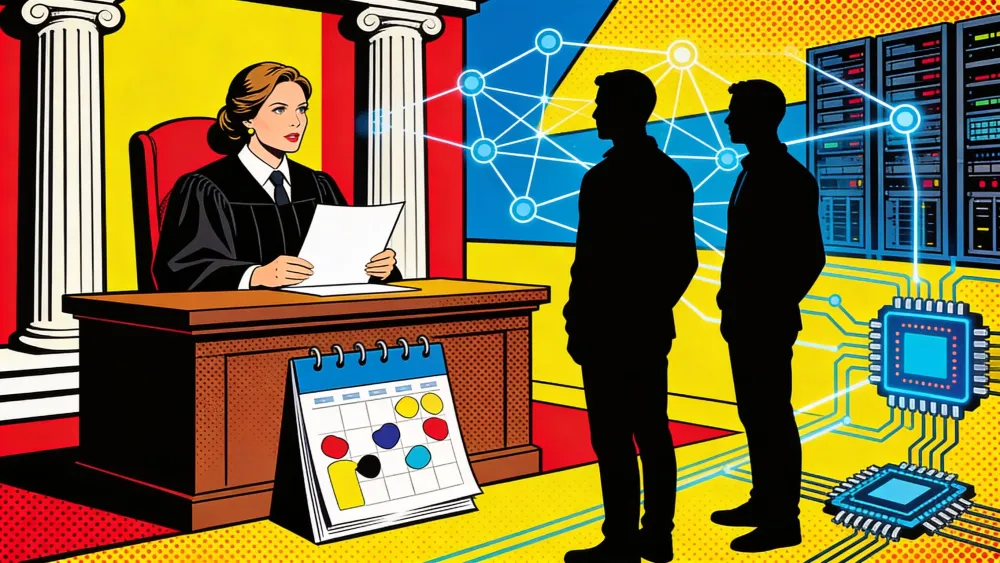
Courtroom deputy Edwin Cuenco handed Judge Yvonne Gonzalez Rogers a note. The note ended three weeks of testimony and Elon Musk's case against Sam Altman and OpenAI. The nine jurors started at 8:30 a.m. and were done before 10:23, finding Musk sued too late to pursue claims tied to a charity he helped create.
Musk answered on X with "calendar technicality." The verdict matters because it turned a mission claim into competitive evidence: a founder who gave about $38 million and later sought as much as $180 billion had to explain why he waited until xAI existed and OpenAI was valued above $850 billion.
Two days before trial, according to CNBC's report on OpenAI's court filing, Musk texted OpenAI president Greg Brockman about settlement. Brockman suggested both sides drop their claims. Musk replied: "By the end of this week, you and Sam will be the most hated men in America. If you insist, so it will be." OpenAI's lawyers wrote that the text "tends to prove motive and bias" and a motivation "to attack a competitor and its principals." Gonzalez Rogers did not admit it. Legal claim, not proof.
Key Takeaways
- The Oakland jury found Musk sued too late, and Judge Yvonne Gonzalez Rogers adopted the advisory verdict.
- Musk called the result a calendar technicality; OpenAI framed the delay as a competitor weapon.
- The trial record shifted attention back to Musk’s 2017 control bid and OpenAI insiders’ equity stakes.
- The ruling removes one IPO overhang while xAI, Anthropic compute demand and Apple distribution pressure stay unresolved.
AI-generated summary, reviewed by an editor. More on our AI guidelines.
The clock narrowed the case
Gonzalez Rogers adopted the advisory verdict immediately. The nine-person panel served in an advisory role, and Gonzalez Rogers accepted its statute-of-limitations finding as the court's own.
OpenAI lead lawyer William Savitt rejected Musk's technicality frame. "It's not a technical decision, it's a substantive one," he said. "It says: You brought your claims too late, and you did it because you were sitting on them to use them as a weapon of a competitor who can't compete in the marketplace."
That was the case OpenAI made as investors watched. Musk sought $134 billion to $180 billion in remedies, Altman and Brockman's removal, and unwinding OpenAI's 2025 restructuring. Trial lawyer James Rubinowitz told Reuters the verdict was "the cleanest possible legal win" because OpenAI "only had to prove the clock had run, and they did."
Control was the older bargain
Brockman's testimony moved the story back to 2017, before ChatGPT and Microsoft's $13 billion investment became a stake Nadella valued at $135 billion. MIT Technology Review reported that Musk wanted majority equity, board control and the CEO role. Brockman put the refusal this way: "The one thing we could not accept was to hand him unilateral, absolute control, potentially, over the AGI."
The odd object was a Tesla painting. Ilya Sutskever brought it to a 2017 meeting as a "token of goodwill," Brockman testified. When the cofounders proposed equal equity, Musk fell silent, said "I decline," stormed around the table, grabbed the painting and walked out. "I actually thought he was going to hit me," Brockman said.
OpenAI's lawyers used Brockman's testimony to argue that Musk's public nonprofit-betrayal framing was contradicted by his own 2017 push for majority equity and a for-profit structure he would control.
Brockman's own position was complicated too. His OpenAI stake is close to $30 billion, while Sutskever's is about $7 billion. A 2017 Brockman journal entry asked, "Financially, what will take me to $1B?" The trial weakened Musk's claim and muddied OpenAI's moral posture.
Get the AI power map before the market prices it in
Strategic AI news from San Francisco. No hype, no "AI will change everything" throat clearing. Just what moved, who won, and why it matters. Daily at 6am PST.
No spam. Unsubscribe anytime.
Grok made the motive argument businesslike
xAI was the quiet context for the verdict. Musk launched it in 2023, then folded it into SpaceX in February in a deal CNBC said valued xAI at $250 billion. OpenAI had just raised $122 billion at a valuation above $850 billion.
Axios reported that SpaceX agreed to give Anthropic the entire capacity of Colossus 1, more than 300 megawatts and more than 220,000 Nvidia GPUs. Dario Amodei said Anthropic saw "80x growth per year in revenue and usage" in the first quarter after planning for 10x. PitchBook's Harrison Rolfes gave the harder read: "xAI's Colossus 1 ended up with capacity that Grok's user base never grew into."
OpenAI's lawyers cited the SpaceX-Anthropic capacity transfer in court to argue Musk's lawsuit was competitive sabotage rather than mission defense, given that one of his companies was renting flagship infrastructure to one of OpenAI's largest enterprise rivals. Rolfes' PitchBook note on the unused Colossus 1 capacity gave the same point a commercial reading outside the trial record.
Apple kept the win from becoming peace
Wedbush analyst Dan Ives told Reuters the ruling was "a huge win for Altman and OpenAI despite the scrapes and bruises on Altman's persona and leadership," removing a $134 billion overhang from a possible public offering. Rubinowitz told Reuters that IPO filing activity could accelerate over the next 30 to 60 days.
Bloomberg reported on May 14 that OpenAI was weighing legal options against Apple over a ChatGPT integration that had not produced the expected subscription lift, and that Apple was testing Claude and Gemini as iOS 27 options ahead of WWDC on June 8.
SpaceX investor Ross Gerber told the New York Times: "The good news is that people hate both of them." Apple's WWDC keynote on June 8 is the next scheduled date at which one of the assistants from the trial record will be named as the default inside iOS 27.
Frequently Asked Questions
What did the jury decide in Musk v. OpenAI?
The Oakland jury found that Elon Musk waited too long to bring his charitable-trust claims against OpenAI, Sam Altman and Greg Brockman. Judge Yvonne Gonzalez Rogers adopted that advisory finding as the court’s own.
Did the verdict decide whether OpenAI stole a charity?
No. The decision turned on timing and the statute of limitations. It did not resolve the underlying merits of Musk’s claim that OpenAI abandoned its original nonprofit mission.
Why did Musk call the verdict a technicality?
Musk said the judge and jury did not reach the merits and that he would appeal. OpenAI’s lead lawyer William Savitt countered that the timing ruling was substantive because Musk brought the claims too late.
Why does xAI matter to the case?
OpenAI argued that Musk waited until after launching xAI, a rival AI company, to sue. The article also notes SpaceX’s Anthropic compute deal as market context for the competitor-sabotage argument.
How does Apple fit into the OpenAI verdict?
Apple did not publicly react to the verdict. Its relevance is distribution: Bloomberg reported OpenAI was weighing legal options over the ChatGPT integration while Apple tested Claude and Gemini for iOS 27.
AI-generated summary, reviewed by an editor. More on our AI guidelines.
Free AI briefing · Weekdays
The AI stories that matter, sourced and explained.
Join the Morning Briefing. It goes out every weekday at 4:45 a.m. Pacific, with later sends for the East Coast, Berlin and Tokyo.
Free when you sign up: The Paperclip Compendium, our tested guide to running AI agents.
Free. Unsubscribe in one click.

Marcus Schuler
Editor-in-Chief and founder of Implicator.ai. Former ARD correspondent and senior broadcast journalist with 10+ years covering tech. Writes daily briefings on policy and market developments. Based in San Francisco. E-mail: editor@implicator.ai