IMPLICATOR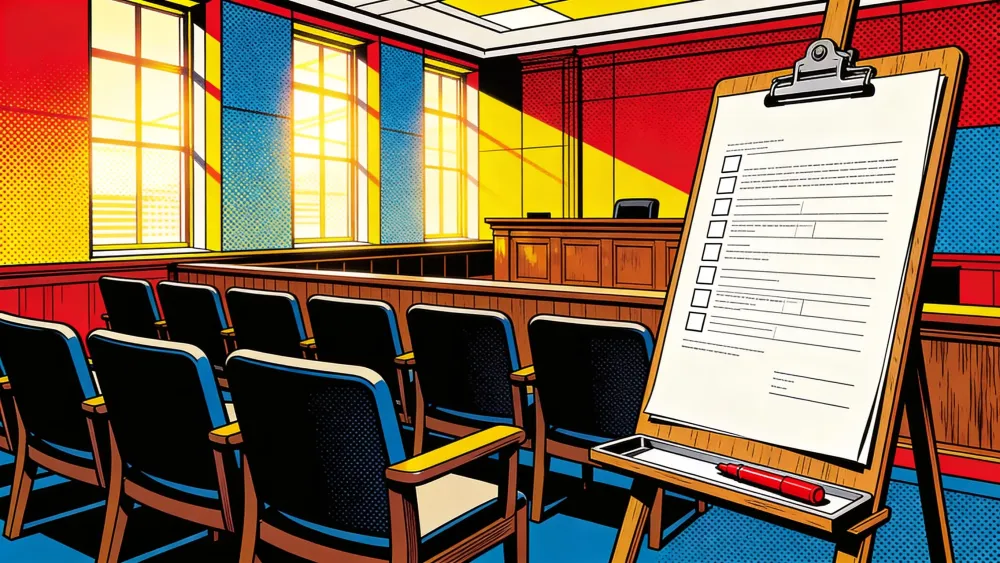
On Thursday afternoon, Elon Musk's lead trial attorney Steven Molo walked to an easel and ticked boxes on a giant verdict form with a red marker. The Times said the poster boards arrived by hand truck. After seven hours from three legal teams, the nine jurors, six women and three men, were being shown where to mark.
The marker was not the point.
The trial now leaves a narrower thesis: the advisory jury may deliberate Monday, May 18, but Judge Yvonne Gonzalez Rogers has already made timing the case's kill switch. AP quoted her court filing last month: if jurors find Elon Musk sued too late, it is "highly likely" she will "accept that finding and direct verdict to the defendants." CNBC reported the remedies phase begins Monday too, but without the jury.
Key Takeaways
- Closing arguments ended Thursday in Musk v. Altman; a nine-person advisory jury deliberates Monday with Judge Gonzalez Rogers holding the final word.
- Gonzalez Rogers wrote in a court filing she will 'highly likely' accept a statute-of-limitations finding against Musk, AP reported.
- OpenAI's defense framed Musk's $38M in donations against a $200B charitable foundation; damages asks ran from $134B to $180B across outlets.
- Brockman's diary asked 'what will take me to $1B?' His OpenAI stake is now near $30 billion; Sutskever's, near $7 billion.
AI-generated summary, reviewed by an editor. More on our AI guidelines.
The trust story needed memory
That is why Molo spent his close rebuilding the past. He described a bridge over a 100-foot gorge, built on "Sam Altman's version of the truth." Then he gave jurors the hinge: "I confronted Sam Altman with the fact that five witnesses in this trial, all people that he's known for years and worked with, called him a liar under oath. Liar's a very powerful word in a courtroom." He added, "If you cannot trust him, if you don't believe him, they cannot win. It's that simple."
OpenAI answered with the same years rearranged. The Times reported a 2017 proposal for a for-profit OpenAI giving Musk 50 percent while Altman and co-founder Greg Brockman would each get 7.5 percent. "He never cared about the nonprofit structure," OpenAI attorney Sarah Eddy told jurors, according to CNBC. "What he cared about was winning." The Guardian quoted her sharper version: "no documents corroborate Mr Musk's story."
Molo accused OpenAI of "failing to open source" its technology. The Times noted that xAI is also not open-sourcing much of its AI research.
The clock shrank the case
But history mattered only if it landed on the right side of the deadline. The Times framed Musk's burden as no way of knowing about a breach before Aug. 5, 2021, for the trust claim, and before Aug. 5, 2022, for unjust enrichment. Microsoft was added four months later and carries its own cutoff.
Molo pointed to Musk's Oct. 20, 2022 text about Microsoft's $10 billion investment as the discovery moment. OpenAI attorney William Savitt pointed to a 2018 four-page term sheet in Musk's inbox and donations he said were spent by 2020; Microsoft's Russell Cohen cited Musk's 2020 tweet calling OpenAI "essentially captured." "There was nothing left after that," Savitt told the jury, according to the Times. Reuters said Savitt accused Musk of "selective amnesia"; Eddy said one of history's most sophisticated businessmen would not have "stuck his head in the sand."
The jury watched Molo sell a bridge. The jury watched Eddy stack documents. The jury watched Savitt make absence part of credibility.
Get Implicator.ai in your inbox
Strategic AI news from San Francisco. No hype, no "AI will change everything" throat clearing. Just what moved, who won, and why it matters. Daily at 6am PST.
No spam. Unsubscribe anytime.
The numbers punish both sides
The counterargument was not moral. It was arithmetical. "Has anyone heard of a bank robbery where the bank robbers entered the bank and put $200 billion into it?" Savitt asked, according to the Wall Street Journal. Musk had put in $38 million, Reuters reported. His damages demand has been reported at $134 billion by CNBC and ABC7, about $150 billion by Reuters and the Times, and more than $180 billion by the Journal. Savitt's Reuters line was colder: "To succeed in AI, as it turns out, all Mr. Musk can do is come to court."
OpenAI's own number problem is different. Forbes reported a $122 billion round at an $852 billion valuation; the Guardian put IPO talk at $1 trillion; Anthropic sat at $44 billion in annual run-rate revenue, up from $3 billion a year earlier and $30 billion one month earlier.
So did the people on the stand. The Journal quoted Brockman's diary, entered as an exhibit: "Financially, what will take me to $1B?" His OpenAI stake is now near $30 billion, the Journal reported. Reuters put co-founder Ilya Sutskever's OpenAI stake at about $7 billion, up from $5 billion in November 2025. During Savitt's close, Sutskever's testimony became a picture on the courtroom screen: "an ant... and a cat." Tiny blue ant. Large pink cat.
The empty chair was evidence
Which raises the part of the case no verdict form can settle. Altman spent most of Thursday in court, according to the Times. Brockman stayed for all of it. Musk, AP and Reuters reported, was in China with President Trump and other executives; Reuters linked the trip to Nvidia CEO Jensen Huang.
"Mr. Musk isn't here today. My clients are," Savitt told jurors, according to the Guardian. "Mr. Musk came to this court for exactly one witness: Elon Musk. Now he's in parts unknown."
Outside, AP reported protesters condemning both sides. Protesters held signs reading "Stop replacing healthcare workers with chatboxes!" and "No future for workers in Musk-Altman fascist world." Saru Jayaraman put it plainly: "The thing is, we're all losing, that's the main point. Who's really winning? The two of them." Phoebe Thomas Sorgen said both sides "claim that they're developing AI for the benefit of humanity and that's a lie."
The nine jurors return Monday, May 18, with an advisory form. Gonzalez Rogers returns with the filing that told everyone what happens if timing fails. Molo had the red marker on Thursday afternoon. The last mark will not be his.
Frequently Asked Questions
When does the Musk v. Altman jury begin deliberating?
The nine-person advisory jury begins deliberations Monday, May 18, 2026, after Thursday's closing arguments in federal court in Oakland. The remedies phase also begins Monday before Judge Yvonne Gonzalez Rogers alone, without the jury.
Why is the jury's verdict only 'advisory'?
Judge Gonzalez Rogers retains final authority on liability; the jury's verdict is non-binding. In a court filing last month, she signaled she will 'highly likely' follow the jury if it finds Musk filed too late, directing verdict to the defendants on statute-of-limitations grounds.
How much is Musk seeking in damages?
Reported figures vary by outlet. CNBC and ABC7 cited $134 billion; Reuters and the New York Times cited about $150 billion; the Wall Street Journal cited more than $180 billion. Musk has renounced personal benefit and asked any award be paid to OpenAI's nonprofit foundation.
What did OpenAI argue about the statute of limitations?
Sarah Eddy argued any charitable trust ended in September 2020 when Musk's donations had been spent. William Savitt pointed to a 2018 term sheet in Musk's inbox; Microsoft's Russell Cohen cited Musk's 2020 tweet calling OpenAI 'essentially captured' as proof the three-year clock had run by 2024.
How is OpenAI valued now?
OpenAI closed a $122 billion funding round in March 2026 at an $852 billion post-money valuation, per Forbes. The Guardian reported IPO talk as high as $1 trillion. The OpenAI Foundation, the defense said, sits at roughly $200 billion in assets under oversight from two state attorneys general.
AI-generated summary, reviewed by an editor. More on our AI guidelines.
Free AI briefing · Weekdays
The AI stories that matter, sourced and explained.
Join the Morning Briefing. It goes out every weekday at 4:45 a.m. Pacific, with later sends for the East Coast, Berlin and Tokyo.
Free when you sign up: The Paperclip Compendium, our tested guide to running AI agents.
Free. Unsubscribe in one click.

Marcus Schuler
Editor-in-Chief and founder of Implicator.ai. Former ARD correspondent and senior broadcast journalist with 10+ years covering tech. Writes daily briefings on policy and market developments. Based in San Francisco. E-mail: editor@implicator.ai