IMPLICATOR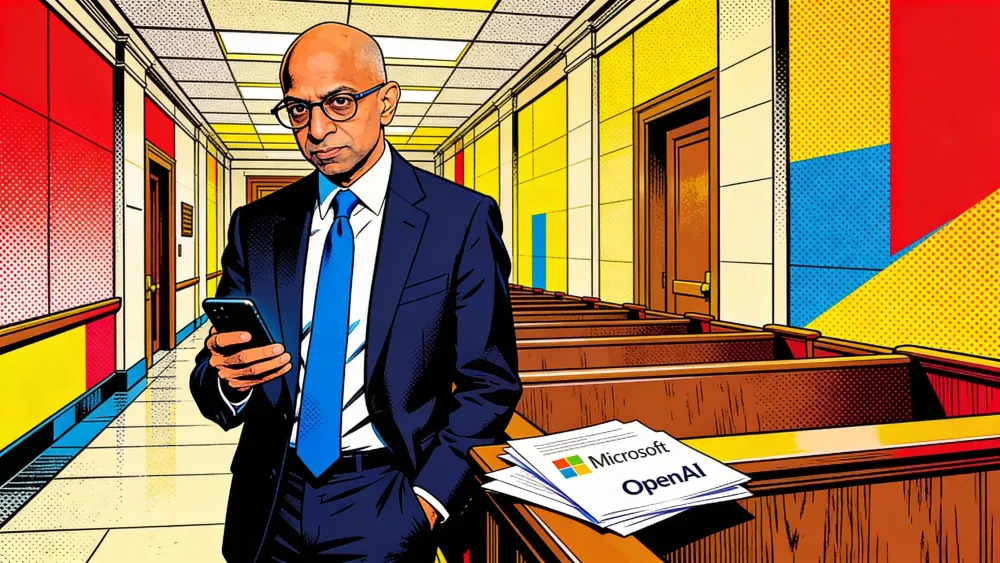
Early Monday morning in Oakland, Satya Nadella paced the federal courthouse hallway before taking the stand in Elon Musk's case against OpenAI and Microsoft, ABC7 reported. Navy suit. Blue tie. By the end of his testimony, Microsoft's chief executive had made Musk's Microsoft theory depend on a missing conversation: "We have each other's phone numbers."
The thesis is plain: Nadella did not clear Microsoft of every OpenAI entanglement, but he made Musk's case harder by turning the partnership from a capture story into a record of accepted risk, public complaints and calls Musk did not make. That was the hinge. Microsoft plainly mattered to OpenAI.
Key Takeaways
- Nadella testified that Musk never called him about Microsoft’s OpenAI investment concerns.
- Microsoft’s $13 billion OpenAI relationship now sits at the center of Musk’s charitable-trust claim.
- The testimony cut both ways: Microsoft looked commercially exposed, but less like a secret controller.
- Remedies remain contested because reports cite both $134 billion and $150 billion damages figures.
AI-generated summary, reviewed by an editor. More on our AI guidelines.
The call that did not come
Musk told jurors that Microsoft's $10 billion 2023 investment was the "key tipping point" that made him believe OpenAI was violating its nonprofit mission, CNBC reported. In August 2017, Musk had thanked Nadella after OpenAI's Dota 2 result: "Very much appreciated" and "Will make sure that people know about Microsoft's help."
"We have each other's phone numbers," Nadella said, according to the New York Times and ABC7.
The answer sat beside the money trail: more than $13 billion into OpenAI across a $1 billion 2019 investment, a $2 billion 2021 investment and $10 billion in 2023. Microsoft executive Michael Wetter said the company had recognized about $9.5 billion in partnership revenue by March 2025.
Musk's public line had hardened by 2020: "OpenAI is essentially captured by Microsoft." From the stand, it was shorter. "I was concerned they were really trying to steal the charity." Nadella's answer: commercial investments, not donations, and a nonprofit-approved for-profit structure "so that they could pursue the mission."
The risk Microsoft accepted
Musk's lawyers tried to make Microsoft look less like a supplier and more like the controlling hand. They had material. Nadella once told Kara Swisher that Microsoft was "below them, above them, around them." In 2022, he wrote: "I don't want to be IBM and OpenAI to be Microsoft."
In court, Nadella said the first was a technical description during the 2023 Altman crisis, meant to reassure customers that Microsoft products would keep running. NBC quoted his independence claim this way: "OpenAI had all the rights and resources they always had." The IBM line pointed to a real fear: Microsoft could fund the AI operating system and still lose the platform.
CNBC reported that Molo asked whether Microsoft became more prominent than IBM after the 1980 DOS deal. "That's right," Nadella said. On Monday, Microsoft was worth $3 trillion. IBM was worth $210 billion.
Follow the trial reshaping AI governance
Strategic AI news from San Francisco. No hype, no "AI will change everything" throat clearing. Just what moved, who won, and why it matters. Daily at 6am PST.
No spam. Unsubscribe anytime.
This is the juxtaposition Musk wanted. Microsoft said it was only a partner. Nadella rejected Diane Greene for an OpenAI board seat because, he testified, "there were going to be conflicts because of our major competition with Google."
The board fight cut both ways
The hardest evidence against OpenAI still came from OpenAI people. The Guardian reported that Mira Murati testified that Altman had a pattern of "saying one thing to one person and completely the opposite to another person." Sutskever confirmed that in 2023 he believed Altman showed "a consistent pattern of lying, undermining his execs and pitting his execs against one another."
Then Nadella gave OpenAI the counterweight. He said the board never gave him clear incidents behind the "not consistently candid" statement. The line "just didn't sort of suffice," he testified, because OpenAI was a company Microsoft was "invested in" and "deeply partnered with." He also called the firing "amateur city" and denied demanding Altman's reinstatement.
There is a narrow point here. Nadella did not say Microsoft had no stake. He said the stake was customer continuity, not legal control. When employees might leave en masse, Microsoft prepared to hire Altman and staff. When customers worried OpenAI might disappear, Nadella talked like a platform owner.
The remedy became the story
By Monday afternoon, the trial had become less about whether OpenAI changed and more about what a judge could unwind. Musk has sought $134 billion or $150 billion, depending on the source and damages theory, plus removal of Altman and Brockman and undoing the for-profit shift. His own donation was $38 million. Microsoft's stake was disclosed at roughly 27 percent and about $135 billion after recapitalization.
Anupam Chander, a Georgetown law professor quoted by the New York Times, said the jury might respond to Musk's line: "It is not OK to steal a charity." Molo's museum-store image was theft turned retail: "steal all the Picassos and use them to turn a profit." Chander's remedy view was cooler: "I have always been skeptical of a federal judge taking a surgical knife to corporate structure." Then: "That seems unlikely."
Sutskever followed Nadella and put the issue in a different form: "The mission of OpenAI is larger than the structure." He said he joined OpenAI after Google offered "as much as $6 million a year" because "I simply cared for it, and I didn't want it to be destroyed." His stake is worth roughly $7 billion, Bloomberg reported. Brockman's is about $30 billion.
Nadella did not erase those numbers. He put a phone between them and Musk's theory. In a trial built around who controlled OpenAI, the Microsoft witness left the jury with the simplest piece of control evidence available: Musk could have called.
Frequently Asked Questions
What did Satya Nadella say about Elon Musk?
Nadella testified that Musk never contacted him with concerns about Microsoft’s OpenAI investments, despite the two having each other’s phone numbers.
Why is Microsoft part of the OpenAI trial?
Musk accuses Microsoft of aiding OpenAI’s alleged breach of charitable trust through its investments and commercial partnership.
How much did Microsoft invest in OpenAI?
The trial record cited more than $13 billion: $1 billion in 2019, $2 billion in 2021 and $10 billion in 2023.
Did Nadella deny Microsoft influenced OpenAI?
He did not deny Microsoft had a stake in OpenAI’s stability. He framed Microsoft’s role as customer continuity and partnership rather than legal control.
What happens next in the trial?
Sam Altman is expected to testify as the defense case continues, with closing arguments and jury deliberations scheduled later in the week.
AI-generated summary, reviewed by an editor. More on our AI guidelines.

Marcus Schuler
Editor-in-Chief and founder of Implicator.ai. Former ARD correspondent and senior broadcast journalist with 10+ years covering tech. Writes daily briefings on policy and market developments. Based in San Francisco. E-mail: editor@implicator.ai