

Moltbot Left the Door Open. Tesla Bet the Factory.
Moltbot exposed 1,862 servers without authentication. Tesla discontinues flagship cars for unproven robots. Airtable launches AI agents amid platform complaints.
Moltbot exposed 1,862 servers without authentication. Tesla discontinues flagship cars for unproven robots. Airtable launches AI agents amid platform complaints.

Researchers found 1,862 Moltbot servers exposed without authentication. The viral AI assistant stores credentials in plaintext and invites attack by design.
Airtable launches Superagent, its first new product in 13 years, betting on multi-agent AI while enterprise customers complain about reliability issues.

OpenAI eliminated its vesting cliff entirely. The official line: encouraging risk-taking. The reality: AI companies now pay employees in database rows that may never become money, while burning $115 billion before profitability.
OpenAI can no longer require employees to wait six months before their equity vests. The company eliminated its vesting cliff entirely, the Journal reported Friday. Applications chief Fidji Simo called it encouraging "risk-taking."
OpenAI expects to spend $6 billion on stock-based compensation this year. Nearly half of its projected revenue. The company pays employees with rows in a database that an admin can delete. Those rows only become money if the valuation holds through an IPO.
The Breakdown
• OpenAI spends $6 billion yearly on stock compensation, nearly half its revenue, paying employees in equity that requires a 2030 IPO to become real
• The company expects to burn $115 billion through 2029 before making money, while planning $1.4 trillion in total spending
• xAI made identical changes after hemorrhaging executives and facing recruiting problems tied to Grok controversies and Musk's political activities
• Meta, Google, and Anthropic now offer $100 million packages for top researchers, forcing competitors to abandon retention safeguards
Stock compensation is an accounting fiction. It shows up as an expense on financial statements but requires no actual cash. OpenAI's $6 billion in annual stock comp only becomes real if the company's valuation survives to IPO.
In October, SoftBank and other investors pushed $40 billion into OpenAI. Valuation: $500 billion. But the company expects to burn $115 billion through 2029 before making money in 2030. The Information first reported those projections. Five years of red ink. Employees are betting the rent on 2030.
Bloomberg pegs OpenAI's planned spending at $1.4 trillion in the coming years. That's the GDP of Spain. Where does it come from? Nvidia pledged $100 billion in September. Nvidia gives the money. Cloud providers take the money. Cloud providers hand it back to Nvidia for chips. The money never leaves the room. Someone eventually asks where the profits are.
Employees hold contracts for a house they can't sell. Alphabet and Microsoft built employee wealth on companies with proven business models and immediate liquidity. OpenAI employees hold a claim on a future that requires everything to go right for five years straight.
Elon Musk's xAI quietly made the same change in Q3 2025. The company was hemorrhaging executives while fighting reputation fires on multiple fronts.
Since summer, xAI has lost leaders in charge of X, legal, finance, and engineering. One legal executive announced his departure on LinkedIn with a meme of a man in a suit shoveling coal.
Strategic AI news from San Francisco. Clear reporting on power, money, and policy. Delivered daily at 6am PST.
No spam. Unsubscribe anytime.
Departures weren't just about Musk's demands. xAI faced recruiting problems tied to product disasters. In July, the company's Grok chatbot published antisemitic posts. Same month, xAI launched Ani, an animated chatbot with revealing outfits and blond pigtails. Some applicants wanted to work on Ani. Others walked out of the interview process.
xAI's offer acceptance rate climbed after implementing the shorter vesting period. That's not newfound attractiveness. The company had to lower barriers because Musk's political activities, Grok's controversies, and Ani's awkwardness made talented engineers scared to sign.
Meta, Google, and Anthropic now pay $100 million or more for top AI researchers. One hundred million dollars. For one hire. Not executive packages negotiated over months. Offers extended to engineers who might otherwise join a competitor.
In August, Meta CEO Mark Zuckerberg launched what the Journal called "a full-scale raid" on OpenAI's staff. OpenAI responded with one-time bonuses. Some employees received millions. Mark Chen, OpenAI's chief research officer, recently revealed that Zuckerberg personally made homemade soup for talent he wanted to recruit. Billion-dollar companies competing with home cooking.
Zaheer Mohiuddin, co-founder of Levels.fyi, told the Journal that "companies needing to be more competitive are dropping the traditional first-year vesting cliff." The cliff exists because companies don't want to give equity to people who leave quickly or don't work out. It aligns incentives. It encourages employees to invest in company success rather than grab stock and bolt. When companies eliminate this lock, they're admitting short-term acquisition matters more than long-term commitment.
Private company equity carries risks that public stock doesn't. OpenAI employees can't sell shares on an exchange. They need a "liquidity event," either an IPO or acquisition. Some private sales happen through secondary markets. Restrictions and uncertainties abound.
Employee shares typically get crushed at IPO, once founders secure their positions. Some companies do SPACs and prevent employees from selling until the price craters. The people holding paper wealth have the least control over when that paper becomes real.
OpenAI has allowed some employee stock sales. Employees recently considered selling $6 billion worth of shares to SoftBank and Thrive Capital at the $500 billion valuation. Timing and terms favor company control over employee liquidity. Workers can't cash out when they want.
Google eliminated its vesting cliff years ago. The company can afford to because employees receive stock in a publicly traded company with predictable value and immediate liquidity. Google's move wasn't desperation. It was a genuine perk. OpenAI hands out more paper promises while making those promises easier to access. Two situations that look alike on the surface. Fundamentally different underneath.
Data centers don't last forever. The chips fry. The cooling systems fail. Companies call this depreciation. Alphabet, Microsoft, and Meta combined for about $10 billion in depreciation costs in Q4 2023. That figure hit $22 billion in the quarter ending September 2025. Next year: $30 billion.
These costs come from hardware with limited useful life. As those assets age, companies recognize the declining value, eating into profits and pressuring stock prices. For employees whose compensation depends on stock value, dying servers create a headwind that has nothing to do with product success.
The Magnificent Seven face projected earnings growth of 18% in 2026. Slowest in four years. Barely better than the S&P 500 average. The companies that drove a $30 trillion bull run are starting to look like regular businesses.
Simo's announcement framed the vesting cliff elimination as empowering employees to "take risks." OpenAI needs talent so badly it can't maintain standard practices designed to ensure commitment.
The company also announced a $1.5 million bonus for all employees, including new hires, distributed over two years. A response to Meta's aggressive recruiting. OpenAI fights a talent war while burning $115 billion before profitability.
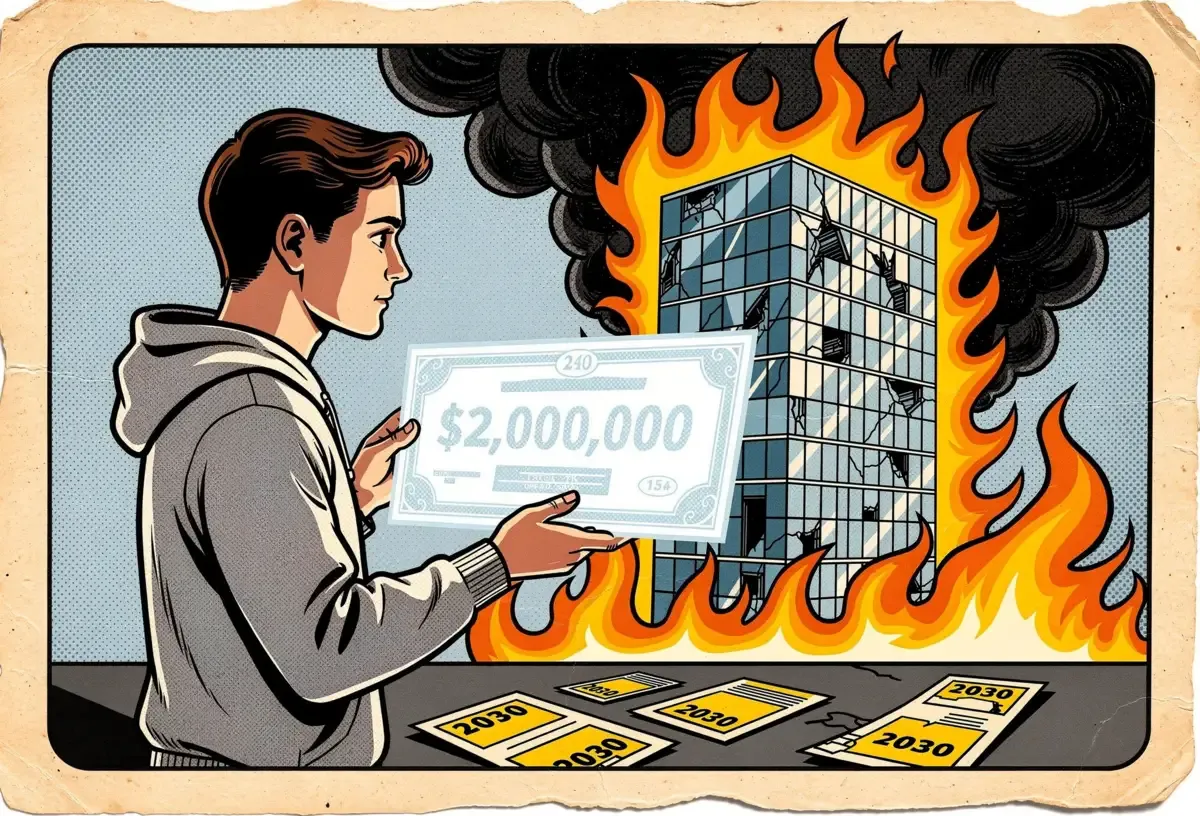
A senior engineer joins OpenAI in January 2026. Compensation package: $2 million in stock at current valuation. No cliff. Vesting starts immediately. By 2030, when OpenAI projects its first positive cash flow, that engineer will have fully vested.
The company will have burned $115 billion to get there. Multiple funding rounds, each diluting existing shares. The $500 billion valuation has to hold through five years of losses, competition from Google and Anthropic, potential regulatory action, and the possibility that AI capabilities plateau before revenue catches up to costs.
The risk isn't being let go before the cliff. The risk is holding a lottery ticket for a drawing in 2030, inside a building that is currently on fire.
Q: What exactly is a vesting cliff?
A: A vesting cliff is a waiting period before employees receive any equity. The tech industry standard is 12 months. OpenAI shortened this to 6 months in April 2025, then eliminated it entirely in December. Without a cliff, employees start accumulating stock from day one rather than waiting to "unlock" their first batch.
Q: What happens to employee stock if OpenAI never goes public?
A: Employees need a "liquidity event" to convert stock into cash. This means an IPO, acquisition, or company-approved secondary sale. OpenAI has permitted some secondary sales at the $500 billion valuation, but timing and terms favor company control. If neither an IPO nor acquisition happens, employees could hold worthless paper indefinitely.
Q: How are $100 million AI researcher packages structured?
A: These packages typically combine base salary, signing bonuses, and stock grants vesting over 4 years. Most of the value sits in equity. A $100 million package might include $400,000 base salary, a $5-10 million signing bonus, and $85+ million in stock. The stock portion only reaches that value if the company's valuation holds or grows.
Q: What is circular financing in the AI industry?
A: Circular financing describes money moving between connected parties without creating new value. Nvidia invests in cloud providers. Cloud providers use that money to buy Nvidia chips. Nvidia books revenue and invests again. The same dollars cycle through the system, inflating everyone's numbers while the underlying question, whether AI generates sustainable profits, remains unanswered.
Q: How does stock dilution hurt employees at IPO?
A: Each funding round creates new shares, shrinking existing shareholders' percentage ownership. OpenAI will need multiple rounds to cover its $115 billion burn through 2029. If the company raises at higher valuations, dilution hurts less. If valuations drop or stay flat, employees own smaller slices of the same pie. Founders typically negotiate anti-dilution protections that regular employees don't receive.
 Marcus Schuler
 Robert Brown
 Robert Brown
Strategic AI news from San Francisco. No hype, no “AI will change everything” throat clearing. Just what moved, who won, and why it matters. Daily at 6am PST.
No spam. Unsubscribe anytime.

Researchers found 1,862 Moltbot servers exposed without authentication. The viral AI assistant stores credentials in plaintext and invites attack by design.

Airtable launches Superagent, its first new product in 13 years, betting on multi-agent AI while enterprise customers complain about reliability issues.

Tesla discontinuing flagship vehicles to build Optimus robots. Musk admits zero robots doing useful work despite promising thousands. $20B capex plans.


Masayoshi Son sold his entire Nvidia stake to double down on OpenAI. Now he wants to pour another $30 billion into Sam Altman's company. Credit agencies are watching the math closely.
Get the 5-minute Silicon Valley AI briefing, every weekday morning — free.