IMPLICATOR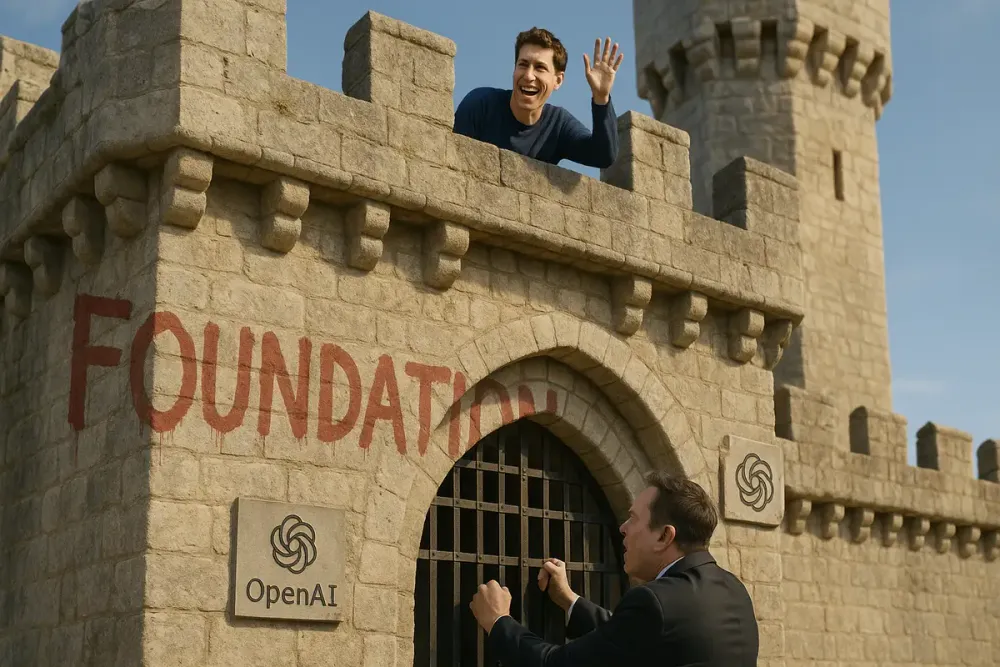
OpenAI completed its conversion to a public-benefit corporation Monday, ending a year-long standoff with California's attorney general. The deal lets Sam Altman pursue a blockbuster IPO as soon as 2027 while keeping the nonprofit foundation nominally in control—a structure critics say mimics the same governance that already failed once.
The agreement came after Altman delivered a direct message to Attorney General Rob Bonta two weeks ago: OpenAI wanted to stay in California. Behind that assurance sat months of implied threat—economic reports positioning OpenAI as the state's AI engine, Democratic operatives including former Sen. Laphonza Butler working back channels, and the specter of following Elon Musk out the door if California blocked the restructuring. Bonta was prepared to sue. He didn't. Instead, he secured pledges that OpenAI would expand in-state and give his office three weeks' notice before any major governance changes.
The restructuring wasn't optional. Altman told investors Tuesday that OpenAI has committed $1.4 trillion to infrastructure—roughly 30 gigawatts of data center capacity—and ultimately wants to hit $1 trillion annually in infrastructure spend. That means adding a gigawatt of capacity weekly at $20 billion per gigawatt. "Eventually we need to get to hundreds of billions a year in revenue," Altman said during a livestream, "and we're on a pretty steep curve towards that."
The Breakdown
• OpenAI converted to public-benefit corporation after Altman promised California expansion; nonprofit keeps 26% stake worth $130 billion and board appointment power.
• Eight of nine foundation board members also serve PBC board, recreating governance structure critics say already failed when nonprofit fired Altman in 2023.
• Company committed $1.4 trillion to infrastructure, needs hundreds of billions annually in revenue to sustain growth ambitions and eventual IPO path.
• California secured expansion pledge and three-week notice on governance changes; critics argue deal provides safety theater without structural independence.
What's actually new
Under the deal, OpenAI's nonprofit—now OpenAI Foundation—owns 26% of the new public-benefit corporation, currently worth about $130 billion. Only the foundation's board can appoint or remove the PBC's directors. Before the PBC changes bylaws, governance, or agrees to a sale, it needs the nonprofit's sign-off.
The foundation's safety committee, chaired by board member Zico Kolter, sits outside the PBC and can halt model releases or require safety measures before deployment. That committee chair can't serve on the PBC board—the one structural firewall between the entities.
California and Delaware attorneys general won't sue over the restructuring. Bonta called it a deal that "ensures charitable assets are used for their intended purpose, safety will be prioritized." Delaware AG Kathy Jennings said it reinforces "guardrails that will guide this potent technology to humanity's benefit."
OpenAI committed to staying in California and expanding there—the economic pledge that closed the deal.
The leverage that worked
Altman spent months building the case that blocking OpenAI would cost California its AI crown. In August, the company released economic analysis claiming California led the nation in AI-driven productivity gains, housed most private AI companies, and captured 68% of U.S. venture capital in the first half of 2025.
San Francisco Mayor Daniel Lurie called Bonta directly in recent weeks to emphasize OpenAI's importance to the city, according to people familiar with the discussion. Altman had served on Lurie's transition team and helped persuade President Trump not to deploy federal troops to San Francisco—capital that translated into municipal support for the restructuring.
The leverage cut both ways. In September, California and Delaware attorneys general wrote OpenAI expressing concerns about safety, citing recent suicides involving prolonged ChatGPT interactions, including a Connecticut murder-suicide. Bonta later told Bloomberg he found Altman "authentically committed" to addressing child safety after the CEO walked him through improvements—parental controls and other safeguards announced shortly after.
From Altman's perspective, staying in California without restructuring meant burning billions while capped at returns investors wouldn't sustain. From Bonta's view, forcing a breakup risked losing the company entirely while gaining little regulatory leverage. Both readings fit.
The paradox no one solved
Eight of the foundation's nine board members also serve on the PBC board. Within a year, OpenAI says, one more will step down from the PBC—leaving seven serving dual roles.
That structure requires directors to mentally toggle between fiduciary duties: nonprofit mission when wearing one hat, shareholder returns when wearing another. "I wish we were not simply trusting that they can do that," said Page Hedley, a former OpenAI executive who organized opposition from ex-employees and legal experts.
The last time the nonprofit tried to assert control—firing Altman in November 2023—Microsoft and employees forced the board out within days. Catherine Bracy, CEO of advocacy group TechEquity, noted the asymmetry: "It strains credulity to think the nonprofit has more control than the for-profit. OpenAI is the most valuable private company in the world, and the last time the nonprofit tried to exert its influence, they were all fired."
Robert Weisman of Public Citizen argued OpenAI has "consistently prioritized the for-profit's goals over its nonprofit's mission" even under the previous structure, which included similar oversight provisions. The new agreement largely replicates those failed guardrails.
Orson Aguilar, CEO of Latino Prosperity Initiative, worried the nonprofit will end up functioning like a corporate foundation—controlled by the for-profit it's supposed to oversee, funding projects that boost the PBC's bottom line rather than challenging it.
For the structure to work, the safety committee chair needs real independence and the board needs genuine bifurcation of loyalties. The agreement assumes both. The critics note that OpenAI's $500 billion valuation and capital commitments create gravitational pull that's hard to resist from inside the same boardroom.
The runway or the cliff
The capital requirements tell the structural story. OpenAI's current trajectory—burning roughly $1 billion monthly, according to earlier reports—doesn't support $1.4 trillion in infrastructure commitments, let alone the weekly gigawatt additions Altman envisions. The company needs enterprise revenue at massive scale, consumer income beyond subscriptions, and eventually public markets.
"I think it's fair to say it is the most likely path for us given the capital needs that we'll have and the size of the company," Altman said of an eventual IPO. No timeline, but the math dictates one.
The restructuring lets OpenAI raise capital without profit caps that limited investor upside to 100x returns. It positions the company for a public offering that could rank among history's largest. It keeps the nonprofit legally in control while enabling the for-profit to operate with commercial velocity.
It also creates a governance structure where the same people owe duties to a charitable mission and a $500 billion corporation simultaneously—betting that announced intentions and attorney general oversight will prevent the conflicts everyone can see coming.
California said yes because Altman promised to stay and expand. Altman needed California to say yes to unlock the capital that makes staying viable. Critics call it safety theater over captured governance. Defenders call it preserving mission while scaling ambition.
The structure's elegant. The board overlap's stark. And somewhere between $1.4 trillion committed and hundreds of billions needed annually, the governance paradox either holds or it doesn't.
Why this matters:
- Dual-board structures at unprecedented scale create a natural experiment in whether nonprofit oversight can survive inside a hyper-growth commercial entity—one whose last assertion of control triggered investor revolt and board removal within 72 hours.
- Capital requirements exceeding $1 trillion make the restructuring less a strategic choice than a survival imperative, transforming OpenAI's governance debate into a question of which structures can sustain the infrastructure race the company's already committed to running.
❓ Frequently Asked Questions
Q: What happened when OpenAI's nonprofit board fired Altman in November 2023?
A: The nonprofit board fired Altman saying it had lost confidence in him. Within days, Microsoft and OpenAI employees forced the board to rehire him and remove the directors who ousted him. Critics point to this incident as proof the nonprofit can't actually control the for-profit arm when conflicts arise.
Q: What's a public-benefit corporation and how is it different from a regular company?
A: A public-benefit corporation is a for-profit company legally required to consider public benefits—not just shareholder profits—in its decisions. Unlike regular corporations that prioritize returns, PBCs must balance profit with stated social missions. However, enforcement depends on oversight mechanisms, which critics say are weak in OpenAI's structure.
Q: Why did California's attorney general investigate OpenAI over suicide concerns?
A: In September, California and Delaware attorneys general cited recent suicides involving people who had prolonged ChatGPT interactions, including a Connecticut murder-suicide covered by the Wall Street Journal. This triggered safety scrutiny that Altman addressed by walking through child-safety improvements, including parental controls OpenAI announced shortly after.
Q: What's the Blue Cross precedent critics reference?
A: In the 1990s, when Blue Cross of California converted from nonprofit to for-profit, the state forced it to dissolve the nonprofit, evaluate all charitable assets, and give equivalent value to independent charities. Critics wanted OpenAI held to the same standard—forcing it to give billions to unrelated nonprofits—but California didn't require that.
Q: How much revenue does OpenAI actually make compared to what it needs?
A: OpenAI reportedly burns about $1 billion monthly. Altman said the company needs to reach "hundreds of billions a year in revenue" to support its $1.4 trillion infrastructure commitment and ambitions for $1 trillion annual infrastructure spend. The gap between current trajectory and capital requirements makes an IPO essentially inevitable.
 Robert Brown
 Marcus Schuler

Marcus Schuler
Editor-in-Chief and founder of Implicator.ai. Former ARD correspondent and senior broadcast journalist with 10+ years covering tech. Writes daily briefings on policy and market developments. Based in San Francisco. E-mail: editor@implicator.ai