
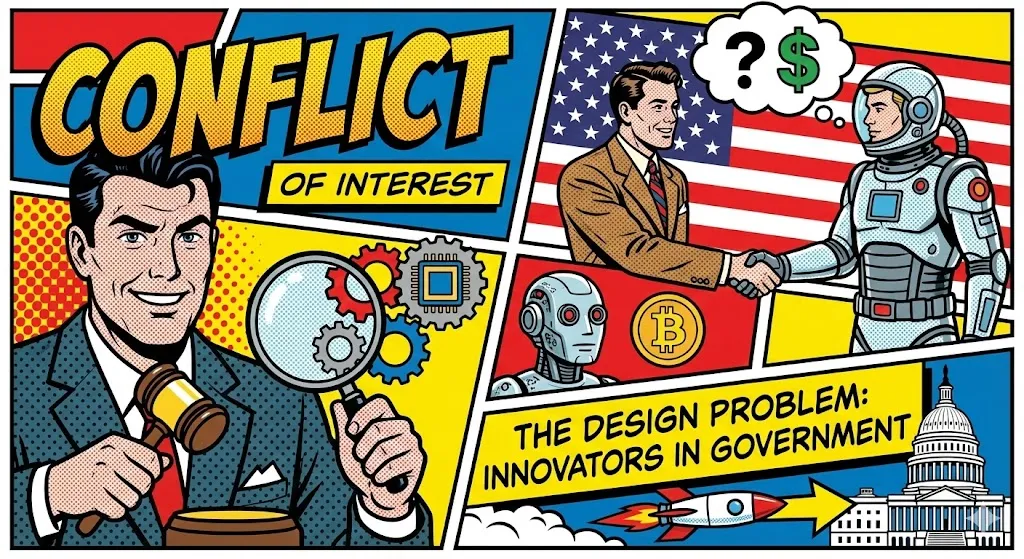
I am not a supporter of the current administration, but I do not need to suspend basic logic to judge David Sacks.
The New York Times paints Sacks as Silicon Valley’s man in the White House, a venture capitalist who helps shape AI and crypto policy while holding hundreds of related investments. The charge is simple: Conflict of interest. The insinuation is grand. Scandal.
Conflict, however, is not a moral stain. It is a design problem.
In a modern, technology driven economy, the question is no longer whether public officials have interests. It is whether those interests run with American power or against it. Sacks’s critics want an impossible figure. A czar who understands AI at the level of Nvidia’s engineers, crypto at the level of BitGo’s architects, yet owns no equity and has never taken a risk - omniscience without exposure.
Sacks is the opposite. He has too much skin in the game.
His portfolio, built over decades in software, data, and now AI, is the fossil record of a worldview that American technological dominance is a strategic asset, not a parlor game, and that regulation should be strict where it must be, restrained where it can be, and fast everywhere. If the United States wins the AI race, Sacks will get richer. So will his rivals, the index funds in everyone’s pension, and the broader economy whose tax base pays for the military his critics claim to defend.
This is a conflict, but it runs in the right direction.
History has seen this movie before. In 1940, Franklin Roosevelt pulled William Knudsen from General Motors to Washington to organize war production. Pacifists called it a sellout to industry. Two years later, that alliance between state and industrialist had turned America into the arsenal of democracy. The lesson was blunt. When a free society faces an industrial race, it drafts the people who know how to build.
Sacks is a Knudsen for computing.
The Times marshals impressive numbers. 708 tech investments, including 449 with AI ties. An unpaid “special government employee” slot that lets him keep working at Craft Ventures under waivers. Holdings in defense tech, data platforms, and crypto infrastructure. Advocacy for an AI Action Plan that speeds data center construction and loosens some export restrictions. Support for the GENIUS Act, which expands stablecoin markets that a portfolio company is positioned to serve.
Strip away the ominous framing, and you reach a prosaic fact. The government hired a man to accelerate AI and crypto, then discovered he had spent his life investing in them.
The political theorist Max Weber clearly saw this tension. Modern government, he argued, cannot be run by ascetics. From that insight follow three rules. The state must recruit specialists whose expertise is inseparable from their economic life; those specialists will have overlapping duties to their profession and to their country, and the real test is not purity but accountability for outcomes.
Apply this to Sacks, and the picture sharpens.
First, a specialist. In AI and crypto, the alternative to people like Sacks is not a neutral priesthood of scholar bureaucrats. A few entrenched incumbents quite capture it. A generalist investor’s portfolio is spread across hundreds of firms rather than one monopoly. His fortunes rise with the overall success of American innovation, not with a single favored champion.
Second, conflicting duties. Sacks owes loyalty to his limited partners, his founders, and the administration he serves. That is precisely why waivers, recusals, and time-limited appointments exist. He has sold prominent positions, accepted constraints, and exposed his finances to more scrutiny than many elected officials who posture about him. If there is evidence that he traded on nonpublic policy decisions or violated his waivers, critics should present it. Atmospherics are not proof.
Third, responsibility. Sacks is not hiding his project. He wants the global AI stack to coalesce around American firms, export controls to function as a strategy rather than a reflex, and stablecoins to be treated as extensions of dollar reach rather than toys to be smashed. One can dispute his judgment on China or on crypto. One cannot pretend his agenda is a secret enrichment scheme disguised as policy.
What truly offends many of his detractors is not his conduct, but his clarity.
They are comfortable with the traditional Washington script. Announce sweeping, cautionary rules, wrap them in process language, then quietly carve exemptions for the well-connected. The revolving door is forgiven when it turns slowly, and nobody says out loud who benefits.
Sacks is abrasive because the gears show. A man who made a fortune on software now urges the state to get out of the way of software. The line between portfolio and philosophy is straight rather than sinuously deniable.
That is not kleptocracy. It is capitalism in the open.
Could this arrangement go wrong? Of course. Any system that leans on a narrow elite risks drifting from opportunity to privilege. That is why ethics law should be sharper, disclosures more precise, and enforcement less theatrical. But the remedy for misaligned incentives is better alignment, not a purity test that bars anyone who has ever built something from advising the state.
Imagine the alternative that Sacks’s critics imply.
An AI council staffed by career regulators who have never shipped a model. A crypto czar whose only exposure to digital assets is a briefing memo. Export control hawks whose knowledge of GPUs comes from video game headlines. China, meanwhile, throws capital and talent at chips and models with one objective in mind: Strategic dominance. A decade later, Washington has immaculate ethics paperwork and a second-rate AI industry.
That bargain is not virtuous. It is reckless.
The real question is not whether David Sacks benefits if America wins the AI race. The real question is whether America is willing to entrust that race to people who would not.