IMPLICATOR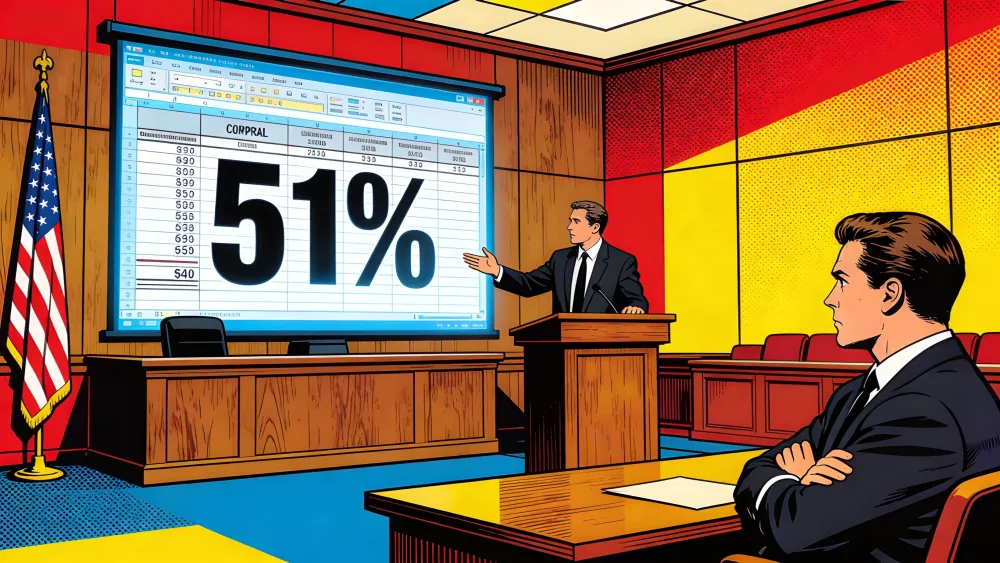
Wednesday morning in Oakland, William Savitt put a March 2026 tweet from Elon Musk on the courtroom screen. "Tesla will be one of the companies to make AGI and probably the first to make it in humanoid/atom-shaping form." Musk had told the jury earlier Wednesday that Tesla wasn't pursuing artificial general intelligence. The screen said it was. In the gallery, Greg Brockman took notes. Red-ink pen, yellow legal pad. Sam Altman watched.
That was the whole afternoon, in miniature.
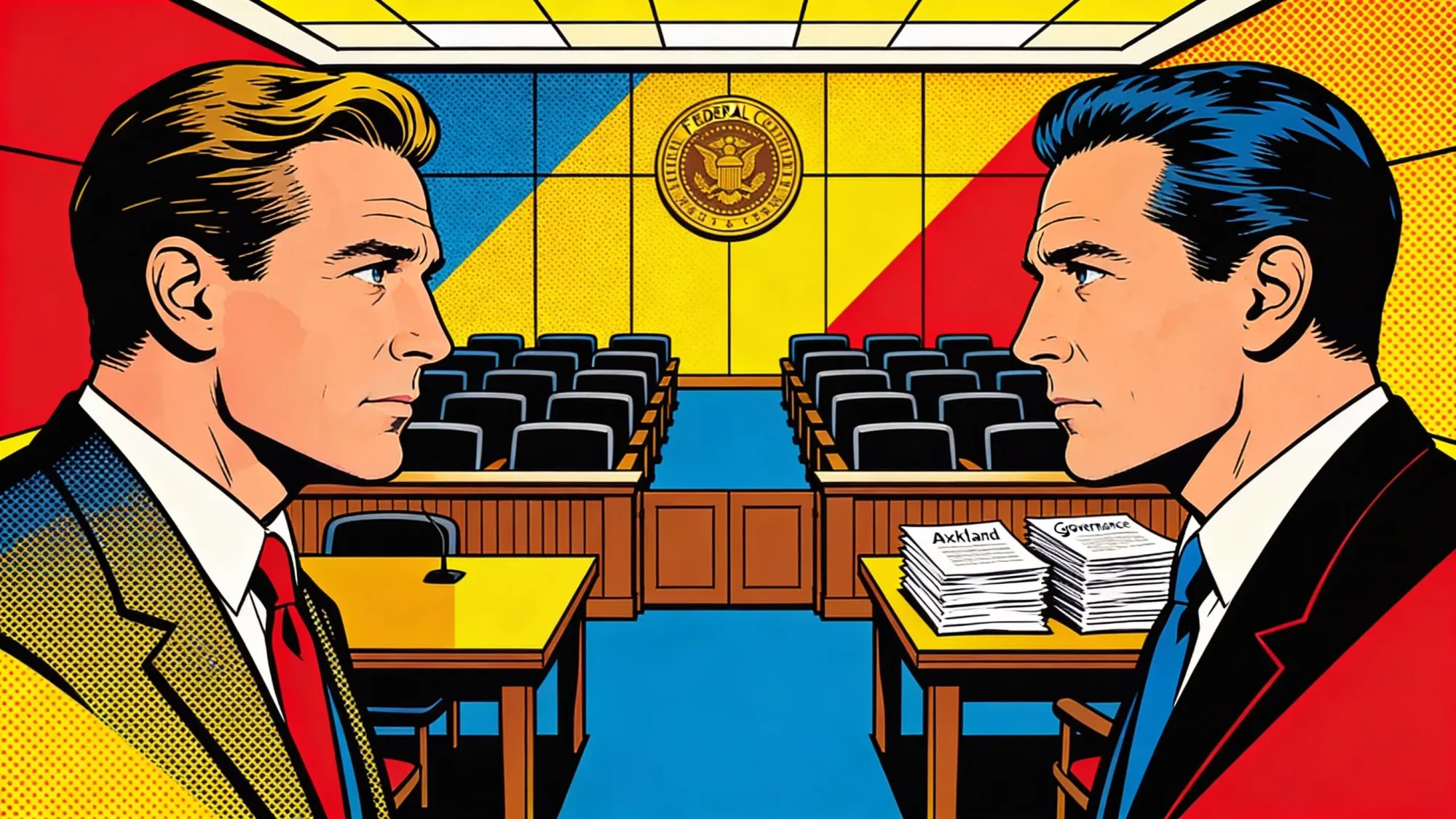
Musk filed this lawsuit to recover a charity he says OpenAI stole. Since Savitt began cross-examination, the case has narrowed. The screen keeps showing Musk's own emails, his own cap table, his own tweets, his own depositions. The argument is no longer about whether OpenAI broke a promise. It is about whether a man who had proposed a for-profit structure himself gets to call its existence a betrayal.
Key Takeaways
- Musk testified Wednesday he was 'a fool' for funding OpenAI, framing $38 million as the seed for what he now calls an $800 billion company.
- OpenAI lawyer William Savitt put a 2017 cap table on the courtroom screen showing Musk would have held 51.20% of the proposed for-profit equity.
- Cofounders Sam Altman, Ilya Sutskever, and Greg Brockman were each listed at 11.01%, with Musk controlling four of seven board seats.
- Savitt told the judge he needs about one more hour of cross-examination Thursday morning.
AI-generated summary, reviewed by an editor. More on our AI guidelines.
The number that kept changing
Musk testified Wednesday that he gave OpenAI "$38 million of essentially free funding to create what would become an $800 billion company." Many accounts ran with it.
Savitt asked him about a different number. The original pledge had been $1 billion. The actual checks ran from December 2015 through May 2017 and totaled $38 million, after which the quarterly $5 million stopped, in late 2017, as the for-profit talks collapsed. Then Savitt produced Musk's pretrial deposition. Under oath, Musk had said the donation total was $100 million. Asked Wednesday whether he had come anywhere near the $1 billion pledge, Musk said: "I contributed my reputation. These things all have value."
The donation figure moved between deposition and testimony. So has the OpenAI valuation Musk uses to frame it. He used $800 billion on the stand. ABC7 reported the company is now valued at $852 billion. KQED used $730 billion. NBC reported the for-profit raised $122 billion in the funding round that closed last month. Musk is seeking $150 billion in damages, with any award going to the nonprofit arm.
Every number in this case has a counterweight. Savitt's job all week is to walk the jury between them.
The cap table he drafted
The most damaging exhibit Savitt has put on screen so far is not an email. It is a spreadsheet.
In September 2017, Jared Birchall, the manager of Musk's family office, sent Musk what Birchall called "a more user friendly version of the cap table that Ilya and Greg are proposing" for a future for-profit OpenAI. The document listed Musk at 51.20 percent of the equity. It listed Sam Altman, Ilya Sutskever, and Greg Brockman at 11.01 percent each. Musk would have controlled four of seven board seats. The other cofounders would have shared three.
Musk testified that he was not opposed to a for-profit subsidiary then, and is not opposed to one now, "as long as it served the nonprofit and had a structure that capped the potential profit of investors." Savitt put a 2016 email next to it. Writing to a colleague at Neuralink, Musk said: "Setting it up as non-profit might, in hindsight, have been the wrong move. Sense of urgency is not as high."
A year later, after the cofounders refused his terms, Musk sent his collaborators a different idea. "The most promising option," he wrote, "would be for OpenAI to attach to Tesla as a cash cow." He hired OpenAI's Andrej Karpathy to Tesla in 2017. He was still on OpenAI's board at the time. He did not, he confirmed Wednesday, ask Karpathy to stay.
Get Implicator.ai in your inbox
Strategic AI news from San Francisco. No hype, no "AI will change everything" throat clearing. Just what moved, who won, and why it matters. Daily at 6am PST.
No spam. Unsubscribe anytime.
This is the juxtaposition Savitt wants the jury to take home: a man arguing OpenAI was promised to humanity, who in the same months drafted a 51 percent stake for himself and priced the lab as a Tesla input.
A morning he did not yell
Musk spent the first half of Wednesday narrating his own character. He told his lawyer Steven Molo that he doesn't lose his temper, that he doesn't yell at people, that he had perhaps once called a safety-focused OpenAI employee a "jackass," but only in the sense of "don't be a jackass." His faith in OpenAI's mission, he said, had moved through three phases. Enthusiastic, then uncertain, and now a phase in which he had become convinced "they were looting the nonprofit."
Savitt began the cross at lunch and by mid-afternoon Musk's voice was up, his answers sharp, his patience for the questions visibly gone. The exhibit on screen was a four-page document from 2018 that laid out OpenAI's proposed for-profit structure. Musk said he had read only the highlighted box at the top, the one marked "important warning." In his deposition, he had said something different: that he didn't think he had read the term sheet at all. Savitt pointed that out. Musk, raising his voice again: "I said I didn't look closely. I read the headline."
Judge Yvonne Gonzalez Rogers cut in repeatedly. Once to ask both sides to "calm down." Later, after Savitt complained on the record about how hard it was to get a concise answer from the witness, she said, "That is the challenge you have." The biggest laugh of the day belonged to her.
When Musk tried to compare a Savitt question to "Will you stop beating your wife?", the judge cut him off. "No, we're not going to go there."
The lawyer with the long memory
Savitt's path to this lectern wound through a New York rock band that played CBGB, a stint driving a yellow cab to pay for it, a Columbia Ph.D. attempt, law school, a clerkship for Ruth Bader Ginsburg, and a partnership at Wachtell, Lipton, Rosen & Katz. His Musk file alone runs in two directions: a securities-fraud defense for Musk and Tesla over the SolarCity acquisition, then a pivot the other way to represent Twitter when Musk tried to back out of the 2022 deal. After Musk completed the purchase, X turned around and sued Wachtell over the $90 million in fees Twitter's prior management had paid the firm for that representation. Dismissed last year. Savitt remembers the file.
Wednesday's questions reached back across a decade of Musk's own correspondence: emails from 2015, 2016, 2017, 2018, and 2019, plus a deposition given under oath, his March 2026 tweet about Tesla and AGI, and a text Altman sent him in April 2019 asking for "a few mins to talk about the Microsoft/openai investment." Musk said he did not recall responding. Savitt said he never did.
On the stand, Musk has insisted that no one should be in control of OpenAI, and certainly not in control of artificial general intelligence. Savitt closed his afternoon block by asking Musk whether he had told Tesla analysts he needed a larger pay package because he wanted significant influence over the "A.I. robot army" Tesla is building. Savitt put that framing to him. Then Savitt asked whether Grok, the chatbot made by Musk's xAI, "lags much farther behind" ChatGPT.
"Not anymore," Musk said.
Savitt told the judge he needs about an hour more on Thursday. The screen will be on.
Frequently Asked Questions
What did Elon Musk say in court Wednesday?
Musk testified he was 'a fool' for providing OpenAI with $38 million in early funding, money he said was used to build an $800 billion company. He accused Sam Altman and Greg Brockman of betraying the lab's nonprofit mission, and grew combative under cross-examination from OpenAI lawyer William Savitt.
What is the cap table Savitt put on screen?
A September 2017 spreadsheet from Jared Birchall, the manager of Musk's family office, laying out a proposed for-profit OpenAI structure. Musk was listed at 51.20 percent of the equity. Sam Altman, Ilya Sutskever, and Greg Brockman were each listed at 11.01 percent. Musk would have controlled four of seven board seats.
Who is William Savitt?
A partner at Wachtell, Lipton, Rosen & Katz, and OpenAI's lead counsel in the trial. He clerked for Justice Ruth Bader Ginsburg, played guitar at CBGB, and once drove a yellow cab. He has represented Musk and Tesla in a securities-fraud case, then later represented Twitter against Musk's 2022 attempt to back out of his acquisition.
How much did Musk actually give OpenAI?
Court filings show Musk delivered $38 million between December 2015 and May 2017. He had originally pledged $1 billion. In a pretrial deposition, he had said his total contribution was $100 million. On the stand Wednesday, asked whether he came near the $1 billion pledge, he said he had 'contributed my reputation.'
What is Musk seeking?
$150 billion in damages, with any award going to OpenAI's nonprofit arm. He also wants OpenAI's recent for-profit conversion unwound, and Sam Altman and Greg Brockman removed as officers, with Altman removed from the board.
AI-generated summary, reviewed by an editor. More on our AI guidelines.

Marcus Schuler
Editor-in-Chief and founder of Implicator.ai. Former ARD correspondent and senior broadcast journalist with 10+ years covering tech. Writes daily briefings on policy and market developments. Based in San Francisco. E-mail: editor@implicator.ai