IMPLICATOR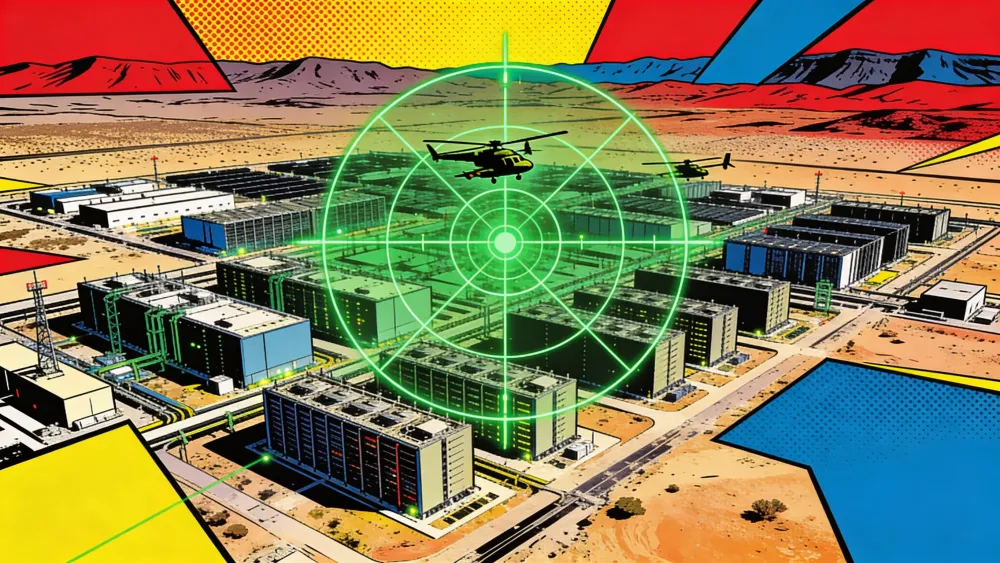
The $30 billion Stargate facility in Abu Dhabi makes for a dramatic target. But the IRGC's threat list runs 18 companies deep, and the real damage is already measured in confidence, not concrete.
On April 3, Iran's Islamic Revolutionary Guard Corps released a video that zoomed from space into an empty patch of Abu Dhabi desert. "Nothing stays hidden to our sight, though hidden by Google," read the caption. Then the night-vision overlay appeared, revealing the full footprint of OpenAI's $30 billion Stargate data center, a complex spanning roughly 10 square miles that somebody decided not to put on Google Maps. Brigadier General Ebrahim Zolfaghari promised "complete and utter annihilation." It was theatrical. It was also unnecessary. Iran had already proved the point.
Five weeks earlier, on March 1, Iranian Shahed drones struck three Amazon Web Services data centers in the UAE and Bahrain, the first confirmed military attack on a hyperscale cloud provider in history. Two of three availability zones in AWS's UAE region went dark. Emirates NBD, First Abu Dhabi Bank, Careem, Hubpay went offline. On April 2, falling debris from an intercepted Iranian missile damaged an Oracle building in Dubai, according to the city's media office. AWS issued an internal memo with language you do not want your cloud provider using: "hard down." No timeline for recovery.
Key Takeaways
- Iran's IRGC threatened 'complete annihilation' of OpenAI's $30B Stargate data center, naming 18 US tech firms as targets
- Iranian drones already hit three AWS data centers and an Oracle facility, the first military attacks on hyperscale cloud providers
- Hundreds of billions in Gulf tech investments from Google, Microsoft, Oracle, Nvidia, and AWS now carry war risk the industry never priced in
- Legal precedents and insurance exclusions mean cloud providers, not clients, likely absorb financial damage from future strikes
AI-generated summary, reviewed by an editor. More on our AI guidelines.
The threat isn't one building
You could treat the Stargate video as propaganda. The IRGC misidentified at least one executive in its footage. The facility is still under construction. But fixating on whether Iran can flatten one data center misses the calculation Tehran is actually making.
The IRGC published a list of 18 American companies it considers "legitimate targets": Cisco, Intel, Oracle, Microsoft, Apple, Google, Meta, IBM, Nvidia, Dell, Palantir, JPMorgan, Tesla, Boeing, GE, HP, and Abu Dhabi's G42. "From now on, for every assassination, an American company will be destroyed," the Guard said. That is not a bluff about Stargate. It is a pricing mechanism for the entire US-Gulf technology relationship.
The footprint is staggering. Oracle already operates cloud regions across Abu Dhabi, Dubai, Jeddah, and Riyadh, deep enough that knocking one out would cascade. Google went bigger still, sinking $10 billion into an AI hub with Saudi Arabia's sovereign wealth fund. Microsoft dropped $1.5 billion on Abu Dhabi's G42. Nvidia broke ground on AI factories in Saudi Arabia through a venture called HUMAIN, targeting 500 megawatts of capacity.
Then there's the raw spending. Amazon, Alphabet, Meta, and Microsoft collectively plan $630 billion in 2026 capex, with roughly three quarters aimed at AI infrastructure. A meaningful chunk of that money was headed for the Gulf.
Get Implicator.ai in your inbox
Strategic AI news from San Francisco. No hype, no "AI will change everything" throat clearing. Just what moved, who won, and why it matters. Daily at 6am PST.
No spam. Unsubscribe anytime.
Soft targets with hard consequences
Sam Winter-Levy, a fellow at the Carnegie Endowment's Technology and International Affairs Program, identified the logic cleanly. "Iran is signaling that it does not distinguish between the civilian and military functions of American companies," he told Anadolu Agency. "From Tehran's perspective, a company that provides cloud services to the Pentagon and to a Dubai bank is a single target."
He is right, and the Pentagon connection is not hypothetical. According to researchers at Georgia Tech, the U.S. military has used Anthropic's Claude, hosted on AWS infrastructure, for intelligence analysis during Operation Epic Fury. That dual-use reality turns every commercial server farm in the region into something an adversary can rationalize attacking under the laws of armed conflict. The 1923 Cuba Submarine Telegraph Company precedent, a century-old case where the U.S. severed British cables during the Spanish-American War, established that wartime actions against dual-use infrastructure carry no compensation obligation. The cloud has become the modern telegraph cable.
Nobody designed a data center to take a missile hit. The things run on uninterrupted power, active cooling, and fiber connectivity, all of which shatter on contact. "If the Iranians knock out their chillers or their power supply, they can take an entire facility offline," Winter-Levy said. These are, in military terms, soft targets. And you cannot hide a building that consumes a gigawatt of electricity.
The damage that matters isn't physical
Here is where the business story leaves the companies involved looking exposed. Amazon's stock actually rallied roughly 3 percent after the March 1 strikes. Analysts reasoned that the demonstrated vulnerability would force enterprises into multi-region disaster recovery, effectively driving up cloud revenue. A single data center costs roughly $800 million to $1 billion. Against $200 billion in Amazon capex for 2026 alone, that is a rounding error.
But the confidence hit compounds. Gulf states spent years and hundreds of billions pitching themselves as the world's safe, stable home for data. Saudi Arabia alone pulled in $21 billion in data center pledges during early 2025. Consultants pegged the regional market at $7.19 billion by 2031. Those projections assumed peace. The drone strikes torched that assumption overnight.
Insurance is the first domino. Standard commercial property policies exclude acts of war. Specialized war risk policies exist but are expensive and heavily contested by underwriters. Then come the contracts. A landmark Dubai Court of Cassation ruling from 2017 established that entering a contract during an active regional conflict means military disruptions are foreseeable risks. Cloud providers, not clients, absorb the financial damage. That precedent now applies directly to every hyperscaler operating in the Gulf.
And many blindsided companies did not even know they were exposed. Their workloads were routed through the region invisibly. When two availability zones went down simultaneously, standard redundancy models failed. Businesses that thought they had backup discovered they did not.
Where the infrastructure goes next
James Henderson, CEO of risk management firm Healix, put it bluntly to CNBC: "Tech assets are now treated as part of the conflict, not peripheral to it." If you sit on the board of any company on that list, that sentence should make you anxious.
The hyperscalers will not abandon the Gulf entirely. The capital, the energy, and the strategic relationships are too significant. But the next wave of AI infrastructure will quietly shift. Northern Europe. India. Southeast Asia. OpenAI already broke ground on a $1 billion facility in Norway before any of this started. That bet looks prescient now.
For the companies still building in the Gulf, the question is no longer whether their facilities can survive a strike. The UAE claims it has swatted down over 500 missiles and 2,100 drones since February. Enough got through to prove the point. The question is whether investors, insurers, and enterprise customers will keep treating the region as a place to park the infrastructure that runs the global economy. Iran does not need to destroy the Stargate data center to achieve its strategic objective. It just needs to make the Gulf expensive enough that the math stops working.
Frequently Asked Questions
Which US tech companies has Iran threatened in the Gulf?
The IRGC named 18 companies as 'legitimate targets': Cisco, Intel, Oracle, Microsoft, Apple, Google, Meta, IBM, Nvidia, Dell, Palantir, JPMorgan, Tesla, Boeing, GE, HP, Spire Solutions, and UAE's G42. The threats single out companies with cloud, AI, and data center operations in the region.
Has Iran actually attacked any data centers?
Yes. On March 1, 2026, Iranian Shahed drones struck three AWS data centers in the UAE and Bahrain, taking two of three availability zones offline. On April 2, debris from an intercepted missile damaged an Oracle building in Dubai. AWS declared multiple zones 'hard down' with no recovery timeline.
How much US tech investment is at risk in the Gulf?
Hundreds of billions. Oracle runs four cloud regions across the Gulf. Google committed $10 billion with Saudi Arabia's sovereign fund. Microsoft invested $1.5 billion in Abu Dhabi's G42. AWS pledged $5.3 billion for a Saudi AI zone. The $30 billion Stargate campus is the largest single facility.
Who pays when a data center gets hit in a war zone?
Likely the cloud providers themselves. Standard commercial insurance excludes acts of war. A 2017 Dubai court ruling established that operating during a regional conflict makes military disruptions foreseeable, putting the financial burden on providers rather than clients.
Will tech companies pull out of the Middle East?
Probably not entirely. The capital, cheap energy, and strategic relationships are too significant. But analysts expect the next wave of AI infrastructure to shift toward safer regions like Northern Europe, India, and Southeast Asia as insurance costs and risk assessments rebalance.
AI-generated summary, reviewed by an editor. More on our AI guidelines.


Free AI briefing · Weekdays
The AI stories that matter, sourced and explained.
Join the Morning Briefing. It goes out every weekday at 4:45 a.m. Pacific, with later sends for the East Coast, Berlin and Tokyo.
Free when you sign up: The Paperclip Compendium, our tested guide to running AI agents.
Free. Unsubscribe in one click.

Marcus Schuler
Editor-in-Chief and founder of Implicator.ai. Former ARD correspondent and senior broadcast journalist with 10+ years covering tech. Writes daily briefings on policy and market developments. Based in San Francisco. E-mail: editor@implicator.ai