IMPLICATOR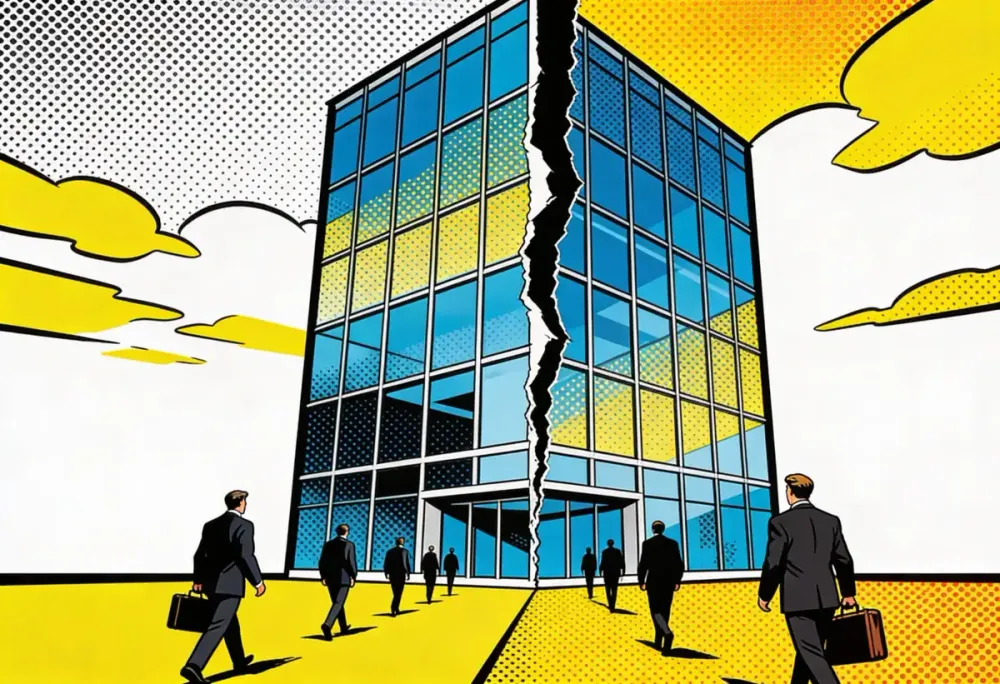
The all-hands went sideways. Mira Murati called the meeting Thursday to address the departure of CTO Barret Zoph. The call ran short. By the time it ended, more employees had decided to leave. According to tech journalist Alex Heath, at least a few resigned that day, some before the Q&A even started. Others are in talks to follow.
If you read the headlines, you came away thinking this was about ethics. A CTO fired for "unethical conduct." Confidential information shared with competitors. Drama at an AI startup. But a source familiar with Thinking Machines told WIRED something that points to a different story: "This has been part of a long discussion at Thinking Machines. There were discussions and misalignment on what the company wanted to build. It was about the product, the technology, and the future."
If you take the press release at face value, this is a scandal about a leaky CTO. If you look at the timeline, it's a structural failure. A company whose leadership never agreed on its direction.
The Breakdown
• More employees resigned after Thursday's all-hands; others are in talks to follow the three founders back to OpenAI
• The $50 billion funding round has stalled amid questions about product direction and leadership clarity
• Tinker, a fine-tuning API, remains the only product. No foundation model has been trained.
• Chief Scientist John Schulman is now the sole original research leader still at the company
The funding question nobody wants to answer
Six months ago, Thinking Machines closed a $2 billion seed round at a $12 billion valuation. Andreessen Horowitz led. Nvidia, AMD, Accel, and Jane Street participated. Everyone wanted in. The bet was straightforward: Murati had assembled the team that built ChatGPT's post-training systems. Give them capital, give them compute, and they'd build something that mattered.
By November, Bloomberg reported the company was in talks to raise at a $50 billion valuation. Some sources said it could reach $55 billion or $60 billion. That round hasn't closed. Benzinga reports that Thinking Machines has struggled to secure additional funding and that leadership hasn't defined a clear product direction.
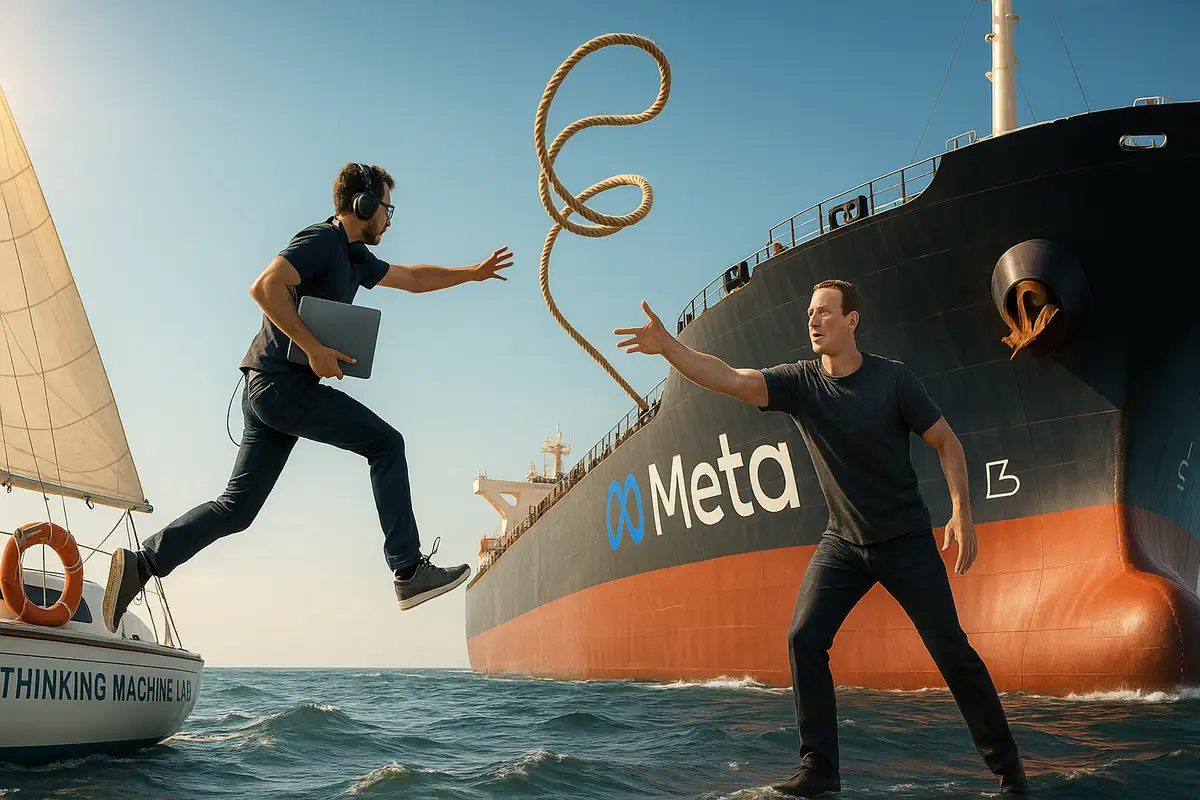
The timing is brutal. Three cofounders have now left. A fourth, Andrew Tulloch, departed for Meta in October. The investors who wrote $2 billion checks six months ago are watching half the founding team walk out the door.
M.G. Siegler captured the math at Spyglass: they've lost half the talent at the cofounder level, so do investors get half off their investments?
Get Implicator.ai in your inbox
Strategic AI news from San Francisco. No hype, no "AI will change everything" throat clearing. Just what moved, who won, and why it matters. Daily at 6am PST.
No spam. Unsubscribe anytime.
A product that doesn't answer the question
Thinking Machines launched its first and only product in October: Tinker. It's an API that lets developers fine-tune open-source models on distributed GPU clusters. The pitch is technical and narrow. Write your training loop locally, hand off the orchestration.
The problem is what Tinker isn't. Not a foundation model. Nothing that goes head-to-head with GPT-5 or Claude or Gemini. You assemble a team that built ChatGPT's soul, and you put them to work on... a fine-tuning API. OpenAI, Anthropic, and Google spent 2025 shipping frontier systems. Thinking Machines spent it building plumbing for other people's models.
A $12 billion company, aiming for $50 billion, with a tool that helps developers tweak Llama. The math doesn't work unless you believe something else is coming.
Chief Scientist John Schulman promised that Thinking Machines would release its own models in 2026. The team that could deliver on that promise is now scattered across OpenAI and Meta. Schulman remains. Soumith Chintala, the new CTO, has the infrastructure expertise to build training systems. But the post-training specialists who knew how to make models useful to actual humans are gone.
The misalignment runs deeper than Zoph
The ethics accusation against Zoph made for compelling headlines. Murati said he was fired for "unethical conduct." Sources told reporters he had shared confidential information with competitors. OpenAI said it doesn't share those concerns. Both versions can't be true, and neither can be verified from outside.
But the "misalignment" narrative from inside the company suggests the real fracture wasn't about one person's behavior. It was about what Thinking Machines was supposed to become.
When Murati left OpenAI in September 2024, she brought researchers who had built some of the most important systems in consumer AI. Zoph ran post-training. Metz worked on technical staff. Schulman, who briefly went to Anthropic before joining Thinking Machines, helped create the reinforcement learning techniques that made ChatGPT feel conversational.
These were product people. They knew how to take a trained model and turn it into something millions of users would actually use. That's different from building training infrastructure. That's different from selling an API to developers.
If the source is right about "discussions and misalignment on what the company wanted to build," then the founding team may have been pulling in different directions from the start. Murati wanted one thing. Zoph and Metz wanted another. That kind of disagreement doesn't get fixed by firing someone. It gets fixed by figuring out what the company is, or by the people who disagree walking away.
The people who disagreed didn't just leave. They retreated to safety. Returning to OpenAI isn't a career move. It's a relief. They traded the chaos of an identity crisis for the clarity of a mission they already understood.
Daily at 6am PST
The AI news your competitors read first
No breathless headlines. No "everything is changing" filler. Just who moved, what broke, and why it matters.
Free. No spam. Unsubscribe anytime.
What remains
Murati still runs the company. Chintala will try to rebuild technical credibility. Schulman, if he stays, represents the last connection to the original research vision. The team of approximately 30 includes talent from OpenAI, Meta, and Mistral. That's not nothing.
But the company that raised $2 billion on the promise of Mira Murati plus the team that built ChatGPT's soul is now a different company. The soul-builders are back at OpenAI. What's left is infrastructure expertise and a CEO facing the hardest fundraising pitch of her career: convince investors to value a company at $50 billion when its technical leadership just defected to the competition.
Mark Zuckerberg reportedly approached Murati about acquiring Thinking Machines earlier in 2025. The talks didn't progress. That option may look different now.
The pattern and the exception
AI researcher Susan Zhang called the ethics leak "the type of character assassination you put out when you find out one of your cofounders might be splitting off." Researcher Roon offered a darker translation: "before cognitive restructuring: important people are leaving. after cognitive restructuring: they're being fired for unethical conduct."
Maybe. Or maybe Zoph did something that justified termination and OpenAI hired him anyway. The AI industry has a high tolerance for drama and a short memory for misconduct.
What can be observed is the outcome. Thinking Machines is smaller, weaker, and facing harder questions than it was a week ago. OpenAI regained three researchers who helped build its most important product. The gravitational pull of the established labs continues to work on the startups trying to escape it.
Anthropic has lost zero cofounders. The company that most explicitly positioned itself around researcher autonomy and safety culture has kept its founding team intact while the rest of the industry cycles through departures and returns. Some structures hold. Others don't.
Thinking Machines hasn't collapsed. The money is still there. So is some talent, and a CEO the industry respects. But the question Murati was hoping to defer just got shoved to the front of the line. What is Thinking Machines building? The people who might have answered that one way are gone. The answer that remains will determine whether the $12 billion bet pays off or joins the long list of AI startups that couldn't hold their talent long enough to ship.
The investors are now left with a spreadsheet that no longer balances. They paid for a super-team. They own an API.
Frequently Asked Questions
Q: How many cofounders has Thinking Machines lost?
A: Four of the original six cofounders have now departed. Barret Zoph, Luke Metz, and Sam Schoenholz returned to OpenAI this week. Andrew Tulloch left for Meta in October 2025. Only Mira Murati and John Schulman remain from the founding team.
Q: What is Tinker and why does it matter?
A: Tinker is Thinking Machines' only product, an API that lets developers fine-tune open-source models on distributed GPU clusters. It launched in October 2025. The issue: it's infrastructure tooling, not a foundation model, which raises questions about whether a $12 billion valuation matches the product.
Q: What happened to the $50 billion funding round?
A: Bloomberg reported in November 2025 that Thinking Machines was in talks at a $50-60 billion valuation. That round hasn't closed. Benzinga reports the company has struggled to secure additional funding amid questions about product direction.
Q: Why did Barret Zoph leave Thinking Machines?
A: Murati said he was fired for "unethical conduct," with sources claiming he shared confidential information with competitors. OpenAI says it doesn't share those concerns. A separate source told WIRED the departures stemmed from "misalignment on what the company wanted to build."
Q: Who is Soumith Chintala and what does his appointment signal?
A: Chintala created PyTorch at Meta and has deep infrastructure expertise. His appointment as CTO signals a shift: the departing cofounders were post-training specialists who made models user-friendly. Chintala's background is in training frameworks and tooling, not consumer products.

Free AI briefing · Weekdays
The AI stories that matter, sourced and explained.
Join the Morning Briefing. It goes out every weekday at 4:45 a.m. Pacific, with later sends for the East Coast, Berlin and Tokyo.
Free when you sign up: The Paperclip Compendium, our tested guide to running AI agents.
Free. Unsubscribe in one click.

Marcus Schuler
Editor-in-Chief and founder of Implicator.ai. Former ARD correspondent and senior broadcast journalist with 10+ years covering tech. Writes daily briefings on policy and market developments. Based in San Francisco. E-mail: editor@implicator.ai