IMPLICATOR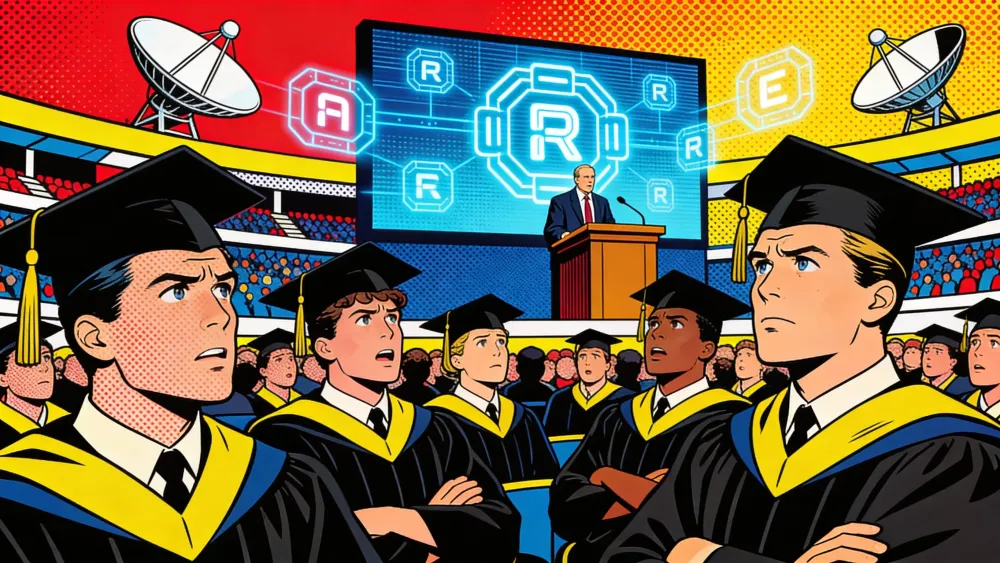
Commencement videos showed University of Central Florida (UCF) graduates booing a speaker after she praised artificial intelligence (AI) and University of Arizona graduates booing former Google CEO Eric Schmidt before and during his address. At UCF, Tavistock Development Company executive Gloria Caulfield called AI "the next industrial revolution" on May 8; at Arizona, boos intensified when Schmidt turned to AI and data centers. Gallup put the share of Americans ages 15 to 34 who described 2025 as a good time to find work near them at 43%, down from 75% in 2022.
Key Takeaways
- UCF graduates booed Gloria Caulfield after she called AI the next industrial revolution.
- Arizona graduates booed Eric Schmidt before and during a speech that moved into AI and data centers.
- Gallup found 43% of young Americans saw 2025 as a good time to find work nearby.
- Pew said U.S. adults remained wary as AI appeared more often at work and school.
AI-generated summary, reviewed by an editor. More on our AI guidelines.
Two ceremonies drew the same response
At UCF, Caulfield addressed arts, humanities, communication and media graduates, Orlando Weekly and TechCrunch reported. The crowd booed her AI line, then cheered when she noted that AI had not been a factor in daily life only a few years earlier. Madison Fuentes, a recent English creative writing graduate, told WKMG that students worried the technology would reduce opportunities in creative fields.
At Arizona, boos grew louder when Schmidt discussed AI and automation, Business Insider wrote. KOLD reported more than 5,500 students graduated Friday night at Casino Del Sol Stadium, where boos began before Schmidt reached the stage and continued during parts of his speech.
Arizona protests began before the speech
The Arizona Daily Star wrote May 15 that student advocacy groups planned to hand out flyers over a lawsuit filed by Michelle Ritter, Schmidt's former girlfriend and business partner, alleging sexual assault and harassment. Schmidt's attorney Patricia Glaser called the claims false and defamatory, and a Los Angeles judge sent the case to arbitration in March, according to the Star.
Some UCF students framed their objection around work and creative jobs. WKMG cited a Cengage survey in which 30% of 2025 graduates had secured full-time jobs related to their degree, compared with 41% of 2024 graduates. An Instagram poll by News 6 put anti-AI responses at 88%, with 12% supporting the technology.
Track the AI labor shift
Get concise reporting on how AI is changing hiring, software work and executive decisions. Daily signals, sourced and edited.
No spam. Unsubscribe anytime.
Polls show broader unease
Gallup's May 11 analysis of 2025 World Poll data showed a 21-point gap between younger Americans and Americans 55 and older on whether it was a good time to find work nearby. Gallup noted that young adults in most advanced economies remain more optimistic about jobs than older adults, making the U.S. gap unusual.
A Pew Research Center review published March 12 said U.S. adults remained wary of AI's effect on daily life even as the technology appeared more often at work and school.
Tech optimism met different rooms
Nvidia CEO Jensen Huang spoke at Carnegie Mellon without audible pushback when he said AI had reinvented computing, according to TechCrunch. Business Insider quoted Huang as telling graduates that AI was not likely to replace them, but that someone using AI better might.
Arizona spokesperson Mitch Zak told NBC News that the university invited Schmidt because of his work in technology, innovation and scientific advancement. The ceremonies suggest universities may face sharper reactions when they describe AI to graduates anxious about entry-level hiring.



Frequently Asked Questions
What happened at UCF's commencement?
Gloria Caulfield, a Tavistock Development Company executive, told UCF graduates on May 8 that AI was the next industrial revolution. The crowd booed that line and later cheered when she noted that AI had not been part of daily life a few years earlier.
Why was Eric Schmidt booed at the University of Arizona?
Student opposition had two tracks. Local reports said protests began before Schmidt took the stage over a lawsuit filed by Michelle Ritter. Boos intensified when Schmidt discussed AI, automation and data centers during the commencement address.
How does the job market connect to the reaction?
Several sources tied the UCF reaction to entry-level hiring anxiety. WKMG cited a Cengage survey showing 30% of 2025 graduates had secured full-time jobs related to their degree, down from 41% of 2024 graduates.
Were all AI commencement remarks booed?
No. Nvidia CEO Jensen Huang spoke at Carnegie Mellon without audible pushback when he discussed AI and computing, according to TechCrunch and Business Insider. Audience, speaker and field of study appear to matter.
What do polls say about public attitudes toward AI?
Gallup found weaker job-market confidence among younger Americans, while Pew said U.S. adults remained cautious about increased AI use in daily life. Both reports help explain the charged reaction.
AI-generated summary, reviewed by an editor. More on our AI guidelines.
Free AI briefing · Weekdays
The AI stories that matter, sourced and explained.
Join the Morning Briefing. It goes out every weekday at 4:45 a.m. Pacific, with later sends for the East Coast, Berlin and Tokyo.
Free when you sign up: The Paperclip Compendium, our tested guide to running AI agents.
Free. Unsubscribe in one click.

Marcus Schuler
Editor-in-Chief and founder of Implicator.ai. Former ARD correspondent and senior broadcast journalist with 10+ years covering tech. Writes daily briefings on policy and market developments. Based in San Francisco. E-mail: editor@implicator.ai