IMPLICATOR
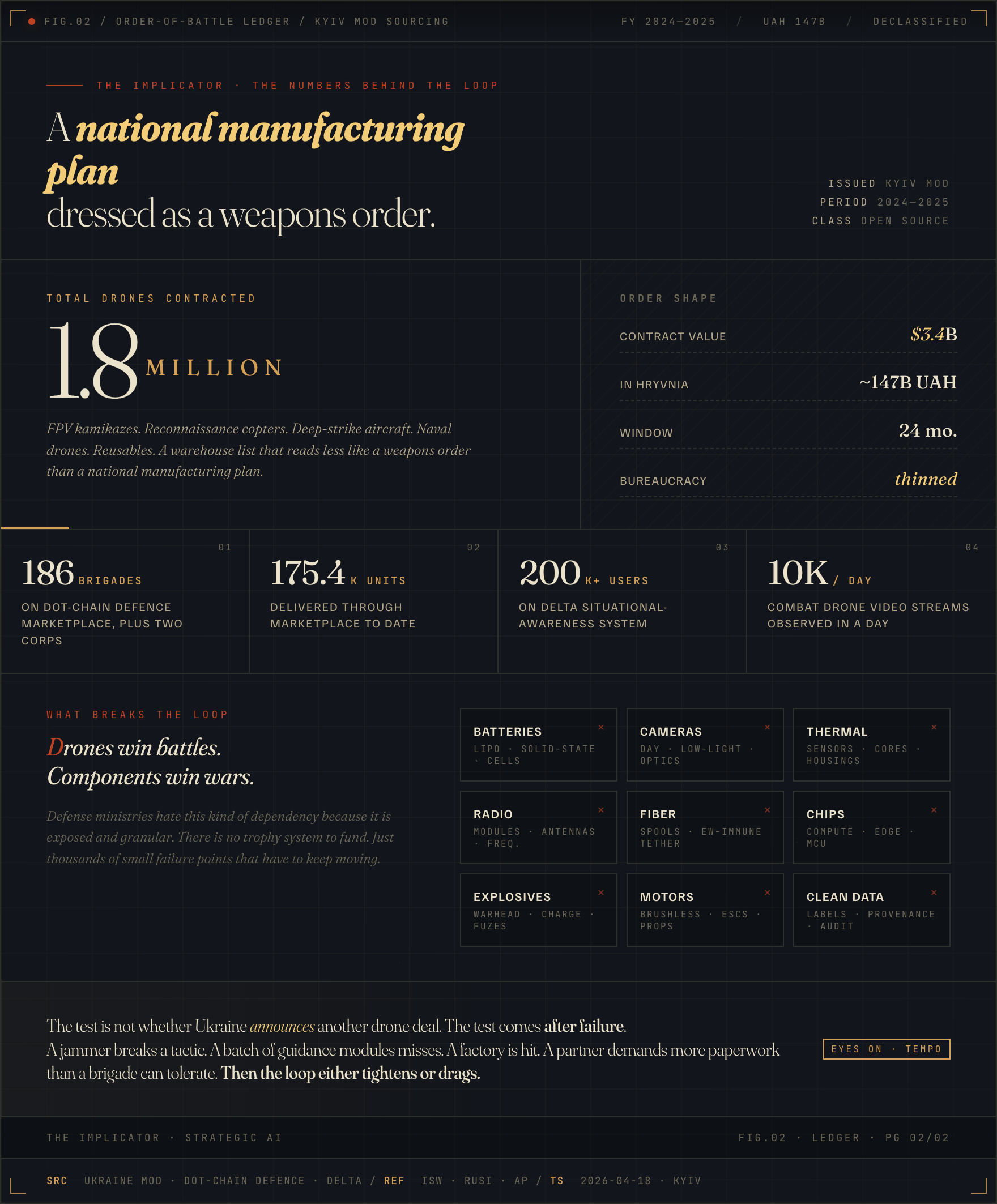
Ukraine's drone war now has a number large enough to numb you. The Ministry of Defence says Kyiv contracted 1.8 million drones for 2024 and 2025, worth roughly $3.4 billion at recent official exchange rates. FPV kamikaze drones. Reconnaissance copters. Deep-strike aircraft. Strike planes. Reusable systems. A warehouse list that reads less like a weapons order than a national manufacturing plan.
That number matters. It also hides the real weapon.
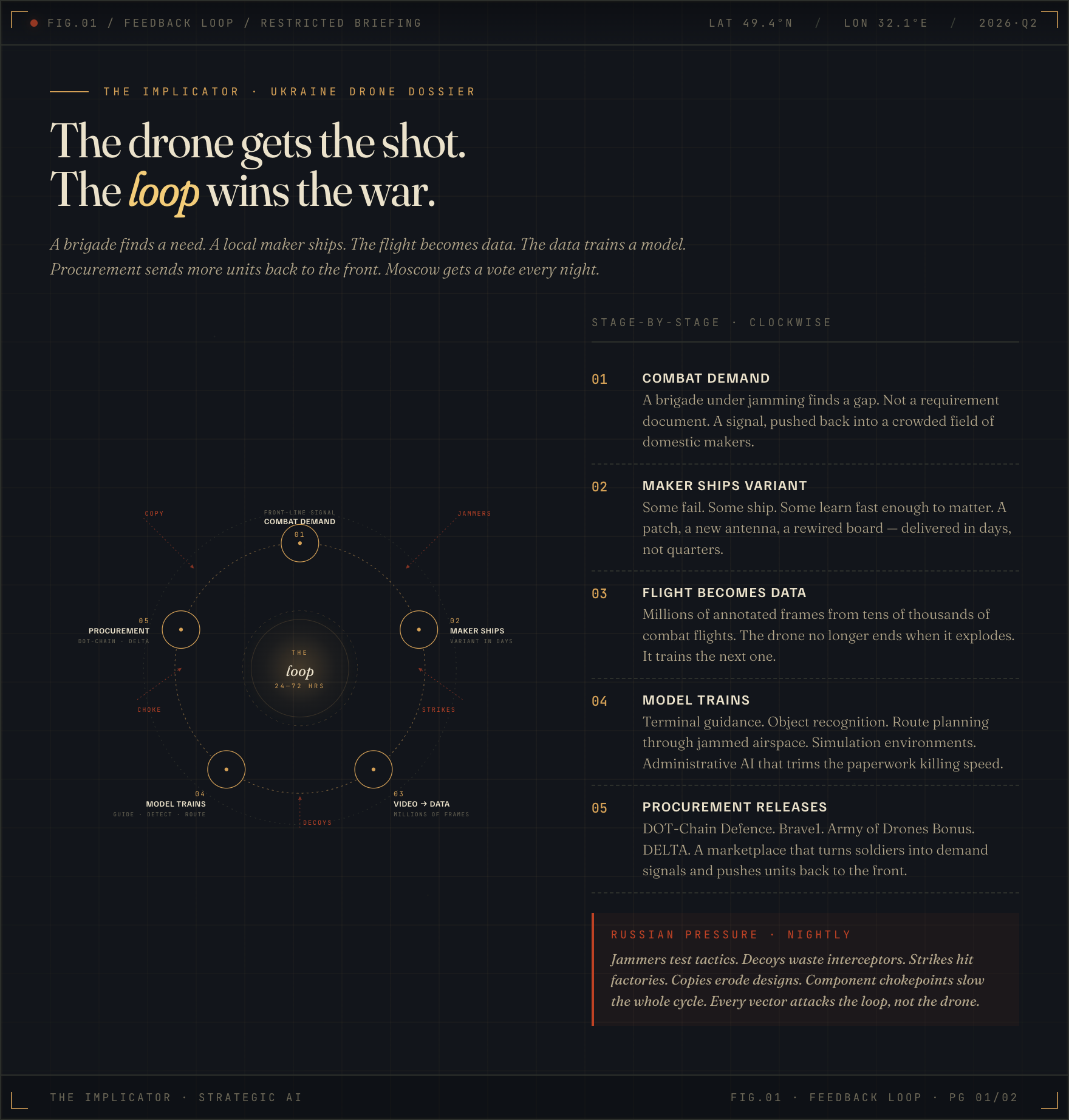
The drone is only the visible part. The advantage sits in the loop behind it: combat units find a need, local makers ship a variant, battlefield video trains the next model, digital procurement sends more units back to the front, and the next Russian countermeasure starts the cycle again.
The loop.
That is why Ukraine can still trouble a richer, larger, more heavily armed Russia. Kyiv cannot win by owning one miracle drone. Russia copies, jams, saturates, and adapts too quickly for that. Ukraine's path is harsher and more demanding: keep the learning cycle shorter than Moscow's.
The new question is not whether Ukraine uses drones and AI. It does, constantly. The question is whether it can keep turning battlefield pain into software, components, and procurement faster than Russia turns scale into pressure.
Key Takeaways
- Ukraine's drone edge sits in the feedback loop behind the hardware.
- AI helps most when jamming, video overload, and procurement drag slow humans.
- Russia copies, jams, decoys, and scales, so single-drone advantages decay fast.
- Kyiv needs components, secure data sharing, and allied production without added drag.
AI-generated summary, reviewed by an editor. More on our AI guidelines.
The loop beats the airframe
Ukraine uses drones in almost every layer of the war. Small FPV drones hunt vehicles and infantry positions. Reconnaissance drones feed artillery. Long-range one-way drones strike rear-area military and industrial targets inside Russia. Naval drones pushed Russia's Black Sea Fleet away from parts of the coast without Ukraine building a surface fleet to match it.
AI enters the picture where humans, radios, and GPS break down. Some systems help a drone keep tracking a target after the pilot marks it. Others help classify objects in video, plan routes through jammed airspace, model enemy behavior, or turn raw footage into training data. The Ministry of Defence said last month that Ukraine had opened controlled access for partners to train models on real battlefield data, including millions of annotated frames from tens of thousands of combat flights.
That is the quiet shift. A drone flight no longer ends when the drone explodes or returns. It becomes data. The data becomes model training. The model becomes a guidance module, a detection tool, or a simulation input. Then the next unit tries it under jamming.
You can see why Kyiv sounds impatient. The country has learned that battlefield advantage expires. A drone tactic that works on Monday can be dead by Friday once Russian electronic warfare units adapt. A camera, chip, battery, antenna, or software patch can matter as much as the airframe.
The Ministry of Defence's new A1 center makes that logic explicit. Its brief is to build AI for battlefield data analysis, prediction of enemy actions, drones and robots that can operate in GPS-denied and electronic-warfare conditions, internal military AI agents, and simulation environments for weapons development. In normal procurement culture, that would sound broad. In Ukraine, it sounds like the shape of the war.
Procurement is now a weapon system
The least dramatic part of Ukraine's drone story may be the most important. DOT-Chain Defence, Brave1, Army of Drones Bonus, DELTA, and the new AI data rooms are not slogans. They are attempts to make the loop move without waiting for a classic defense bureaucracy to catch up.
The MoD says DOT-Chain Defence was available to 186 combat brigades and two corps, with UAH 12 billion planned for first-quarter 2026 orders and 175,400 units already delivered through the marketplace. Its DELTA figures point the same way: more than 200,000 users, with as many as 10,000 drone combat streams in a day. Wartime ministries sell their own success, so discount the shine. The machinery still points forward.
Ukraine is trying to turn soldiers into demand signals.
That is a different model from the old weapons pipeline, where ministries define requirements, contractors bid, and frontline users wait. In Ukraine's version, a unit that discovers a problem under Russian jamming can push demand back into a crowded field of domestic makers. Some fail. Some ship. Some learn fast enough to matter.
This is why the AI part cannot be separated from the drone part. AI-assisted terminal guidance helps when a radio link drops in the last stretch. Object recognition helps when operators drown in video. Simulation helps companies test ideas before wasting scarce hardware. Administrative AI may sound dull, but faster procurement, auditing, and recruitment can decide whether a useful device reaches the front in weeks or dies in paperwork.
Russia should feel exposed by this, because mass alone is a slow answer to a fast loop. Moscow can produce drones at scale and flood Ukraine's skies with Shahed-style attacks. It can copy successful Ukrainian designs. It can jam, spoof, decoy, and strike factories. But copying an airframe is easier than copying a national habit of wartime iteration.
And that habit is the real moat.
Track the AI arms race before the demo wins
Strategic AI news from San Francisco. No hype, no "AI will change everything" throat clearing. Just what moved, who won, and why it matters. Daily at 6am PST.
No spam. Unsubscribe anytime.
Russia is attacking the same loop
The weak version of the Ukraine drone story says Kyiv is simply more innovative. That flatters everyone in the West and explains too little.
Russia adapts. Institute for the Study of War analysts warned last year that the battlefield AI revolution had not arrived at scale for either side and that real drone breakthroughs require software, hardware, training, procurement, and operational feedback to work together. That assessment matters because it punctures the fantasy of autonomous swarms suddenly deciding the war.
The contest is uglier. Russia has deep electronic-warfare capacity, large missile stocks, Iranian-linked drone designs, decoys, domestic production, and a willingness to spend drones nightly to exhaust Ukrainian defenses. If Ukraine's answer to every Shahed is an expensive interceptor, the math breaks. If Ukraine's answer depends on a component that Russian strikes or Chinese export pressure can choke, the loop slows.
That is the danger. Ukraine's advantage depends on tempo, but tempo depends on boring inputs. Batteries. Cameras. Thermal sensors. Radio modules. Fiber spools. Chips. Explosives. Test ranges. Clean data. Repair benches. Engineers who do not leave. Commanders who accept fast feedback instead of hiding bad results.
Defense ministries hate that kind of dependency because it is exposed and granular. There is no single trophy system to fund. No clean parade image. Just thousands of small failure points that have to keep moving.
If you want to know whether Ukraine is keeping its lead, watch the dull parts. Are brigades still getting the variants they request? Are AI models trained on fresh battlefield data rather than stale demos? Are domestic manufacturers paid quickly enough to survive? Are cheap interceptors scaling faster than Russian decoys? Are operators still allowed to tell engineers that the new thing failed?
The answers will matter more than any viral strike video.
The advantage has to become allied
Ukraine can keep the edge only if the loop stops being purely Ukrainian and becomes allied without becoming slow.
That is the hard part. Allies can bring money, factories, air-defense stocks, sensors, chips, and political cover. They can also bring forms, committee cycles, export controls, and gold-plated requirements that ruin the thing they came to copy. The German track shows both sides of the trade. AP reported this week that Ukraine and Germany began work on joint production covering drones, missiles, software, and modern defense systems. That list is the right list. Hardware and software now belong in the same sentence.
Kyiv should push allies toward three priorities.
First, scale the component base. RUSI put the point bluntly in a recent title: drones win battles, components win wars. Ukraine needs redundant supply for motors, batteries, optics, compute modules, radio parts, and materials. If one supplier fails, the loop should bend, not snap.
Second, protect the data layer. Battlefield video is now a training asset. That makes it valuable, sensitive, and politically delicate. Ukraine needs enough sharing to let partners improve models, enough security to protect units, and enough audit trails to keep target recognition from drifting into fantasy. The moral case and the military case point in the same direction here. Bad data kills performance before it kills legitimacy.
Third, keep humans in the useful part of the loop. Full autonomy sounds efficient until it meets mud, spoofing, smoke, civilians, decoys, and a tired operator staring at a broken feed. The near-term win is not a machine that replaces judgment. It is a machine that carries a drone through jamming, flags likely targets, trims paperwork, and gives a commander more time to decide.
That sounds modest. It is not. In a war where advantage decays in days, modest tools at huge scale can beat dazzling tools that arrive late.
The test is speed after failure
The next phase will not be decided by whether Ukraine announces another AI center or another drone deal. Announcements are easy. Russia gets a vote every night.
The test will come after failure. A batch of guidance modules will miss. A Russian jammer will break a successful tactic. A component line will dry up. A model will misclassify debris. A factory will get hit. A procurement portal will clog. A partner will demand more paperwork than a brigade can tolerate.
Then the loop either tightens or drags.
Ukraine's drone advantage began as improvisation under pressure. It became an industry because the pressure never stopped. To keep that advantage, Kyiv has to make speed permanent without making it careless. Allies have to add capacity without adding drag. And commanders have to stay honest about what AI can do, because the quickest way to lose the edge is to believe the demo more than the front.
The drone gets the camera shot. The loop wins the war.
Frequently Asked Questions
How does Ukraine use drones against Russia?
Ukraine uses small FPV drones for front-line strikes, reconnaissance drones for artillery, long-range drones against rear-area targets, and naval drones in the Black Sea. The stronger pattern is how those missions feed data back into production and software updates.
Where does AI matter most?
AI matters most in target tracking, object recognition, route planning, simulation, data analysis, and procurement support. It helps when jamming, GPS loss, video overload, or paperwork would otherwise slow humans down.
Is Ukraine using fully autonomous drone swarms?
Public evidence does not support that claim at battlefield scale. The current edge is narrower and more practical: assisted guidance, better data processing, faster procurement, and drones that remain useful when links degrade.
How can Ukraine keep its drone advantage?
Ukraine needs redundant components, fast domestic procurement, secure battlefield-data sharing, cheap drone interceptors, and allied production that adds capacity without slowing the feedback loop.
What is Russia doing to catch up?
Russia is scaling domestic drone output, using decoys, improving electronic warfare, adapting designs, and running nightly drone pressure campaigns. That makes Ukraine's advantage temporary unless Kyiv keeps learning faster.
AI-generated summary, reviewed by an editor. More on our AI guidelines.

Marcus Schuler
Editor-in-Chief and founder of Implicator.ai. Former ARD correspondent and senior broadcast journalist with 10+ years covering tech. Writes daily briefings on policy and market developments. Based in San Francisco. E-mail: editor@implicator.ai