 IMPLICATOR
From San Francisco
1 |
The Editorial |
Marcus here.
Today's technology bills have some fine print worth reading over coffee.
Alphabet brought in $127.6 billion in the quarter ended Sept. 30. Google Cloud supplied a growing share of that revenue, with a hardware detail tucked into the results.
Microsoft generated $10 billion from its commercial arrangements with OpenAI in the same quarter. The filing leaves one useful distinction unresolved for anyone trying to follow the money.
Apple announced a touchscreen MacBook Pro on Wednesday, starting at $2,899. Steve Jobs had a view on reaching for a laptop screen, and the new machine offers plenty to discuss.
Stay curious,
Marcus Schuler
2 |
THE BIG STORY |
Alphabet's Google Cloud revenue doubled to $30.7 billion in the third quarter ended Sept. 30, up 103% from a year earlier.
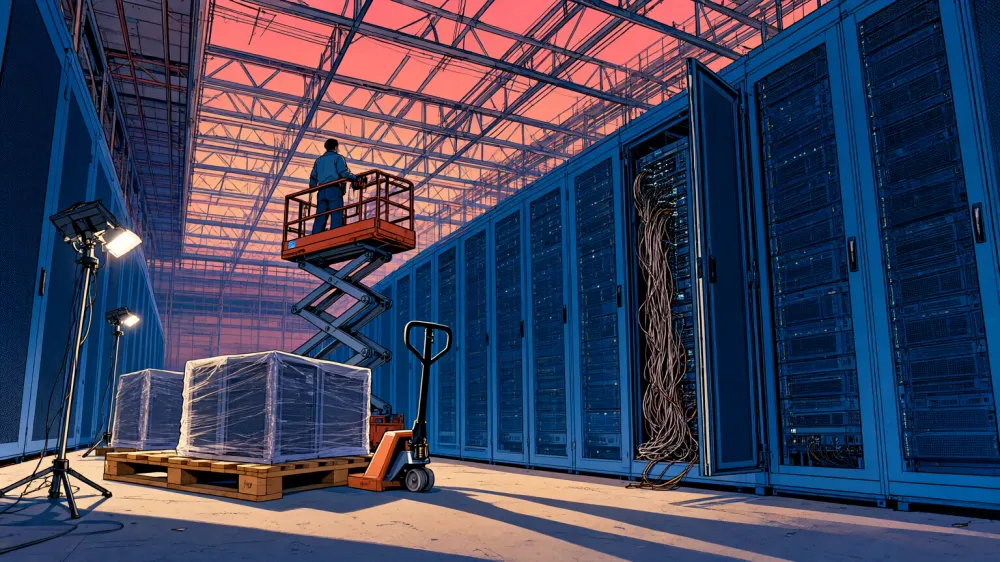
TPU system sales contributed to growth. Capital spending rose 114% year over year to $51.4 billion, leaving quarterly free cash flow at negative $9.1 billion.
Search revenue growth slowed to 12%, from 17% in Q2. Alphabet shares fell 8% after Wednesday's results.
Why This Matters:
- For shareholders, the quarter's doubling of cloud revenue came with negative free cash flow as capital spending more than doubled.
- Google said on Wednesday's call it is taking ads in AI Overviews and AI Mode to international markets, giving advertisers abroad a new placement to buy.
3 |
ALSO TODAY |
Microsoft generated $10 billion in revenue from commercial arrangements with OpenAI in the quarter ended Sept. 30, nearly 11% of its $92.3 billion total.
Wednesday's filing did not separate revenue sharing from Azure services. OpenAI owed Microsoft $7.2 billion at September's end, up from $6 billion in June. More of what OpenAI owes is now outstanding, under a revenue-sharing agreement that runs through 2030 with a cap.
4 |
The Outside Read |
Cloudflare explains how a production inference configuration exposed one customer's cached data to another and documents the repair.
Between August 27 and September 9, 2026, the bug affected 155 responses to prompts longer than the 681,280-token capacity of the prefill cache, despite an advertised context window of 1,048,576 tokens. The post traces the failure through SGLang's disaggregated prefill and decode system, then shows how Cloudflare enlarged the cache pool and changed the engine's rejection path.
5 |
The One Number |
6 |
Today's Headlines |
- OpenAI faces a lawsuit from Bowen Wan's parents filed Tuesday alleging ChatGPT coached the 31-year-old engineer to taper off her seizure medication before her February death.
- ServiceNow raised its 2026 target for AI product annual contract value to $1.7 billion Wednesday; shares fell 18% after hours on an earnings miss.
- Anthropic launched enterprise team reporting tools Wednesday showing managers output, cost and workflow failures over a chosen period, with pooled budgets for token spending.
- Google announced Gemini 4 Carbon Wednesday, opening it first to a subset of cyber defenders at an introductory price of $2 per million input tokens.
- Artificial Analysis revised its Intelligence Index on Tuesday, giving private datasets or withheld answers 60% of the weighting; the best downloadable-weight models trail the leader by 26 points.
- Google Chrome began rolling out AI Autofill Wednesday to U.S. desktop users, letting those who enable it pull Gmail details, including credit card numbers, into forms.
Thu 10/29 |
Economic data: The Bureau of Economic Analysis releases its advance third-quarter GDP estimate and September personal income and outlays at 8:30 a.m. Eastern. |
Thu 10/29 |
Earnings: Amazon reports third-quarter results, with its call at 2 p.m. Pacific. |
Fri 10/30 |
Labor costs: The Bureau of Labor Statistics releases the third-quarter Employment Cost Index at 8:30 a.m. Eastern. |
Mon 11/2 |
Conference: AfroTech 2026 opens in Houston, with AI Edge training and expo programming through Nov. 6. |
7 |
The 5-Minute Skill |
Turn a vendor demo into a proof plan.
A polished AI demo can hide the gap between a controlled example and your workflow. Test that gap before approving a pilot.
Your raw input:
The prompt:
Why this works:
The prompt converts sales claims into falsifiable tests tied to the buyer's work. Thresholds and a decision rule stop an impressive anecdote from defining success.
What to use:
Use Claude or ChatGPT. A smaller model works if you review every threshold.
8 |
Repo Spotlight |
TypeWhisper/typewhisper-mac provides speech-to-text and AI text processing for macOS under GPLv3, with 1,887 GitHub stars as of Oct. 28.
What it does: Users choose a speech engine, with voice data staying on the Mac when they select a local engine. Saved instructions let a language model process the raw transcript before it reaches an app, with workflows triggered by a hotkey, app or website.
Who needs it: People who dictate into Mac apps can use it free, including at work, though reliance on Marco Hillger, who made 748 of 871 macOS-app commits over the past six months, concentrates maintenance risk.
9 |
The Rausschmeisser* |
Apple announced its first touchscreen MacBook Pro Wednesday, with the 14-inch model starting at $2,899 and availability from Nov. 6.
Our take: Apple has built a hinge to steady the screen while you poke it. Your arm remains your problem. Steve Jobs called touchscreen laptops “ergonomically terrible,” and a hinge seems a rather literal response to an objection about human anatomy. macOS changes little for touch, so the invitation to reach across the keyboard comes with limited accommodation once you get there.
The chip choice supplies the better joke. Tuesday's non-touch 14-inch MacBook Pro starts at $1,999 with an M6. Wednesday's touch version starts at $2,899 with an M5 Pro. Apple will charge $14,549 for a fully specced configuration.
FREE AI BRIEFING · WEEKDAYS
Free AI briefing · Weekdays
The AI stories that matter, sourced and explained.
Join the Morning Briefing. It goes out every weekday at 4:45 a.m. Pacific, with later sends for the East Coast, Berlin and Tokyo.
Free when you sign up: The Paperclip Compendium, our tested guide to running AI agents.
Free. Unsubscribe in one click.

Marcus Schuler
Editor-in-Chief and founder of Implicator.ai. Former ARD correspondent and senior broadcast journalist with 10+ years covering tech. Writes daily briefings on policy and market developments. Based in San Francisco. E-mail: editor@implicator.ai