IMPLICATOR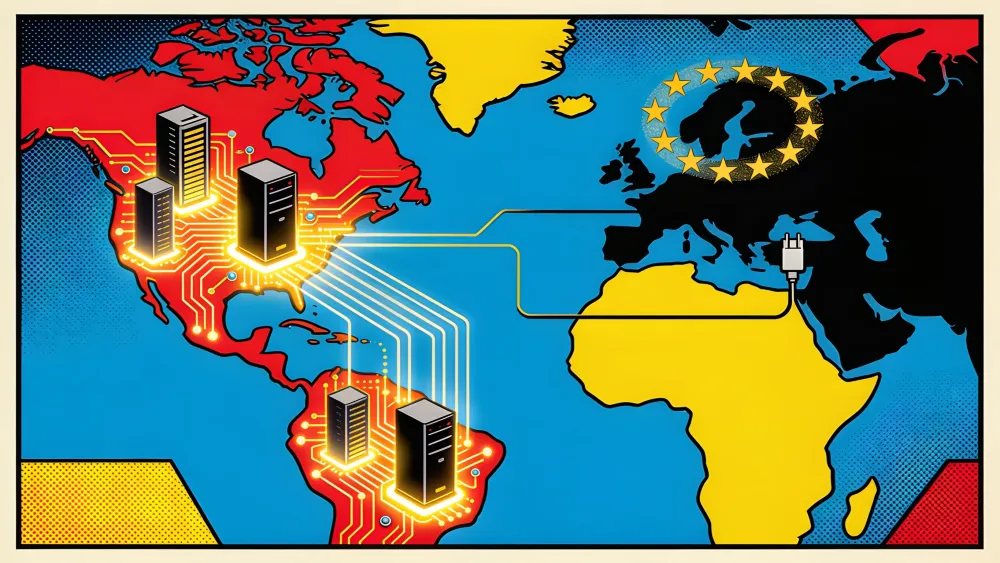
San Francisco | Monday, June 22, 2026
A made-up disaster has done what years of Brussels white papers could not. A viral scenario called Europe 2031 pegs the continent at 5 percent of the world's AI compute against America's 80, and it surfaced a day before Washington cut European access to Anthropic's strongest models. Lawmakers now quote the fiction as a forecast.
The talent is voting with its feet. John Jumper, who won a Nobel for AlphaFold, left Google DeepMind for Anthropic, a day after a Gemini co-lead went to OpenAI. Google keeps doing the science, and the people behind it keep leaving.
And the open-weight lead looks increasingly Chinese: five reviewers gave Z.ai's GLM-5.2 a narrow win over Moonshot's Kimi this month. Brussels, meanwhile, keeps publishing.
Stay curious,
Marcus Schuler
Viral 'Europe 2031' Scenario Puts EU at 5% of Global AI Compute

A made-up catastrophe is shaping real AI policy. Europe 2031, published June 11 by Brussels-based researchers, puts the continent at 5 percent of global AI compute against 80 percent for the United States.
It went viral during the G7 talks, one day before Washington cut European access to Anthropic's Fable 5 and Mythos 5. The authors argue the gap is physical first: America's largest AI supercomputer runs at 1,250 megawatts, Europe's at 83.
Their prescription breaks with reflex. Instead of funding Mistral, they want Europe to build enough compute to draw in American operators and gain bargaining power. Critics note that several US deals the scenario cites as proof of dominance, including a $100 billion OpenAI-Nvidia pact, have since collapsed.
Why This Matters:
- Europe's bottleneck is now framed as energy and data centers rather than a missing chat app, which redirects where public money should go.
- If Brussels accepts the diagnosis, the fight moves to deregulated build-out zones that still need sign-off from all 27 member states.
Reality Check
What's confirmed: Europe 2031 was published June 11 by the Arq Foundation, citing Europe at 5% of global AI compute against 80% for the US and an 83-megawatt versus 1,250-megawatt supercomputer gap.
What's implied (not proven): That a compute build-out to attract US operators is the right cure, and that the fictional five-year slide is a plausible path.
What could go wrong: The plan needs capital Europe has "not attempted in peacetime," plus approval from all 27 member states.
What to watch next: Whether the Cloud and AI Development Act's accelerated build-out zones get approved; the process usually runs 12 to 18 months.

The One Number
5% - Europe's estimated share of global AI computing capacity in the Europe 2031 scenario published June 11. The scenario says the United States controls a share roughly sixteen times larger. In this framing, Europe's AI problem starts with power, sites and chips rather than a homegrown chat app.
Source: Europe 2031, June 11, 2026
💰 Fresh Funding
💰 Fresh Funding
Raises $260M: Dream expands sovereign AI for governments
Dream said Thursday it raised $260 million at a $3 billion valuation in a round co-led by Bicycle Capital and Group 11, with Antler, Bain Capital Ventures, Tru Arrow Partners and other investors joining. The Tel Aviv and Vienna company sells AI and cyber-defense systems to governments and critical-infrastructure operators, and Reuters reported it has nearly $300 million in sales since late 2024.
Visit Dream →Raises $100M: Ent brings intent-aware security to AI-era endpoints
Ent said Tuesday it emerged from stealth with a $100 million seed round led by Decibel, with Sequoia, Crosspoint Capital Partners, Craft Ventures, Shield Capital, Felicis and In-Q-Tel participating. The RiskIQ and Microsoft Security Copilot veterans behind Ent are building on-device models that intervene before a user, browser extension or AI agent completes a risky action.
Visit Ent →Raises $70M: XDOF builds training-data pipes for physical AI
TechCrunch reported Wednesday that XDOF raised $70 million from Thrive Capital, Spark Capital, a16z, Lux and WndrCo as it came out of stealth. The San Mateo robotics-data startup says 20 customers, including several frontier AI labs, already use its teleoperation and annotation stack to train general-purpose robots.
Visit XDOF →Nobel Laureate John Jumper Leaves DeepMind for Anthropic

A Nobel Prize winner just walked out of Google's top AI lab. John Jumper, who shared the 2024 chemistry Nobel for AlphaFold, is leaving Google DeepMind for Anthropic after nearly nine years.
His exit lands one day after Gemini co-lead Noam Shazeer left for OpenAI, two senior research losses for Alphabet inside 48 hours. Jumper had been working on AI coding, an area where DeepMind staff worry Google lacks a clear enterprise product against Claude Code and Codex.
For Anthropic, the hire points at life sciences. The company paid $400 million in stock for biotech startup Coefficient Bio in April, and its healthcare lead wants "a meaningful percentage" of the world's life-science work running on Claude. Jumper's specialty, protein structure, fits that ambition.

AI Image of the Day

Prompt: massive lion king walking directly toward the camera, perfectly centered composition, giant front paw dominating the foreground, intense ice-blue eyes locked on the viewer, powerful muscular body, ultra detailed golden fur, realistic black claws, crystal-clear ring of water surrounding the paw, frozen droplets suspended in midair, extreme depth and perspective, low-angle ground-level shot, cinematic wildlife photography, razor-sharp focus, natural lighting, hyper realistic detail.
GLM-5.2 Edges Kimi K2.7 Code in Early Coding Tests

The two strongest Chinese open models to launch this month went head to head, and the early verdict gives Z.ai's GLM-5.2 a narrow edge over Moonshot's Kimi K2.7 Code.
Across five independent reviews, the pair often traded wins on quick one-shot tasks, and Kimi sometimes finished faster. The gap showed up on a second look, when reviewers inspected the code and found GLM's builds held together better, wiring a Next.js and Prisma stack without errors where Kimi's carried more bugs.
The two split on strengths. GLM-5.2 runs a one-million-token context, an MIT license, and costs near 50 cents a task. Kimi is the only one that reads images and runs an agent swarm across files, though its context is roughly a quarter the size. None of this rests on a standardized benchmark.

🧰 AI Toolbox

How to Turn a Script into a Finished Animation with One AI Agent Using Anijam
Anijam is an all-in-one animation platform built around a conversational AI agent that handles the full pipeline: script, scene breakdown, character consistency, motion, lip sync, and final editing. Paste a story or describe a concept and the agent returns a shot list, generates the scenes, keeps your characters consistent across them, and assembles the finished animated video. Replaces a chain of separate tools (storyboard, image gen, video gen, editor) with a single interface from Dzine.
Tutorial:
- Sign up at anijam.ai and pick a project template (short film, product explainer, animated ad, children's story)
- Paste a script or describe the story in plain language: "A robot discovers a lost cat in a rainy city and helps it find its way home"
- Let the AI agent break the script into shots with suggested camera angles, pacing, and scene transitions
- Define your main characters once, Anijam maintains consistency across every scene automatically
- Generate scenes and review the timeline, tweak any shot by editing the prompt or adjusting motion controls
- Add voiceover and watch the agent apply lip sync to each character
- Export the finished animated video as MP4 or push directly to YouTube, TikTok, or Instagram
URL: Anijam
What To Watch Next
|
||
|
||
|
||
|
||
|
💡 5-Minute Skill: Turn a 42,000-Word AI Policy Text Into Five Board Questions
Monday, 3:18 p.m. Someone sent the board a 42,000-word AI policy text and asked for "implications." Do not let the model summarize it into fog. Make it turn the document into questions management has to answer.
Your raw input:
Document: 42,300-word AI policy statement. Themes: labor displacement, autonomous weapons, child safety, concentrated data power, outside oversight. Audience: board risk committee. Need: five questions for management, no theology, no summary.
The prompt:
Act like a board risk adviser. Turn this long AI policy text into five questions management must answer. For each, give the risk, owner, evidence to request, and next decision. Separate moral claims from operational controls. Do not summarize the document. Do not use slogans.
The output:
Question: Which AI use cases affect jobs, safety or customer data? Owner: COO and CISO. Evidence: deployment list, vendor approvals, incident logs. Decision: which uses need human review, outside audit or a pause.
Why this works:
Long policy documents usually turn into quotable mush. This prompt forces the model to convert values into controls, owners and evidence requests, which is what a board can actually act on.
What to use:
Claude is best when you paste the full document or long excerpts. ChatGPT is faster for turning the output into a one-page board memo. Gemini helps if the policy text is live on the web, but verify every quote before it reaches directors.
📖 AI Alphabet
|
G
|
📖 AI Alphabet Ground Truth Ground truth is the trusted answer a model is supposed to learn from or match. It serves as the reference point for training, testing, and evaluation. |
AI & Tech News
China Hits US Firms With New Export Controls and Procurement Bans
Beijing imposed export controls on ten US companies and barred government agencies from buying from 46 more, including Anduril and MP Materials. The Monday measures widen earlier restrictions across semiconductors, aerospace and critical minerals.
Samsung Rolls Out ChatGPT Enterprise and Codex Company-Wide
Samsung deployed OpenAI's ChatGPT Enterprise and Codex to its Korea staff and its global Device eXperience division. It counts as one of OpenAI's largest enterprise deployments to date.
ByteDance Nears $1 Trillion Valuation Without an IPO
TikTok parent ByteDance is trading above $600 billion in gray markets, closing in on a $1 trillion valuation. Sources say a public listing remains unlikely given regulatory and geopolitical friction.
Tencent Tests Xiaowei AI Assistant Inside WeChat
Tencent began testing an AI assistant called Xiaowei built directly into WeChat, its super-app. It runs on Tencent's own WeLM model alongside DeepSeek's language models.
Defense Tech Funding Hits $12.3 Billion, Topping All of 2025
Startups building drones and battlefield AI have raised $12.3 billion across 175 deals this year, already past 2025's full-year total. Analysts warn the jump in valuations looks like a hype cycle.
Japan's Chip-Gear Makers Post First-Ever Drop in China Sales
Sales of chipmaking equipment from Japan's top five suppliers to China fell 10% for the year ended March 31, the first decline on record. China's drive to build a domestic equipment base is the cause.
SoftBank-Backed Robot Maker Coowa Preps Hong Kong IPO
Shanghai embodied-AI firm Coowa plans a Hong Kong listing within two to three months, people familiar with the matter said. Its latest round raised $600 million at a $3 billion valuation.
Apple Supplier Lingyi iTech Files for $1.1 Billion Hong Kong IPO
Shenzhen-listed Lingyi iTech filed for a Hong Kong listing of up to $1.1 billion, with pricing set for June 26. Proceeds back a push into AI servers, smart glasses and robotics.
Europe Bets on Factory AI as It Trails in Consumer Models
Behind the US and China on consumer AI, Europe is steering investment into industrial uses through Mistral, Siemens and Schneider Electric. The pitch leans on the region's manufacturing and engineering depth.
Morgan Stanley Pushes Data-Center Builders Toward Leveraged Loans
Morgan Stanley is urging data-center developers to finance with leveraged loans instead of bonds. The bank expects about $15 billion in new issuance for the sector this year.
🚀 AI Profiles: The Companies Defining Tomorrow
Sarvam is the Bengaluru company building India's full-stack sovereign AI, from training infrastructure to frontier models to the products that put them inside banks and government ministries. It raised $234 million in the first close of a $300 million Series B on June 15, valuing the three-year-old company at $1.5 billion and making it India's newest AI unicorn. The timing is pointed, because the raise landed days after Anthropic cut off foreign access to its Fable and Mythos models on a US government order. 🇮🇳
Founders
Founded in 2023 by Vivek Raghavan and Pratyush Kumar, who met building AI4Bharat, the Indian-language research lab at IIT Madras backed by Aadhaar architect Nandan Nilekani. Raghavan helped build India's national biometric ID system; Kumar came out of Microsoft Research and the same language-AI program. Their argument is that a country of 1.4 billion people speaking 22 official languages cannot rent its core AI from labs a foreign government can switch off.
Product
Sarvam trains its models from scratch in India rather than fine-tuning Western weights. Its two open-weight releases this year, Sarvam-105B and the edge-sized Sarvam-30B, cover reasoning, long documents, and agentic tasks across more than 22 Indic languages; the company says the larger model holds up against bigger reasoning systems on standard benchmarks, and the smaller one runs on consumer hardware. The products already run in regulated work, including a voice campaign that handled policy renewals for 45 million insurance customers and a data project that reached 17 million farmers for the Ministry of Agriculture.
Competition
At home, Sarvam is the best-funded name in a government-seeded cohort. The IndiaAI Mission picked it alongside BharatGen, Gnani AI, Gan AI, and Avataar AI to build homegrown foundation models. Abroad, the relevant comparison is the open-weight field it wants to substitute for, Meta's Llama, Mistral, and the cheaper Chinese models from DeepSeek and Moonshot, plus the frontier labs whose access is the real risk, OpenAI, Anthropic, and Google. Its wedge is the languages and public-sector use cases those models treat as an afterthought, sold through HCLTech, which already sits inside enterprise IT.
Financing 💰
$234 million as the first close of a targeted $300 million Series B, at a $1.5 billion post-money valuation, roughly a sevenfold markup from its 2023 round. HCLTech led as strategic investor, taking a 10.5% stake for about $150 million, with Bessemer Venture Partners joining and existing backers Khosla Ventures and Peak XV Partners following on. Sarvam had raised $41 million in seed and Series A before this; HCLTech's unaudited figures put its FY26 revenue near 45 crore rupees, about $5 million. Source: TechCrunch, June 15, 2026.
Future ⭐⭐⭐
India has wanted a frontier-model champion for years and kept funding research that stopped short of product. Sarvam is the nearest exception, with a real distribution partner and a sovereignty case that got stronger the week Anthropic went dark abroad. It becomes the country's AI anchor if HCLTech's enterprise channel turns 22-language models into paid deployments, and it stays a national-pride project if the distance between 45 crore rupees of revenue and a $1.5 billion valuation does not close. 🪔
🤨 Yeah, But...
Engadget and CNET reported that Karl Khan sued Anthropic in federal court over Claude Max usage limits, alleging the $100 and $200 plans deliver far less access than the advertised five and 20 times Pro usage. CNET quoted the filing calling Anthropic's usage disclosures "a black box," while Engadget noted Khan hit weekly limits after upgrading for Claude Code.
(Engadget, June 15, 2026; CNET, June 15, 2026)
Our take: Anthropic has found the one subscription model more confusing than airline miles. The company sells "20x" access, then explains that messages vary by file length, conversation length, model choice and whatever a five-hour coding session does to the meter. Maybe the math is fair, but the lawsuit will test it in the least flattering venue available.
The business problem is easier to see: heavy users bought a $200 plan because Claude Code felt like work infrastructure, not a chatbot. When the meter cuts them off, it stops feeling like premium software and starts feeling like a casino chip count.
The funny part is that the AI company now needs a court to define what "usage" means.
Free AI briefing · Weekdays
The AI stories that matter, sourced and explained.
Join the Morning Briefing. It goes out every weekday at 4:45 a.m. Pacific, with later sends for the East Coast, Berlin and Tokyo.
Free when you sign up: The Paperclip Compendium, our tested guide to running AI agents.
Free. Unsubscribe in one click.

Marcus Schuler
Editor-in-Chief and founder of Implicator.ai. Former ARD correspondent and senior broadcast journalist with 10+ years covering tech. Writes daily briefings on policy and market developments. Based in San Francisco. E-mail: editor@implicator.ai