IMPLICATOR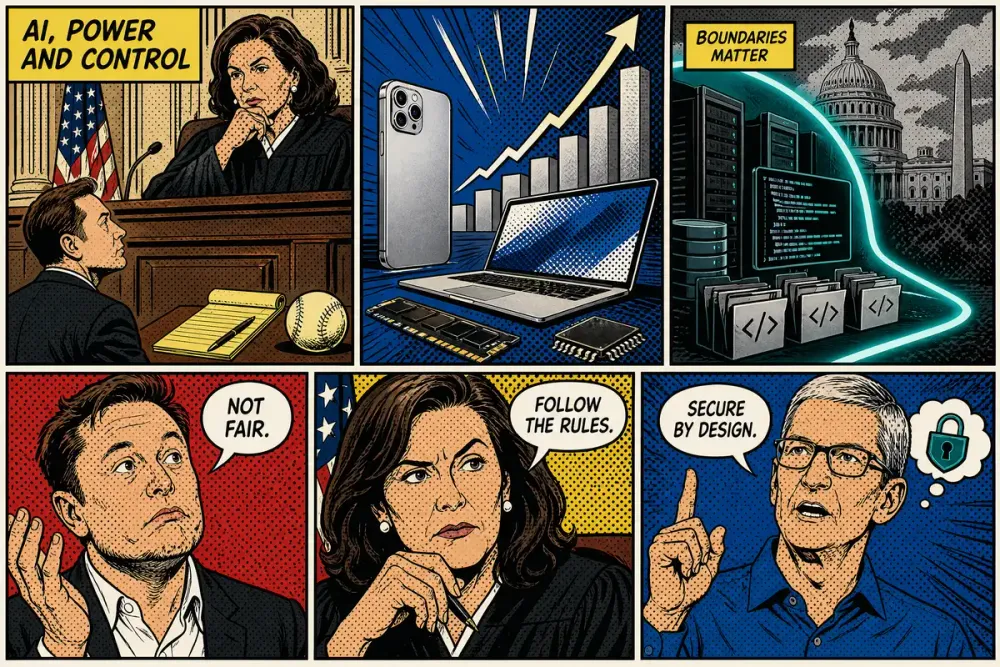
San Francisco | Friday, May 1, 2026
Musk's courtroom problem keeps getting smaller. A soft ball, a yellow legal pad, a witness trying to object, and one judge rationing apocalypse talk did more work than the grand speeches. OpenAI now has a cleaner line: the accuser is running in the same race.
Apple gives the issue a hardware counterweight. Revenue hit $111.2 billion, iPhone 17 set a March record, and Cook forecast 14% to 17% June growth. The catch is supply: chips, Macs, and memory costs are already pressing on Ternus.
Anthropic turns defense into product with Claude Security, but Mythos stays political. The enterprise beta scans code and routes fixes into Claude Code while Washington argues over access to stronger cyber models.
Stay curious,
Marcus Schuler
Know someone drowning in AI noise? Forward this briefing. They can subscribe free here.
Five Strange Scenes From Musk v. Altman
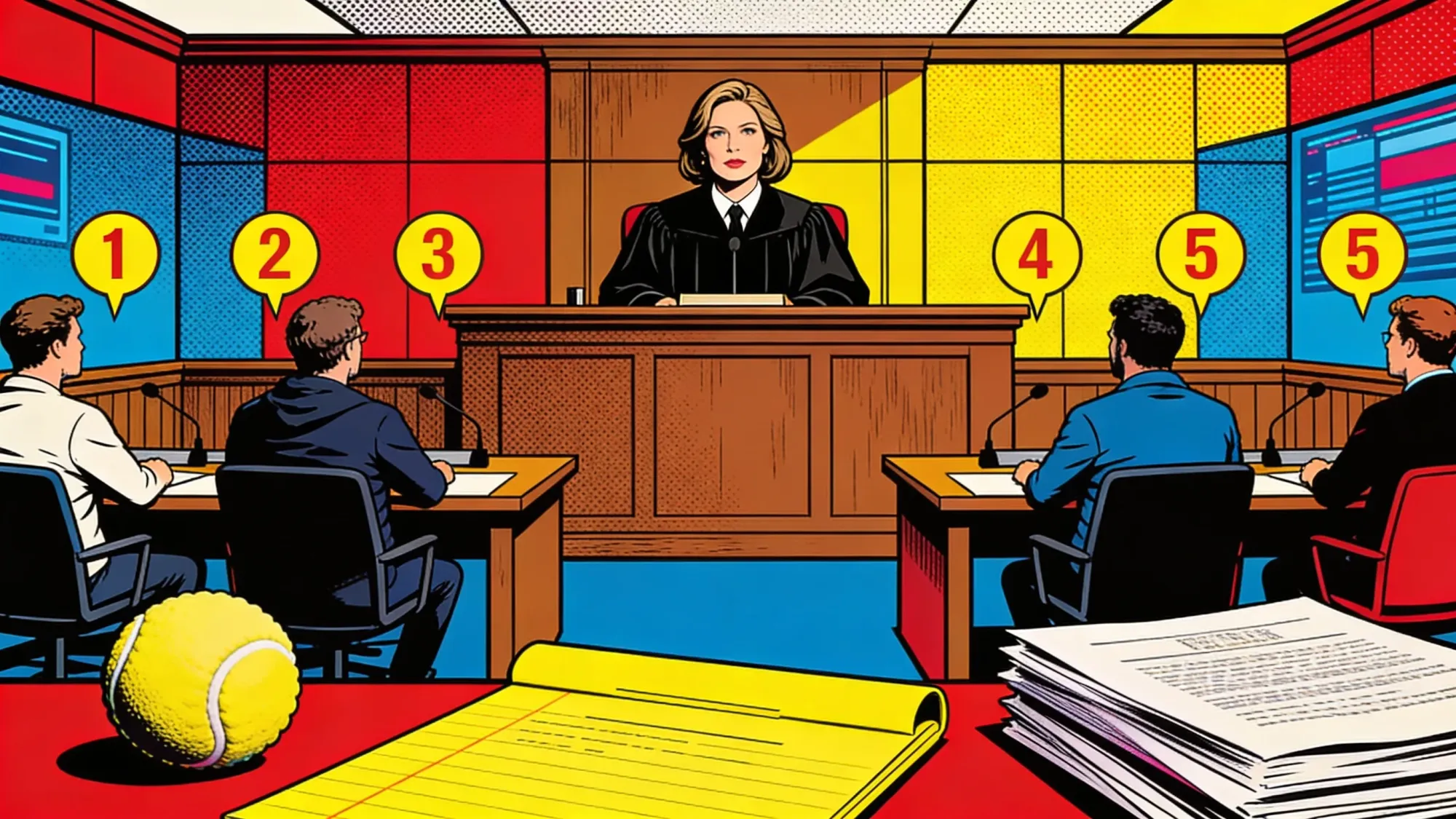
The first week did not make the AI industry's origin myth larger. It shrank it into objects, objections and paperwork.
Musk v. Altman began as a fight over OpenAI's soul. By Thursday, Judge Yvonne Gonzalez Rogers was steering the room back to charitable trust, control and documents. Extinction talk had to wait its turn.
William Savitt, OpenAI's lead lawyer, then walked Musk through old emails, deposition answers, tax questions and funding promises. Musk did not stay in witness mode. He objected to leading questions from the stand. Rogers reminded him he was not a lawyer. Musk replied that he had taken "Law 101."
The cleanest moment came when xAI became the exhibit. Asked whether xAI had used OpenAI models, Musk answered: "Partly." Later, Jared Birchall's testimony pulled the Musk-backed $97.4 billion bid for OpenAI's assets back into the room.
Why This Matters:
- The case keeps translating Silicon Valley's moral language into emails, bids and founder-control documents.
- OpenAI wants jurors to see not only a donor grievance, but a rival's market fight.
Reality Check
What's confirmed: Rogers limited extinction-risk testimony, Musk said xAI had partly used OpenAI models, and Birchall testified about donations.
What's implied (not proven): The week helped OpenAI frame the case as a control fight, not only a charity betrayal.
What could go wrong: A messy record may still give both sides enough fragments to claim victory.
What to watch next: Whether Monday's testimony brings the apocalypse back with proper foundation.
The One Number
114% - Intel's April stock gain, the best month in its Nasdaq history and far above its previous monthly record. The rally says investors are no longer merely rewarding cost cuts; they are pricing a foundry, packaging and AI-CPU comeback before Intel has fully delivered it.
Source: CNBC, April 30, 2026
Apple Forecasts 14% to 17% June Growth After iPhone Record

Apple's quarter looked cleaner than its AI story. The next test is whether the hardware cushion buys enough time.
Apple reported $111.2 billion in March-quarter revenue, up 17%, and forecast 14% to 17% growth for June. iPhone sales rose 22% to $56.99 billion after iPhone 17 set a March-quarter record.
The problem is supply, not demand. Cook said advanced-node processor supply limited iPhone shipments, and MacBook Neo, Mac mini and Mac Studio constraints will continue into the current quarter. Apple also warned that higher memory costs will pressure margins.
That gives John Ternus a cleaner handoff when he replaces Cook as CEO on Sept. 1, but not an easy one. WWDC now has to turn the Siri plan into something investors can see.
Why This Matters:
- Strong iPhone demand gives Apple cover while it tries to repair the AI product story.
- Memory and Mac constraints show the AI hardware squeeze is reaching consumer devices.

AI Image of the Day

Prompt: Cinematic fantasy illustration, a crazy gnome scientist rides a self built jury rigged steam powered road roller, patched brass boiler, rattling pistons, spinning gears, leaking valves blasting white steam, soot stained paint and warning runes, the gnome sits high on a crooked metal seat with huge goggles, wild hair, manic grin and loud laughter. The heavy roller thunders through a meadow path and crushes mushrooms and flowers, sparks and steam trailing behind. in front of the heavy roller small glowing nude fairies flee ahead in panic, wings a blur, leaving trails of glittering dust, some darting between tall grass and ferns. Warm sunset light mixed with cold steam haze, dramatic motion blur on the roller, sharp focus on the gnome face, wide angle low tracking POV, high contrast, ultra detailed metal textures and steam, whimsical but dangerous tone, high resolution, masterpiece quality.
Anthropic Opens Claude Security Beta as Mythos Fight Deepens

Anthropic is turning defensive security into a commercial product while its strongest cyber model stays behind a political gate.
Claude Security is now in public beta for Claude Enterprise customers. The product scans repositories, validates findings, exports audit material and sends patch work into Claude Code.
The launch lands as Washington scrutinizes Anthropic's separate Mythos access plan. White House officials opposed an expansion to roughly 120 organizations, while draft national-security AI rules push agencies toward multiple vendors and tighter contract language.
The split matters. Claude Security gives enterprise buyers a supervised vulnerability workflow. Mythos remains the restricted capability everyone in government wants to control first.
Why This Matters:
- Cyber models are moving from research preview to enterprise budget line.
- Anthropic now has to sell defensive access while proving stronger tools stay governed.

🧰 AI Toolbox

How to Compose Studio-Quality Songs from a Text Prompt with Flow Music
Flow Music is Google's generative AI instrument for creating, remixing and sharing full songs from simple prompts. Pick a genre, mood, tempo and instrumentation, and Flow Music generates a layered track you can shape interactively, swapping an instrument or shifting the mood without starting over. Built on Google DeepMind's Lyria 3 model, which understands rhythm, arrangement and time-aligned lyrics. Share tracks with a single link.
Tutorial:
- Go to Flow Music and sign in with a Google account.
- Describe the song you want in plain English: "Upbeat indie pop with acoustic guitar and vocals, 120 BPM, feel-good mood."
- Pick genre, mood, tempo and instrumentation from the controls to refine the generation.
- Listen to the full track generated by Lyria 3, then remix it by swapping an instrument or shifting mood.
- Add time-aligned lyrics and regenerate the vocal track to match.
- Loop and extend sections to build a longer arrangement without losing coherence.
- Share the track with a link or download the audio file for your own project.
URL: Flow Music
What To Watch Next (24-72 hours)
|
||
|
||
|
💡 5-Minute Skill
Turn a No-Sleep Adderall Mistake Into a Workday Triage Plan
It is 7:18 a.m. You slept maybe 45 minutes after taking Adderall too late. You work in finance, the sprint-cost review starts at 11, and you do not want one tired decimal to become Monday's incident report. Open Claude and make the day about error cost, not heroics.
Your raw input:
I slept maybe 45 minutes after taking 20 mg Adderall too late yesterday. I work in finance, not engineering, but the last three days were a heavy software sprint and I need to be in the office today. Tasks: budget variance review, 11 a.m. sprint-cost check-in, 2 p.m. vendor call, month-end cleanup. Symptoms: wired, tired, dry mouth, anxious, no appetite, hands slightly shaky. I can postpone one thing, not everything.
The prompt:
Act like a calm chief of staff. Give me a realistic workday survival plan that does not involve taking more Adderall. Output: first 30 minutes, safe work, what to postpone, what to tell my manager, caffeine/food/hydration rules, and symptoms that mean I stop working and call a doctor. Keep it blunt and useful.
The output:
Water, salty food, no extra stimulant, and no driving if you feel impaired. Safe work: read-only review, agenda prep, notes and cleanup. Risky work: approvals, final numbers, vendor commitments. Move the vendor call if possible. Tell your manager you slept badly and want a second set of eyes before anything goes out. One normal coffee. Stop and call a doctor for chest pain, faintness, confusion, severe panic or a racing heart that does not settle.
Why this works:
The trick is asking AI to sort the day by error cost. A tired brain can still collect facts. It should not approve spend.
What to use:
Claude. It keeps the tone closer to office realism than clinic handout.
📖 AI Alphabet
|
T
|
📖 AI Alphabet Transformer A transformer is the neural network architecture behind most modern language models. Its key strength is handling relationships between many pieces of information at once through attention. |
AI & Tech News
Alphabet Rallies as Meta Pays the AI Bill
Alphabet's stock rose 10% Thursday and closed April up 34%, CNBC reported. Meta fell 8.5% the same day, which shows the AI capex trade is splitting between companies that can show cloud upside and companies still asking investors to wait.
Meta Layoff Questions Keep Coming
Meta's HR chief told employees she could not rule out further cuts as the company prepares a 10% workforce reduction, Business Insider reported. Zuckerberg says AI automation is not the main driver, but the timing keeps the question alive.
Senators Move to Wall Off Prediction Markets
Sens. Kirsten Gillibrand and Dave McCormick introduced a bill to ban federal officials from trading on prediction markets, Politico reported. The proposal follows concern that officials with nonpublic information could turn military, policy or election events into trades.
Western Digital Beats as AI Storage Demand Rises
Western Digital reported fiscal Q3 revenue of $3.34 billion, up 45% from a year earlier, Reuters reported. The company also forecast quarterly revenue above estimates, but the after-hours drop showed storage investors want cleaner proof that AI demand can keep compounding.
China's EV Fight Moves From Price to AI Features
Chinese automakers are shifting from discount battles to AI cockpit features, CNBC reported. ByteDance says its Doubao assistant now powers more than 7 million vehicles across 145 models, putting consumer AI directly inside the dashboard fight.
CopyFail Linux Bug Triggers Patch Scramble
Researchers disclosed a severe Linux privilege-escalation flaw called CopyFail, Ars Technica reported. The bug lets unprivileged users gain root access, and public exploit code raises the pressure on distributions that have not yet shipped fixes.
Huawei Expects AI Chip Revenue to Hit $12 Billion
Huawei expects AI chip revenue to reach about $12 billion in 2026, the Financial Times reported. Demand for the Ascend 950PR shows China's domestic AI stack is becoming a revenue story, not only a sanctions workaround.
AI Executives Admit the Labor Plan Is Thin
AI industry workers privately expect broad job disruption from the AGI push, Jasmine Sun wrote in The New York Times. The uncomfortable point is not that executives see the risk. It is that the mitigation plan still looks smaller than the deployment plan.
SanDisk Beat Fails to Extend Stock Rally
SanDisk reported a large earnings beat, but shares still slipped after hours, MarketWatch reported. The consumer segment miss mattered because investors are trying to separate durable AI storage demand from one more hardware stock that already ran ahead.
Nebius Buys Eigen AI for Faster Inference
Nebius agreed to buy Eigen AI for $615 million in stock and cash, Bloomberg reported. The deal gives the cloud provider technology meant to make inference faster and cheaper on existing silicon, where AI economics increasingly get decided.
🚀 AI Profiles: The Companies Defining Tomorrow
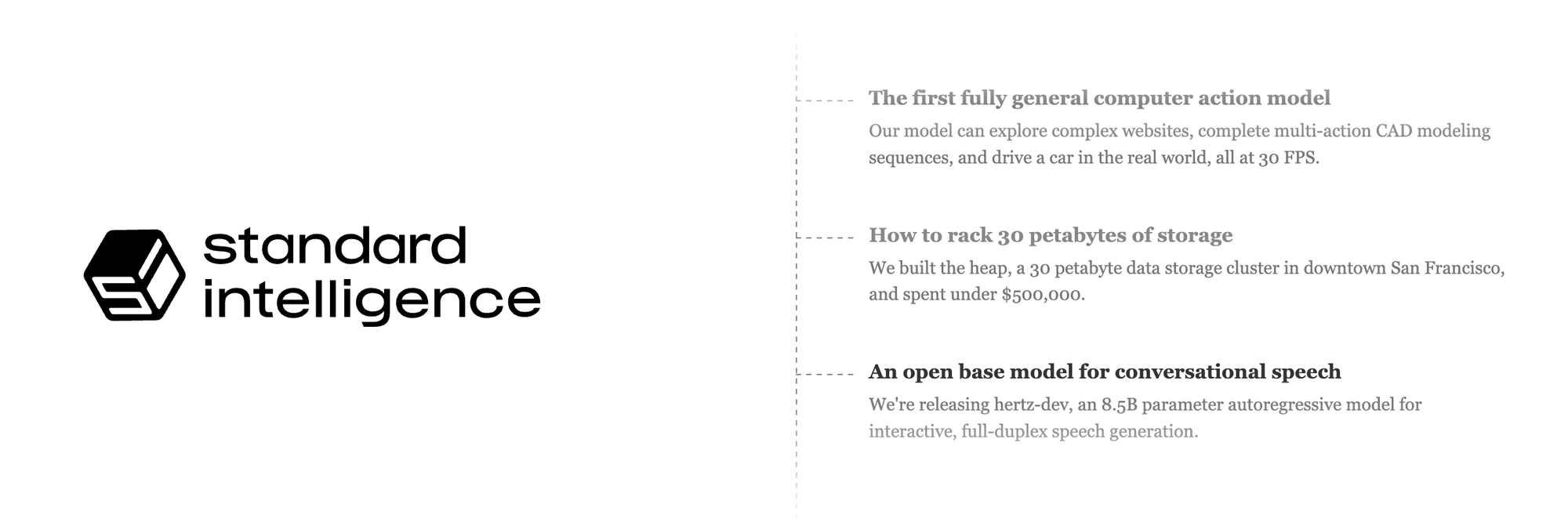
Standard Intelligence is a six-person San Francisco AI lab trying to make agents learn by exploring computer environments, not by waiting for humans to label the next dataset. The company just raised $75 million from Sequoia and Spark Capital to scale its FDM model series, after early FDM-1 results moved computer use from a data bottleneck to a compute bottleneck.
Founders
The company is keeping the spotlight on the lab rather than on founder mythology. Its fundraising note is signed by the Standard Intelligence team and says the company has six people in San Francisco. The outside signal is the cap table: Sequoia's Sonya Huang, Spark's Mikowai Ashwill and Yasmin Razavi, plus angels and advisors including Milan Kovac, Stanley Druckenmiller and Andrej Karpathy.
Product
Standard Intelligence is building the FDM model series for agentic computer use. The core idea is video pretraining: train models on how software behaves over time, then let them explore and build skills in new environments. The claim is ambitious: a path to superhuman performance on general computer tasks, in the same broad sense that current language models have already become superhuman at many coding tasks.
Competition
The near-term fight is against every lab trying to make computer-use agents reliable: OpenAI, Anthropic, Google DeepMind, Adept-style agent startups, and the browser-agent layer forming around enterprise workflows. Standard Intelligence's wedge is not another chat interface. It is the bet that video-trained general learners can escape the brittle script-following behavior that still makes many agents feel impressive for five minutes and expensive by Friday.
Financing 💰
$75 million in new funding from Sequoia and Spark Capital. The company says the round gives it several orders of magnitude more compute for FDM scaling and enough room to fund blue-sky alignment research for general learners. Source: Standard Intelligence fundraising update, April 29, 2026.
Future ⭐⭐⭐
This is the kind of company investors fund before the nouns are stable. The technical premise is big, the team is tiny, and the output is still research-heavy. If FDM models make computer use scale with compute rather than hand-built data, Standard Intelligence becomes a serious agent lab. If not, it becomes another expensive proof that "general computer tasks" are where demos go to learn humility.
🤨 Yeah, But...
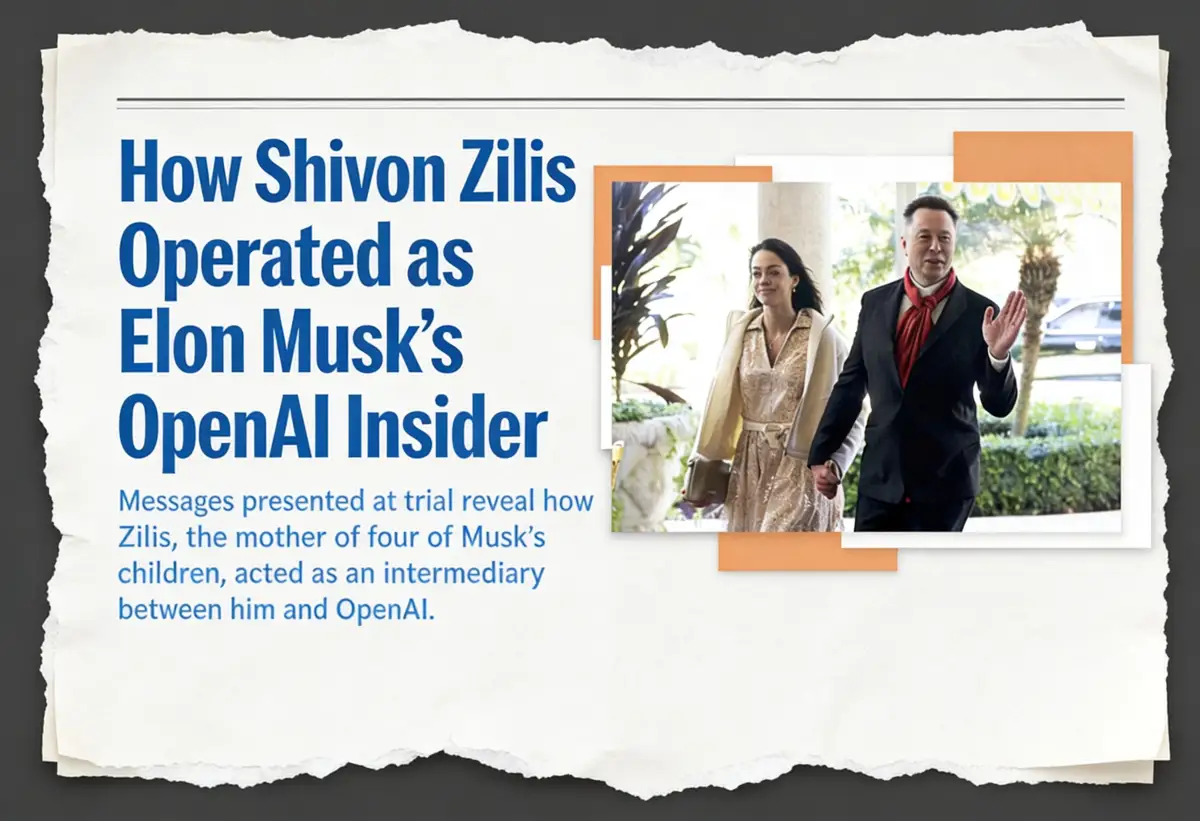
WIRED reported Thursday that trial messages in Musk v. Altman show Shivon Zilis acting as a backchannel between Elon Musk and OpenAI, advising Musk on whether to stay "close and friendly" while also counseling Sam Altman on how to handle Musk. Musk spent the week telling jurors OpenAI stole a charity; the exhibits made early OpenAI look more like a group chat with governance paperwork.
Our take: Musk's case is supposed to be about corporate structure. The funniest witness so far is the informal one: the relationship spreadsheet. Zilis appears in the record as adviser, board member, liaison, confidante, executive and family member, which is less an org chart than a Silicon Valley seating plan. Everyone wanted OpenAI to save humanity. Everyone also wanted updates, control, talent, money and someone to text before replying. The scandal is not that OpenAI became a company. It is that it first operated like a founder house where HR, strategy, romance and AGI risk all used the same kitchen.
Free AI briefing · Weekdays
The AI stories that matter, sourced and explained.
Join the Morning Briefing. It goes out every weekday at 4:45 a.m. Pacific, with later sends for the East Coast, Berlin and Tokyo.
Free when you sign up: The Paperclip Compendium, our tested guide to running AI agents.
Free. Unsubscribe in one click.

Marcus Schuler
Editor-in-Chief and founder of Implicator.ai. Former ARD correspondent and senior broadcast journalist with 10+ years covering tech. Writes daily briefings on policy and market developments. Based in San Francisco. E-mail: editor@implicator.ai