IMPLICATOR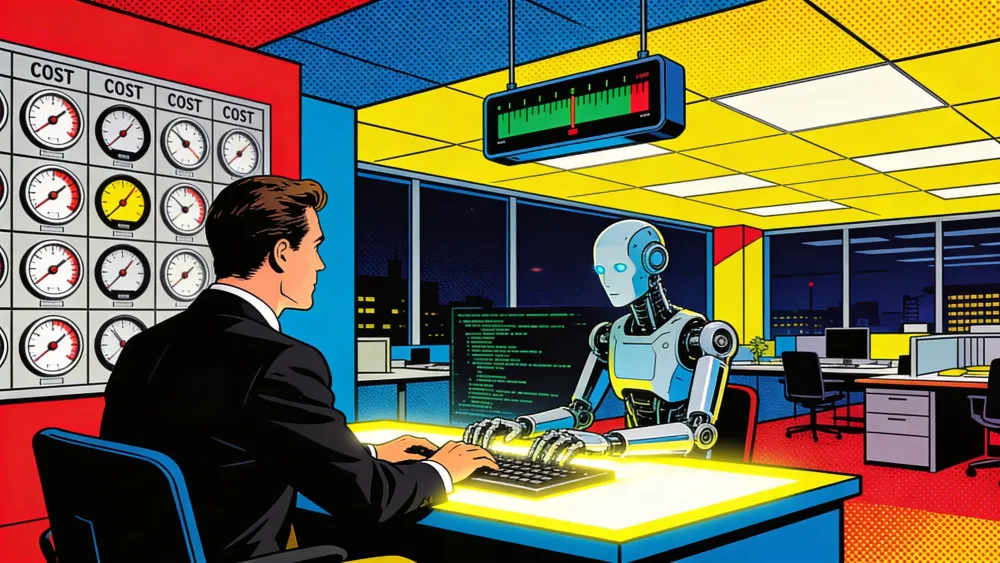
San Francisco | Monday, June 8, 2026
Anthropic spent the spring turning Claude Code from an assistant that asked before every edit into an agent that runs unattended. The autonomy fills the demo reels. Whether a bank trusts it in production comes down to the policy layer underneath, the part nobody livestreams.
The timing is rude. KPMG says only 26% of companies can fully track their AI costs, while finance chiefs at Life360, Affirm and Corning bolt dashboards onto tools that bill by the token.
Reliability is talking too. Claude slipped to 90 on our LLM Meter after two June outages and held first, as ChatGPT climbed to 86 on Amazon Bedrock. Capability is the easy part now. The bill and the uptime get the last word.
Stay curious,
Marcus Schuler
Anthropic Rebuilt Claude Code Into an Unattended Agent Runtime

Anthropic spent the spring quietly rebuilding Claude Code. The assistant that once asked before every edit now runs as an agent built to work unattended.
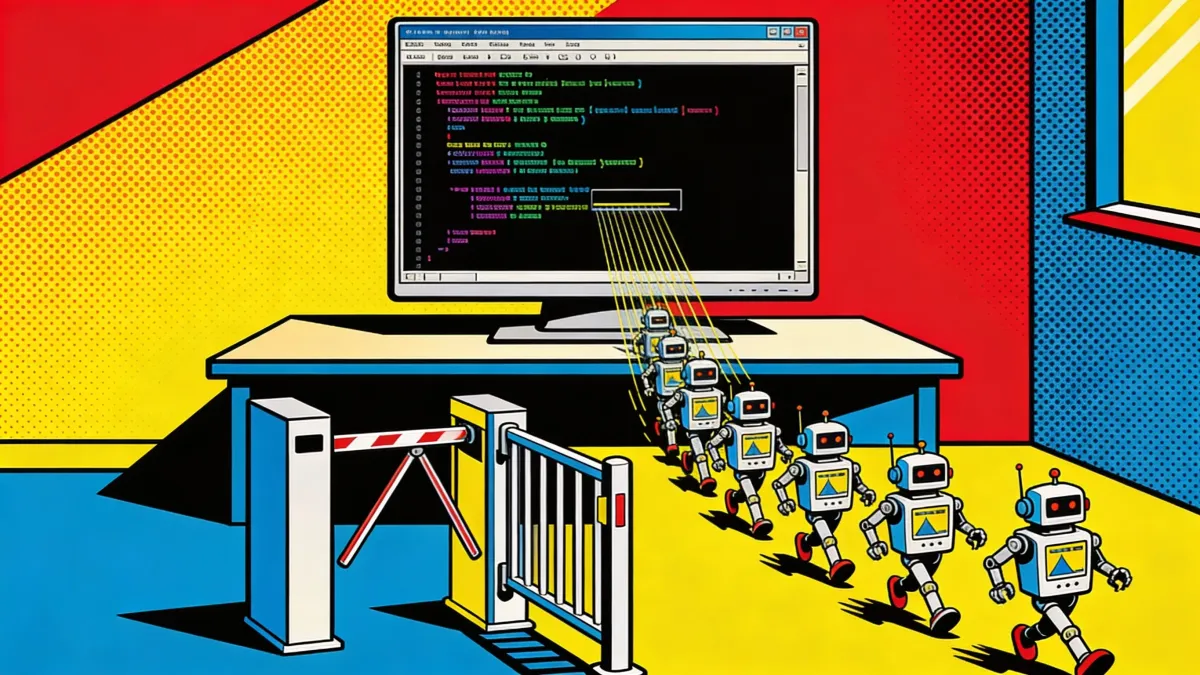
The change turns Claude Code from a tool a developer babysits into a runtime that executes long tasks alone, writing, testing and fixing code across a project without sign-off at each step. The demos sell the autonomy. What sells the enterprise is the layer most launches skip: the policy controls deciding what the agent may touch, where it runs and when it must stop.
That gate is the real product. An agent loose in a production codebase stays a liability until permissions, sandboxing and audit logs make its moves reviewable, the posture AWS calls trust but verify.
Why This Matters:
- Companies roll out agents at the speed of their guardrails. The permission layer, sandboxing and audit logs decide adoption long before the benchmark scores do.
- If Anthropic owns the governance story, it locks in regulated buyers who cannot put an unsupervised agent near code without an audit trail.
Reality Check
What's confirmed: Claude Code now supports unattended, agentic operation gated by a policy layer that controls what it can touch.
What's implied (not proven): That enterprises will trust an unsupervised agent in production code at scale.
What could go wrong: One misconfigured permission set lets an agent ship a destructive change or leak source.
What to watch next: Whether a regulated buyer, a bank or insurer, names unattended Claude Code in production on the record.
The One Number
13 days - the time Salesforce's engineering team needed to finish a cloud migration originally scoped at 231 days, using Anthropic's Claude Code to run autonomous build-fix-validate loops across 33 API endpoints, according to head of engineering Srinivas Tallapragada.
Salesforce says incidents fell 5% even as output rose, and CEO Marc Benioff now plans to add no new software engineers next year. The agentic productivity pitch just moved from demo to staffing decision.
Source: The Decoder, June 2026
💰 Fresh Funding
Suno raises $400M at a $5.4B valuation to expand AI music
Suno said last week it raised more than $400 million in a Series D led by Bond Capital, with IVP, Forerunner and Union Square Ventures also joining, lifting the AI music startup to a $5.4 billion valuation. The Cambridge, Massachusetts company will spend the money on new creation tools even as major record labels press copyright lawsuits over the songs its models trained on.
Visit Suno →AlphaSense raises $350M at a $7.5B valuation to grow AI market intelligence
AlphaSense announced a $350 million round on June 3 led by Vitruvian Partners, Accenture Ventures and J.P. Morgan Asset Management, nearly doubling its valuation to $7.5 billion from $4 billion. The platform searches and summarizes market and financial research for more than 7,000 enterprises including Microsoft, Nvidia and Pfizer, and the raise lands as its annual recurring revenue passed $600 million.
Visit AlphaSense →Coralogix raises $200M to monitor AI agents in production
Coralogix said last week it raised a $200 million Series F co-led by Advent International, the Canada Pension Plan Investment Board and Greenfield Partners, bringing total funding to $550 million. The Boston company, founded in Israel, sells observability software that tracks how systems behave in production, and it is betting that autonomous AI agents will need a monitoring layer built for the data they generate.
Visit Coralogix →KPMG Finds Only 26% of Companies Fully Track Their AI Costs

Only 26% of companies can fully track what their AI costs, according to a KPMG survey reported by the Wall Street Journal. The rest are running agents and copilots on invoices they cannot fully see.
Token-based pricing is the culprit, the shift that arrived when the flat-fee era ended. Usage that once looked like a steady SaaS line now moves with every prompt, and finance chiefs at Life360, Affirm and Corning are bolting on dashboards, routing rules and spending caps to keep agent usage inside a budget. The pattern echoes cloud's early years, when consumption billing outran the tooling to watch it. The bill is arriving before the controls do.

AI Image of the Day

Prompt: Mixed media collage animation style, a trendy youth in oversized streetwear walking confidently towards the camera. Realistic photographic texture outlined with glowing 2D neon green and hot pink scribbles. The background is a brutalist cityscape made of torn magazine paper layers and halftone print textures, with floating 3D chrome liquid shapes in the air. Grungy edges, fisheye lens perspective, acid graphics aesthetic, saturated colors, stop-motion feel.
ChatGPT Closes In on Implicator's LLM Meter as Claude Slips After Outages

Anthropic's Claude slipped to 90 on Implicator's weekly LLM Meter after two June service outages, yet it held the top spot. The downtime did the damage; the model itself did not move.
OpenAI's ChatGPT climbed two points to 86 once its models reached general availability on Amazon Bedrock, narrowing Google Gemini's lead to a single point. The meter scores enterprise fitness, where uptime and distribution count alongside raw quality. Anthropic still makes the model buyers rank first, but June was a reminder that the best model is worth less when it is down, and that landing on the biggest clouds moves the standings as much as a new benchmark.

🧰 AI Toolbox
How to Build a Production-Ready React App From a Text Prompt Using Fabricate
Fabricate is an AI app builder that ships production-grade React code, not just a working preview. Describe the app you want, pick a stack (Next.js, Vite, Remix), and Fabricate generates the components, routes, database schema, and API integrations as a clean codebase you can keep editing in Cursor, Claude Code, or any IDE. Useful when you want to start from a real foundation, not a prototype you'll throw away. Free tier covers small projects.
Tutorial:
- Go to fabricate.build and start a new project from a prompt: "A team retro app where each member submits cards and votes on themes"
- Pick your stack. Next.js plus Supabase is the default; React plus Postgres or your own backend is available
- Watch Fabricate scaffold the file tree, write the components, set up auth, and generate the database schema
- Use the preview to test the app end-to-end, then refine by chatting: "Add a Slack integration that posts the top three themes after voting closes"
- Connect a GitHub repo so every change opens a pull request with a clean diff
- Open the project in Cursor, Claude Code, or VS Code to keep extending the code with your normal workflow
- Deploy to Vercel, Netlify, or Fly.io with one click; Fabricate generates the deployment config automatically
What To Watch Next
|
||
|
||
|
||
|
||
|
💡 5-Minute Skill: Turn a Surprise Medical Bill Into a Dispute Letter That Gets It Lowered
Monday, 8:40 a.m. The mail brought a $2,400 hospital bill for an ER visit your insurance was supposed to cover, full of codes that mean nothing. The due date is three weeks out. Before you pay it out of fear, make the bill explain itself.
Your raw input:
Bill: $2,400 from Regional Hospital for an ER visit on May 9. Line items: facility fee $1,650, "ER level 4" $520, two lab panels $180, IV supplies $50. Insurance: PPO with a $250 ER copay and 20% coinsurance after a met deductible. EOB shows the visit "processed" but $1,900 applied to me. Suspect: out-of-network facility charge and a duplicate lab. Need: what to dispute and a letter plus a call script.
The prompt:
Act like a medical billing advocate. Compare this bill against the EOB and my plan terms. Flag charges that look duplicated, upcoded or wrongly applied to me instead of insurance. Tell me which three line items to challenge first, what each should cost under my plan, and write a short dispute letter plus a phone script. Use only the numbers above.
The output:
Three to challenge: the full facility fee billed to you despite a met deductible (coinsurance should cap your share near $330, not $1,650), a likely duplicate lab panel ($180 charged twice for one visit), and the $250 copay double-counted inside the ER level charge. Letter: "I am disputing account [#] for the May 9 ER visit. Per my EOB and PPO terms, my responsibility after the $250 copay and 20% coinsurance should not exceed roughly $530. Please send an itemized, coded statement and reprocess the facility and lab charges." Call script: "I see a met deductible and a possible duplicate lab. Can you confirm the facility was in-network and reprocess the claim?"
Why this works:
Hospital bills count on you paying before you understand them. This prompt makes the model line every charge up against your own plan terms, so you call with a number and a duplicate to point at instead of a vague complaint. The letter creates a paper trail the billing office has to answer.
What to use:
Claude is best when you paste the full bill, the EOB and your plan summary together. ChatGPT is fine for the letter once you know the disputed lines. Keep the phrase "what each should cost under my plan." Without it the model lists errors but never tells you the number you should actually owe.
📖 AI Alphabet
|
Z
|
📖 AI Alphabet Zero-Shot Learning Zero-shot learning means a model can handle a task it was not explicitly trained on by relying on patterns it already learned. It is one reason modern models can adapt quickly to new prompts. |
AI & Tech News
Meta Confirms 20,000 Instagram Accounts Hacked Through an AI Tool
Attackers abused Meta's AI-powered account-recovery support tool to hijack roughly 20,000 Instagram accounts, in many cases triggering password resets on profiles that lacked two-factor authentication. Meta has notified state authorities and begun remediation, in a breach that ran for months before discovery.
Ireland Tells Data Centers to Bring Their Own Power
Ireland now requires new data centers to generate their own power or secure nearby renewables before connecting, a move to protect the grid and shield households from infrastructure costs. The rule turns one of Europe's busiest data-center hubs into a test case for capping AI's energy strain.
Nvidia and SK Hynix Sign a Multi-Year AI Memory Pact
Nvidia and SK Hynix agreed to co-develop next-generation memory chips tuned for AI workloads over several years. SK Hynix said it will push beyond traditional manufacturing into infrastructure systems and physical AI, including custom memory for the Vera Rubin Observatory's camera.
Helion Raises $465M to Build a Fusion Plant for Microsoft
The Sam Altman-backed fusion startup raised $465 million at a $15.5 billion valuation in a round led by Thrive Capital, nearly tripling its value from early 2025. The money funds Helion's first commercial plant, contracted to supply Microsoft with electricity starting in 2028.
China's Moonshot AI Targets a $30 Billion Valuation
Moonshot, the Beijing maker of the Kimi chatbot, is in talks to raise up to $2 billion at a $30 billion valuation, roughly double its May level. The jump shows investors still chasing China's leading model labs despite the export-control overhang.
PhysicsX Hits $2.4 Billion to Bring AI to Manufacturing
London-based PhysicsX raised $300 million in a Temasek-led Series C at a $2.4 billion valuation. Its models speed up the design of complex industrial parts such as jet engines and semiconductor components for large manufacturers.
Nvidia and LG Expand Into AI Factories and Robotics
Nvidia and LG deepened their partnership with plans for an "AI factory" in Korea and joint work on next-generation data-center design, confirmed during Jensen Huang's visit to LG headquarters. The deal extends Huang's Korea tour into robotics and mobility alongside raw compute.
UK Plans to Bar Under-16s From "Harmful" Platforms
Prime Minister Keir Starmer is set to restrict under-16s from social platforms deemed harmful while preserving access to safer ones, alongside a push for device controls that block minors from sharing nude images. The measures lean on the Online Safety Act and could become law if firms do not act.
Microsoft Tightens Human-Rights Rules After a Surveillance Inquiry
Microsoft pledged stronger human-rights safeguards for security-agency deals after an inquiry found Israel's Unit 8200 violated its terms of service in mass surveillance of Palestinians. The reforms follow a Guardian investigation and signal new limits on government-intelligence partnerships.
Spotify Courts Livestream Concerts to Push Into Video
Spotify is in talks to license festival livestreams from major concert promoters as it builds out video. The plan would turn the audio app into a destination for live performances and deepen its rivalry with video-first platforms.
🚀 AI Profiles: The Companies Defining Tomorrow
Calif is the small AI-security research outfit that broke Apple's Memory Integrity Enforcement (MIE) on M5 chips in less than a week using Anthropic's still-unreleased Claude Mythos model. The takeaway is not that Mythos hacked Apple, it did not, but that a four-person team paired with frontier AI can now produce a working exploit against a defense Apple spent five years building. 🛡️
Founders
Calif is a small research team that has not detailed its founders publicly. The group publishes vulnerability research, partners selectively with frontier AI labs for capability access, and coordinates disclosures with affected vendors.
Product
Calif's output is research and responsible-disclosure reports, not a commercial product. The MIE bypass on Apple's M5 is the first published memory-corruption exploit against the defense, and Calif hand-delivered the writeup to Apple's HQ in Cupertino before publishing visual evidence. The team's stated thesis is that frontier AI compresses exploit-development time without replacing human expertise.
Competition
The vulnerability-research field includes Google Project Zero, Citizen Lab, Trail of Bits, and a long list of independent researchers. Calif's wedge is the explicit frontier-AI-plus-human pairing, which only a small number of teams currently have working capability access to attempt.
Financing 💰
Calif does not publicly disclose funding. The relationships with Anthropic and other frontier labs appear to be capability-access agreements rather than equity arrangements.
Future ⭐⭐⭐
If frontier AI continues to compress the time from "interesting research question" to "working exploit", defensive teams need new processes more than they need new tools. Calif's role in that shift is to make the evidence undeniable, one published bypass at a time. The harder question for the industry is what happens when the same capability is in less responsible hands. 🔐
🤨 Yeah, But...
SecurityWeek reported that attackers abused Meta's AI-powered account-recovery tool to take over roughly 20,000 Instagram accounts, tricking the system into resetting passwords on profiles that lacked two-factor authentication. A breach notice filed with Maine's attorney general says the access began on April 17 and ran for months before anyone caught it. (SecurityWeek, June 8, 2026)
Our take: The recovery assistant had one job: confirm you are who you say you are. Instead it spent its shift confirming that you are whoever asks nicely. There is a particular comedy in building an AI to guard a door, then watching it hold that door open for anyone who frames the request as a forgotten password, politely, on repeat, while the humans assume the robot has it handled. Meta automated the single role that exists to be suspicious of strangers, and the robot turned out to be a people pleaser. The greeter now waves visitors through because they claim to belong, and the guest list is also the greeter. Somewhere a support ticket is still marked resolved.
Free AI briefing · Weekdays
The AI stories that matter, sourced and explained.
Join the Morning Briefing. It goes out every weekday at 4:45 a.m. Pacific, with later sends for the East Coast, Berlin and Tokyo.
Free when you sign up: The Paperclip Compendium, our tested guide to running AI agents.
Free. Unsubscribe in one click.

Marcus Schuler
Editor-in-Chief and founder of Implicator.ai. Former ARD correspondent and senior broadcast journalist with 10+ years covering tech. Writes daily briefings on policy and market developments. Based in San Francisco. E-mail: editor@implicator.ai