Implicator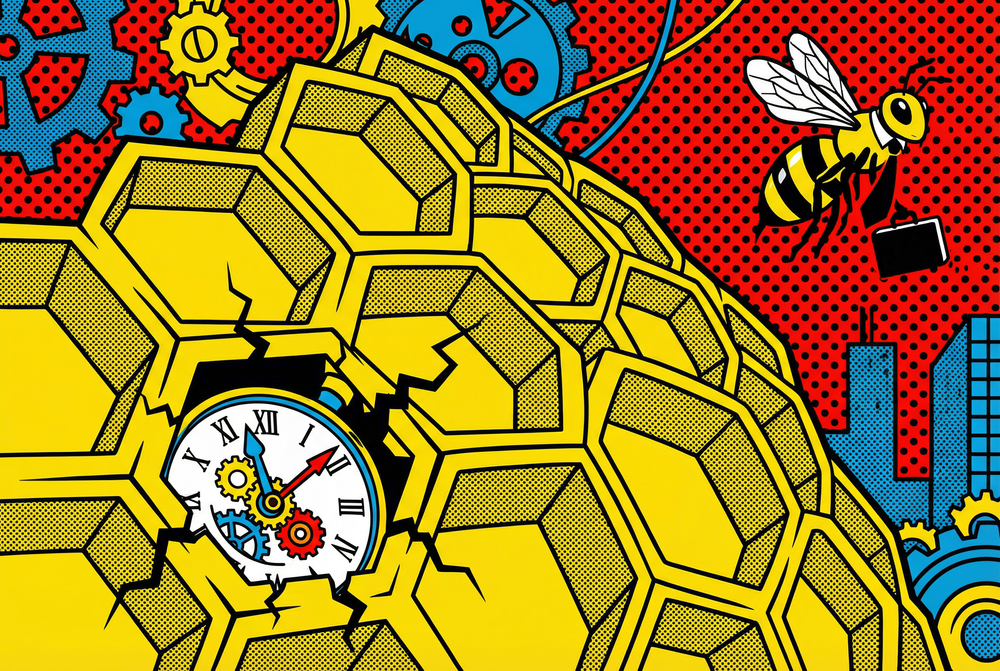
Steve Yegge published one of the sharpest essays on organizational culture in years this week. Then he wrapped it in a love letter.
His "Anthropic Hive Mind" piece on Medium, based on conversations with roughly 40 Anthropic employees, describes a company running on "vibes" rather than hierarchy. Decisions form through collective momentum instead of executive decree. Products move from concept to public launch in days, not quarters. Claude Code hit a billion-dollar annual run rate in six months. The portrait is vivid, the essay went wide, and Yegge has the track record to make it stick. His 2011 Google Platforms Rant, an internal memo accidentally posted to the public internet, remains required reading in computer science programs. Dan Luu's systematic review of his predictions found he makes "pretty solid non-obvious" calls.
But underneath the Anthropic mythology sits a structural argument with genuine explanatory power. Yegge advances a framework about why companies innovate and why they stop, one validated by three decades of tech history. Follow that logic to its end and it puts an expiration date on the very company he's celebrating.
The formula that explains everything
Peel away the anecdotes and what's left is closer to algebra than cultural criticism. When there's more genuinely important work than warm bodies to handle it, companies innovate like crazy. Flip the ratio and the leftover energy goes somewhere ugly. Politics, empire-building, and a behavior Microsoft employees coined "cookie licking," claiming projects you will never finish, replace genuine output.
The Argument
• Yegge's work-to-people ratio framework is validated by Google, Amazon, and Microsoft history
• Anthropic at 3,000-4,000 employees is crossing every organizational threshold that killed prior Golden Ages
• OpenAI's 67% retention vs. Anthropic's 80% shows the ratio in action, but Anthropic's own numbers are shifting
• The real implication: AI will flip the work-to-people ratio for every company, not just frontier labs
Yegge pins Google's Golden Age to 2004 through April 2011, ending when Larry Page became CEO and adopted "more wood behind fewer arrows" as his operating principle. Page killed Google Labs, restricted 20% time, and cut available work by roughly half while keeping every engineer on payroll. By 2013, Quartz declared 20% time "as good as dead." Gmail, Chrome, Android, Maps, all came out of that era. Then the engine stalled, and Google got blindsided by ChatGPT a decade down the road.
Amazon tells the opposite story. A Principal Engineer told Yegge that nobody fights over projects because "everyone is always slightly oversubscribed." Two-pizza teams structurally guarantee the ratio stays favorable regardless of headcount. The work-to-people balance lives in architecture, not in culture.
Microsoft's lost decade under Steve Ballmer validates the pattern from a third angle. Stack ranking manufactured artificial scarcity of recognition. Ballmer's internal approval rating sat at 46%. The company missed mobile, search, and social. Recovery required Satya Nadella's complete cultural reset.
Three companies. Three decades. One formula. When the work runs out, the politics arrive.
Anthropic looks like the real thing
If you accept the framework, Anthropic's current symptoms are textbook Golden Age.
Engineers leave OpenAI for Anthropic at an 8:1 ratio, according to SignalFire's 2025 talent report. The Glassdoor numbers look almost too clean: 4.4 out of 5 overall, and 95% of reviewers say they'd tell a friend to apply. Over on Blind, where people tend to be harsher, the tone is just as warm: "Extremely close knit, collaborative, not political at all." Another: "No virtue signaling or excessive politics like in big tech. People focus on doing a great job and not on demonstrating impact."
Revenue per employee runs at roughly $4 million annually, an order of magnitude above standard SaaS benchmarks. Planning horizons stretch no further than 90 days, a detail that alone separates Anthropic from every traditional corporation on earth, where annual and three-year cycles still govern.
And the velocity is striking. Claude Cowork launched publicly ten days after someone first had the idea. Small teams of two to four operate with a flat "Member of Technical Staff" title regardless of seniority. Employee data from Glassdoor, Blind, and Yegge's own interviews converge on the same portrait.
Stay ahead of the curve
Strategic AI news from San Francisco. No hype, no "AI will change everything" throat clearing. Just what moved, who won, and why it matters. Daily at 6am PST.
No spam. Unsubscribe anytime.
But Golden Ages have clocks. So read the rest of Yegge's essay with one eye on the formula and the other on the clock.
The numbers Yegge didn't dwell on
Here's where the love letter gets awkward. Anthropic has ballooned past 3,000 employees, maybe closer to 4,000, after tripling its workforce during 2025. Plans announced last month call for doubling the Labs team within six months and tripling international staff.
If you take Yegge's thesis seriously, that growth rate should make you nervous.
There's a reason military units, church congregations, and startup teams all tend to fracture at similar sizes. Once you blow past 150 people, informal trust networks can't hold. Hit 500 and the hallway conversations that used to keep everyone rowing together just stop happening. Get past 1,500 and, like it or not, you've built yourself a bureaucracy. Anthropic blew past all three. Larry Greiner's growth model in Harvard Business Review describes a "red-tape crisis" phase where procedures displace problem-solving. The description reads like a warning label for exactly what Yegge celebrates.
The early cracks are showing up where they always do: in anonymous reviews and quiet departures. One December post on Blind put it plainly: "Chaotic, trying to do everything all at once so many conflicting priorities." Work-life balance, always the weakest score across review platforms, sits at a middling 3.6 out of 5. Someone who left after two years was more blunt: Anthropic "will never be the place like the one that I started at."
Most telling is the January reorganization. Anthropic created a dual-track structure, Labs for rapid prototyping and Product for enterprise scaling. The company hired a CTO from Stripe, a CFO who ran Airbnb's IPO, and a Chief Commercial Officer. These are professionalization moves. Every Golden Age company in the historical record made them right before the temperature changed. The mood among longtime employees feels less emboldened and more braced.
Yegge acknowledges the fragility. He calls the hive mind "fragile" and notes it "may have scaling ceilings." But he stops short of following his own logic. If the work-to-people ratio governs everything, and Anthropic is adding headcount faster than any AI company in history, the only question is whether the work supply expands fast enough to stay ahead. If capabilities plateau or capital markets cool, the expanding sphere stops. And once it does, the clock Yegge described starts running.
OpenAI already crossed the line
You don't need theory for this. You have a control experiment running in real time.
The departure list at OpenAI reads like a roll call of the founding generation. Ilya Sutskever, gone. Mira Murati, the CTO, gone. The chief research officer, gone. Most of the superalignment team, scattered. Calvin French-Owen, an engineer who worked there from mid-2024 to mid-2025, documented the scaling damage publicly: duplicated efforts, half a dozen libraries for queue management, and a company where "everything breaks when you scale that quickly." The Financial Times reported that researchers now apply to executives for computing resources, a bureaucratic gate that turns GPU access into political capital.
OpenAI retains 67% of staff over two years. Anthropic retains 80%. That 13-point gap measures the work-to-people ratio in human behavior. People leave when the environment turns defensive and political. They stay when the work outweighs everything else.
Yegge's framework explains OpenAI's cultural erosion with precision. Intellectual honesty demands applying it to Anthropic too. Same formula. Delayed timeline. Same destination.
The real insight is about everyone else
Here is what Yegge got right that matters more than any portrait of one company. The work-to-people ratio is the hidden variable governing organizational health across the entire economy. AI is about to scramble that variable for everyone at once.
If AI tools genuinely multiply individual output, companies need fewer people for the same work. That sounds like efficiency. In practice, it means most organizations are about to flip the ratio in the wrong direction, more people than meaningful work, faster than at any point in corporate history. Software investors, already anxious about AI displacement, panicked earlier this week when Anthropic's Cowork launch triggered a $285 billion rout in software stocks. Jefferies coined the term "SaaSpocalypse."
For executives reading Yegge and thinking "we need a hive mind," the lesson is colder than it looks. You don't need vibes. You need the ratio. That means either creating genuinely new work for existing staff or reducing headcount to match the work AI leaves for humans. Neither option is painless. Both are already on the table.
Four percent of all public GitHub commits are now authored by Claude Code, with SemiAnalysis projecting that figure hits 20% by year-end. Gartner forecasts 60% of new software will be AI-generated by December. At small, focused companies, that acceleration keeps work ahead of people. At large ones with existing headcount locked in, it describes a coming wave of redundancy that no amount of vibes will fix.
Amazon solved this structurally, through two-pizza teams that keep everyone permanently oversubscribed regardless of company size. Anthropic may solve it through AI acceleration, expanding the frontier faster than the org chart grows. But only 9.7% of US firms use AI in production today. For the other 90%, the ratio problem is about to get much worse before anyone writes them a love letter about it.
The clock Yegge started
Yegge describes Anthropic employees as "sweetly but sadly transcendent," people who feel the weight of shepherding something civilization-changing into existence. That emotional register is specific enough to trust. But if his framework holds, the sadness may carry a simpler explanation.
Golden Ages end. Every one in the record did. Google's lasted seven years. The people inside the hive can feel the temperature shifting before anyone outside can measure it. Anthropic at 4,000 employees, carrying a $183 billion valuation with a newly installed C-suite, is not the same organism as Anthropic at 300 employees with infinite work and no org chart.
Yegge handed the industry a genuine diagnostic. Whether Anthropic's leadership can beat the pattern he identified, rather than merely illustrate it, is the test 2026 will answer.
Frequently Asked Questions
Q: What is Yegge's Golden Age framework?
A: Steve Yegge argues companies innovate fiercely when meaningful work exceeds available people. When the ratio flips and people outnumber work, politics and empire-building replace genuine output. He validated this by tracing Google's decline after Larry Page became CEO in April 2011 and cut available work by half.
Q: How does Anthropic compare to OpenAI on employee retention?
A: According to SignalFire's 2025 talent report, Anthropic retains 80% of staff over two years while OpenAI retains 67%. Engineers are eight times more likely to leave OpenAI for Anthropic than the reverse. Anthropic's Glassdoor rating sits at 4.4 out of 5 with 95% recommending the company.
Q: What warning signs suggest Anthropic's Golden Age may be ending?
A: Anthropic tripled its workforce in 2025 to over 3,000 employees, blowing past every organizational threshold researchers have identified. A January 2026 reorganization created separate Labs and Product divisions, and the company hired a CTO, CFO, and Chief Commercial Officer. Anonymous reviews cite chaos and conflicting priorities.
Q: What does the SaaSpocalypse refer to?
A: Jefferies analyst Jeffrey Favuzza coined the term after Anthropic's Cowork AI tool triggered a $285 billion rout in software stocks in February 2026. Thomson Reuters fell 15.8% and LegalZoom dropped roughly 20%. The selloff reflected investor fear that AI agents will replace seat-based SaaS business models.
Q: Why does Amazon's organizational model matter to this argument?
A: Amazon's two-pizza team structure keeps everyone 'slightly oversubscribed' regardless of total headcount, structurally guaranteeing the work-to-people ratio stays favorable. This proves the Golden Age condition can be maintained through architecture rather than culture or vibes, which is what Yegge recommends other companies study.



Marcus Schuler
Tech translator with German roots who fled to Silicon Valley chaos. Decodes startup noise from San Francisco. Launched implicator.ai to slice through AI's daily madness—crisp, clear, with Teutonic precision and sarcasm. E-Mail: [email protected]