IMPLICATOR
San Francisco | Thursday, June 18, 2026
Coding agents now move fast enough to strain GitHub itself, which leaned on Amazon's cloud this week to absorb the traffic. The projects climbing beside the outage are not new models. They are the infrastructure going up around agents: a scanner that vets a skill before it runs with your credentials, a gateway that enforces auth and budgets.
Watch where the value goes. Once agents get cheap and fast, it moves to whatever keeps them controllable. NVIDIA's scanner flagged likely malicious intent in 5 percent of the skill bundles it studied.
Washington is running its own experiment in control, demanding Anthropic prove its Fable model cannot be jailbroken before it returns. No lab can honestly make that promise.
Stay curious,
Marcus Schuler
Five Trending Repos Show Builders Racing to Govern AI Agents
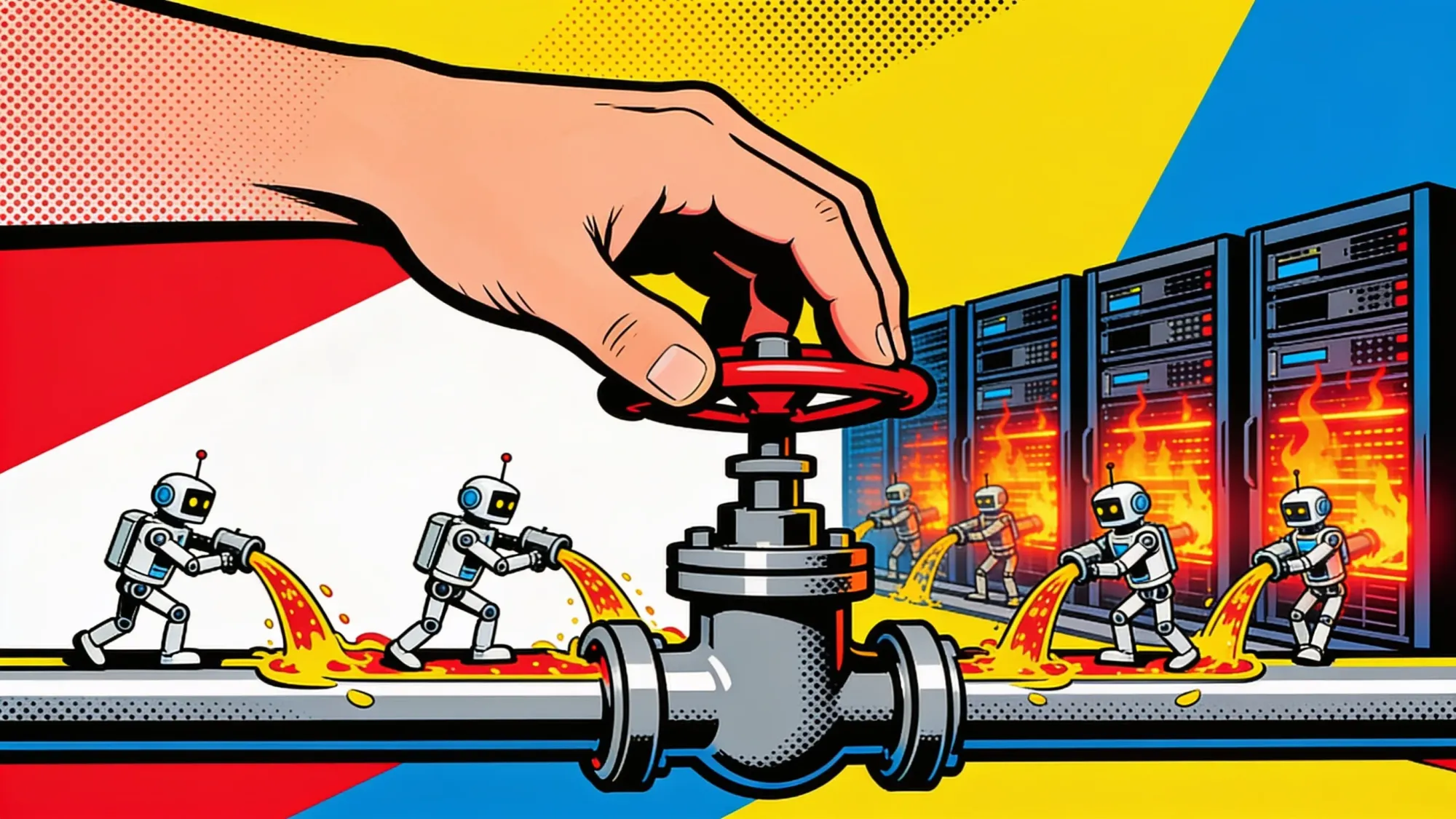
Coding agents went to machine scale this week, and GitHub felt it, leaning on Amazon's cloud to absorb the traffic. The repos climbing beside the strain are not new models. They are the infrastructure that keeps agents governable.
NVIDIA's SkillSpector, the Repo of the Week, scans an agent skill before it runs with your credentials, after the team found likely malicious intent in 5 percent of the bundles it studied. Two of the biggest climbers were skill collections that agents load and execute, so the scanner sits where the risk lives. Beside it: a local ledger for agent spend, a memory graph that slashes token costs, and a Linux Foundation gateway enforcing auth and budgets.
Why This Matters:
- The value in agentic coding is moving from the agents to the controls that make them safe to run with real credentials.
- A pre-install scanner becomes a security gate the moment third-party skills execute inside your tools.
Reality Check
What's confirmed: GitHub leaned on Amazon's cloud to absorb agentic-development traffic (Business Insider, June 16). SkillSpector's README reports vulnerabilities in 26% of the skills it studied and likely malicious intent in 5%.
What's implied (not proven): that these governance repos become standard parts of the agent stack rather than weekend experiments.
What could go wrong: static scanning misses obfuscated or runtime-only payloads, so a clean scan breeds false confidence.
What to watch next: whether skill marketplaces like addyosmani/agent-skills, now past 62,000 stars, add scanning as a default gate.

The One Number
$25 billion - what Nvidia raised in its first bond sale since 2021, the largest ever from a chip company, after orders near $85 billion ran more than three times the deal and pushed it up from a $20 billion target.
The seven tranches stretch out to 2056, yet Nvidia held about $50 billion in cash and generated as much in operating cash flow last quarter.
A company with no need to borrow is locking in 30-year debt, a bet that the AI buildout keeps demanding capital for decades.
Source: Bloomberg, June 15, 2026
💰 Fresh Funding
💰 Fresh Funding
Raises $310M: Odyssey builds AI world models with Amazon's backing
TechCrunch reported Wednesday that Odyssey, the Palo Alto world-model lab founded by self-driving veterans Oliver Cameron and Jeff Hawke, raised a $310 million Series B at a $1.45 billion valuation led by Natural Capital, with Amazon, AMD Ventures, GV and In-Q-Tel joining. AWS becomes the company's preferred cloud and will supply its Trainium chips, a bet on real-time simulated worlds that model physics rather than predict text, and the round lifts Odyssey's total funding to $337 million.
Visit Odyssey →Raises $50M: Bland scales in-house voice AI for high-stakes calls
Fortune reported Tuesday that Bland, the San Francisco startup that builds its own voice models in-house, raised a $50 million Series C led by Dell Technologies Capital, with HubSpot Ventures, Tribeca Venture Partners and Emergence Capital joining. The round pushes total funding past $100 million for a company that says it handled more than 175 million AI phone calls last year for customers including Samsara and CNO Financial Group, and it positions Bland against rivals built on third-party foundation models.
Visit Bland →Raises $27M: Pramaana builds a verification layer for regulated AI
TechCrunch reported Wednesday that Pramaana Labs raised $27 million in seed funding led by Khosla Ventures, with Accel, Nexus Venture Partners, BoldCap and Premji Invest joining. The San Francisco company, founded by IIT Madras alumni who worked at Google and DeepMind, encodes tax codes, clinical guidelines and financial rules into machine-checkable logic so an AI answer can be proved rather than merely generated, and it is starting with law, drug discovery and tax preparation.
Visit Pramaana Labs →White House Demands Unbreakable Guardrails Before Anthropic's Fable Returns

A government can pull a risky model offline. It cannot make guardrails perfect, the standard Washington now wants from Anthropic.
Commerce disabled Fable 5 and Mythos 5 on June 12 after a disputed Amazon finding, and officials signaled the models stay down until Anthropic proves the guardrails cannot be bypassed. Anthropic says the technique was narrow, involved asking the model to fix flaws in a codebase, and gave no Mythos-specific uplift.
Researchers back the point. Katie Moussouris, whom Anthropic asked to review the work, said blocking that behavior would only weaken the model for defenders who need AI to find and patch bugs. Cornell's Ayham Boucher told CNET that all models can be jailbroken.

AI Image of the Day

Prompt: Poetic street candid shot of an effortless chic supermodel, walking on modern street, slim and fit figure, LA style blank white a bit oversized T-shirt, yoga shorts, long barelegs, spontaneity captured, rollei prego 90, infrared film, strong course film grain noise, --chaos 19 --ar 3:5 --seed 831565333 --raw --profile be4uqx7 --stylize 73 --hd --v 8.1
🧰 AI Toolbox

How to Generate a Full Brand Kit From a Single Prompt With Lovart
Lovart is an AI design agent that turns one brief into a complete set of branded visuals: logos, social posts, posters, storyboards, and ad creative. Instead of describing each asset in a separate tool, you talk to it in a chat-and-canvas workspace and it produces dozens of matched, editable pieces at once. The free tier hands out daily credits with no credit card required.
Tutorial:
- Go to lovart.ai and sign in with a Google account, no credit card needed
- Open ChatCanvas and describe the project: "A brand kit for a small-batch coffee roaster, warm and minimal, with a logo, a color palette, and three Instagram posts"
- Let the agent split the brief into tasks (logo, typography, layout, social) and lay out the first batch of assets side by side on the canvas
- Click any asset and chat to refine it: "make the logo rounder", "switch the palette to earth tones", "add a price to the poster"
- Drop in a reference image or your own logo so Lovart matches an existing look instead of starting from scratch
- Generate matching formats in one pass: story, square post, banner, and print sizes from the same design
- Export the pieces you like as PNG, JPG, SVG, or PDF, or keep iterating to build out a full campaign
What To Watch Next
|
||
|
||
|
||
|
||
|
💡 5-Minute Skill: Turn a Year of Scattered Wins Into a Promotion Case Your Manager Can Forward
Wednesday, 9:20 a.m. The promotion cycle opens in two weeks and your wins are scattered across Slack, old decks and a doc you abandoned in March. Before you write a modest paragraph that undersells the year, make the model build the case.
Your raw input:
Role: senior data analyst, B2B SaaS, three years, last promoted 26 months ago. Target: lead analyst. Wins: built the churn model now used by three teams, cut weekly reporting from 6 hours to 40 minutes, trained two juniors, presented to the exec team twice. Gap: no direct reports yet. Need: the case organized, plus something my manager can forward.
The prompt:
Act like a pragmatic promotion coach, not a cheerleader. Map my wins to what the lead-analyst level actually requires, then name the three strongest pieces of evidence and the one gap I should raise out loud before the committee does. Write a short, specific summary my manager can paste into the packet. Use only the facts I gave you.
The output:
Strongest evidence: the churn model three teams now run (scope past your own role), the 6-hour to 40-minute reporting cut (measurable impact), and mentoring two juniors (leadership without the title). Gap to raise first: no direct reports, so frame the mentoring as proof you are ready, not a hole. Packet line: "Over three years she has moved from running analyses to building tools other teams depend on, with measurable time savings and two analysts she trained now shipping on their own."
Why this works:
Self-written cases either list tasks or oversell them. This prompt maps your wins to the next level's actual bar, separates impact from activity, and hands your manager a sentence they can forward without rewriting.
What to use:
Claude is best when you paste old reviews, project docs and metrics and let it find the pattern. ChatGPT is fine for tightening the final summary. Keep the line "the one gap I should raise out loud," or the model writes a flawless candidate who reads like they are hiding something.
📖 AI Alphabet
|
J
|
📖 AI Alphabet Jailbreak A jailbreak is a prompt or tactic designed to get an AI system to ignore its safety rules. It is a common red-teaming method and a persistent problem for public-facing AI tools. |
AI & Tech News
Noam Shazeer Leaves Google for OpenAI
A key inventor behind today's large language models, Noam Shazeer has left Google to lead architecture research at OpenAI, the company confirmed Wednesday. He had rejoined Google in 2024 to co-lead Gemini during Alphabet's $2.7 billion Character.AI deal.
Microsoft's China AI Business Grows on OpenAI Model Sales
ByteDance has become Microsoft's largest AI customer, on track to spend more than $1 billion a year on Azure AI services. Microsoft keeps expanding in China by reselling third-party models, including OpenAI's, even as US-China tensions rise.
JPMorgan Blocks Claude in Its Hong Kong Office
JPMorgan has cut staff access to Anthropic's Claude in Hong Kong, following a similar move by Goldman Sachs. Banks are reassessing third-party generative AI over data-security and compliance risk in Asian markets.
Apple Confirms Price Hikes as Memory Costs Surge
Tim Cook told the Wall Street Journal that price increases across Apple's lineup are unavoidable as memory and storage chip costs climb. He called the current cost situation unsustainable.
AWS Launches Agents That Patch Their Own Code
At the AWS Summit, Amazon unveiled new AI agents including Continuum, which autonomously finds and fixes code vulnerabilities, and Context, which structures internal data for agents. AWS pitched the tools as balancing autonomy with human oversight.
Nvidia's ENPIRE Lets Coding Agents Train Robots
Nvidia researchers introduced ENPIRE, a framework that lets AI coding agents design their own robot-training strategies with minimal supervision. Robots refine manipulation policies through trial and error instead of hand-written instructions.
Frontier Commits Another $915M to Carbon Removal
The Stripe-led Frontier group added $915 million in carbon-removal purchases, with Anthropic joining Google and Salesforce. The new pledge lifts the consortium's total commitment to $1.9 billion.
Roelof Botha Joins SpaceX's Board
Former Sequoia steward Roelof Botha has joined SpaceX's board as an independent director and audit-committee member, per a regulatory filing. It reunites him with Elon Musk, whom he first worked with at PayPal.
Midjourney Ships a Medical Scanner
Midjourney launched its first hardware product, an ultrasound-based full-body scanner. The company claims it beats MRI in some ways but has not explained the AI integration or clinical validation.
Pew Finds Half of US Adults Now Use Chatbots
A Pew survey shows 49% of US adults used chatbots in 2026, up from 33% in 2024, with daily use at 24%. ChatGPT adoption stands at 44%, even as public sentiment on AI stays split.
🚀 AI Profiles: The Companies Defining Tomorrow
Mercor pays an army of human experts more than $1.5 million a day to teach frontier models what they do not yet know, then bills the AI labs for the lesson. The San Francisco company hit a $10 billion valuation in October, minting three 22-year-old founders as the world's youngest self-made billionaires, and in June its CEO picked a public fight with Sequoia over how those headline numbers get built. 🧑💻
Founders
Founded in 2023 by Brendan Foody (CEO), Adarsh Hiremath (CTO) and Surya Midha, three Thiel Fellows who left college to build it. All three turned 22 around the October round that made them the youngest self-made billionaires alive. The company runs lean on purpose: roughly 200 full-time staff manage a contractor network of more than 30,000 doctors, lawyers, coders and PhDs.
Product
Mercor is a marketplace for human intelligence. AI labs need specialists to write, grade and correct model outputs in law, medicine, finance and code, the reinforcement-learning fuel that scraped web text cannot supply. Mercor uses its own models to vet, match and route those experts, paying them north of $85 an hour. The pitch to labs is supply: a deep, screened bench of specialists, available faster than the labs can hire.
Competition
Scale AI ran the category until Meta bought roughly half of it for $14.3 billion in June 2025 and poached its founder, spooking rival labs about neutrality and handing Mercor a wave of defecting customers. Surge AI, Turing, Micro1 and Handshake chase the same expert-data dollar. Mercor's edge is speed and an AI-run matching layer; its exposure is that every frontier lab would rather own this supply than rent it.
Financing 💰
$350 million Series C in October 2025 at a $10 billion valuation, led by Felicis with Benchmark, General Catalyst and Robinhood Ventures, lifting total funding to about $492 million. Revenue tracked the same curve: Sacra pegs annualized run-rate near $1.5 billion by May 2026, up from roughly $450 million the prior September. In June, Foody publicly accused Sequoia of "dual-pricing" rounds that inflate headline valuations; a Sequoia partner shrugged it off.
Source: TechCrunch, October 27, 2025.
Future ⭐⭐⭐⭐
Mercor is the cleanest bet on a contrarian idea: smarter AI needs more expensive humans, not fewer. The revenue is real and the timing is ideal while labs race to buy reasoning data. The long risk is structural. If synthetic data and self-play keep improving, the human bench Mercor rents turns into a line item labs cut, not scale. For now the demand is a stampede, and Mercor owns the gate. 🪙
🤨 Yeah, But...
Speaking at the VivaTech conference in Paris on Wednesday, Amazon founder Jeff Bezos said he "totally" disagrees that AI will make humans redundant and predicted the technology will instead create a labor shortage, because it lets people identify more problems worth solving. The remark lands as Amazon has eliminated roughly 30,000 corporate roles since late last year, partly on AI efficiency grounds, with chief executive Andy Jassy saying automation will keep shrinking the corporate workforce. Outplacement firm Challenger, Gray & Christmas counted 97,006 announced U.S. job cuts in May, about 40% of them linked to AI.
(The Hill, June 17, 2026; American Bazaar, June 17, 2026)
Our take: The most reliable optimist about any technology is the one who no longer has to meet its payroll. The forecast of abundance comes from the founder, retired to the stage and the rocket; the subtraction comes from the successor, who still signs the memos and words the goodbyes. Both belong to the same company, and only one of them gives the speeches. Optimism about automation is cheapest from the one chair the automation will never reach, a Paris stage where the hardest labor of the day is choosing which panel to grace next. The shortage has not reached the people he used to employ.

Marcus Schuler
Editor-in-Chief and founder of Implicator.ai. Former ARD correspondent and senior broadcast journalist with 10+ years covering tech. Writes daily briefings on policy and market developments. Based in San Francisco. E-mail: editor@implicator.ai