IMPLICATOR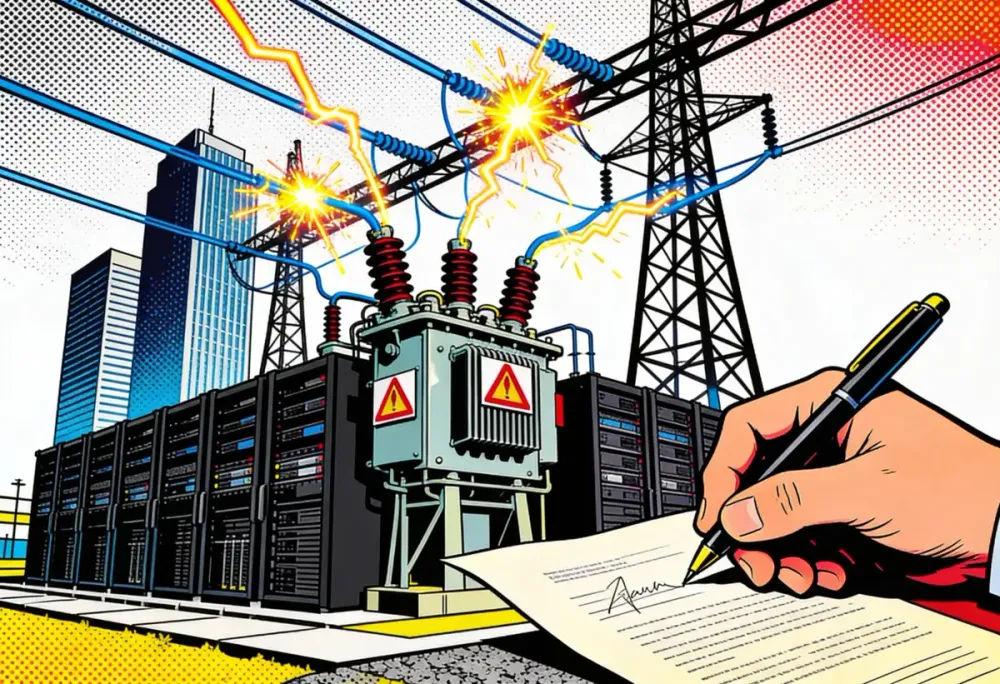
PJM Interconnection runs the largest power grid in America. It serves 67 million people across 13 states, from Virginia to Illinois. Last month, for the first time in its history, the grid operator failed an auction. Not a small miss. A 6.6-gigawatt shortfall, roughly the output of six nuclear reactors.
PJM blamed the failure on data centers.
Now the Trump administration and a bipartisan coalition of governors want PJM to hold an emergency auction. The catch: only data center operators can bid. Lock in for fifteen years. No exit clauses. Pay for the capacity whether you use the electricity or not. Think of it as building a private toll road where only one trucking company can drive, and they pay the toll even if their trucks stay parked in the garage.
The plan could underwrite $15 billion in new power plants, built specifically to feed the machines running AI.
The company that operates the grid wasn't invited to the announcement. "Apparently they will make an announcement," PJM spokesman Jeffrey Shields told CNN. "We have not been invited and will not be there."
That silence speaks louder than the press release.
The Breakdown
• Trump and bipartisan governors push for 15-year power contracts exclusively for data center operators, potentially worth $15 billion
• PJM, the grid operator serving 67 million people, failed its first auction ever last month due to data center demand
• Microsoft preemptively pledged to cover electricity costs, but the "statement of principles" is non-binding
• Small AI infrastructure companies face margin squeeze while cloud majors can pass costs to customers
The politics of the electric bill
Voters might forgive gas prices, but they punish utility bills. That logic is currently redlining. Last September, Americans paid a record 18.07 cents per kilowatt-hour for electricity, 7.4% more than the year before. Homeowners felt it worse, their bills climbing 10.5% between January and August alone.
But if you live near a data center, the math gets uglier. A Bloomberg analysis found that areas near these facilities saw electricity costs jump as much as 267% compared to five years ago. Virginia's largest utility raised rates 9%. New Jersey bills climbed more than 20%.
Democrats campaigning on lower utility bills swept races in New Jersey, Virginia, and Georgia last November. Republicans noticed. The party's congressional prospects now hinge partly on kitchen-table issues like this one. Trump keeps touting cheaper oil and gas, but electricity bills tell a different story.
"I never want Americans to pay higher Electricity bills because of Data Centers," Trump posted on Truth Social earlier this week.
You've seen this template before. The administration wants AI dominance but doesn't want voters blaming them for the electric bill. So they're doing what politicians always do when caught between competing interests: making someone else pay.
Stay ahead of the AI power curve
Strategic AI news from San Francisco. No hype, no "AI will change everything" throat clearing. Just what moved, who won, and why it matters. Daily at 6am PST.
No spam. Unsubscribe anytime.
The toll road nobody asked for
Standard power auctions work on 12-month cycles. Utilities and generators show up, bid for the right to supply electricity, and the contracts expire a year later. Prices move. The market resets.
What Trump and the governors are proposing looks nothing like that. They want 15-year commitments. Fixed capacity payments. Data center operators locked into contracts that survive recessions, AI winters, and changes in administration.
Here's what that means in practice: if Microsoft bids on 500 megawatts and AI demand craters in 2030, Microsoft still pays. If Google locks in capacity and then moves its data centers to Texas, Google still pays. The toll road gets built, and the trucking company that ordered it pays whether the trucks roll or not.
"It sounds like a significant improvement and a natural next step from bring-your-own new generation," Joe Bowring, president of PJM's independent watchdog Monitoring Analytics, told Bloomberg. The model already exists in miniature. Google, Meta, and Amazon have all explored building dedicated power supplies for their facilities. This plan scales the approach to the entire PJM region.
But here's what makes the proposal unusual. The White House and governors can't actually mandate any of this. PJM is a private company. The "statement of principles" being signed today is non-binding. It's a request dressed up as a directive.
Real pressure exists, though. Shapiro from Pennsylvania signed. Moore from Maryland signed. Both Democrats. Bipartisan coalitions are hard to ignore. ClearView Energy Partners analyst Timothy Fox put it plainly: pressure from the Trump administration and a bipartisan coalition of PJM states "is very likely to motivate a considerable response."
Microsoft's preemptive surrender
Three days ago, Microsoft President Brad Smith stood at a podium in Washington and announced the company's "Community-First AI Infrastructure" initiative. Five commitments: pay electricity rates high enough to cover all infrastructure costs, reduce water use 40% by 2030, create local jobs, pay full property taxes, invest in community AI training.
The timing wasn't subtle. Trump had posted about making tech companies "pay their own way" the day before. Smith showed up with a pledge that looked an awful lot like compliance.
Microsoft is trying to pave over the friction with cash. The company pledged $25 million for water and sewer upgrades in Virginia, essentially buying new plumbing for the neighbors so they won't complain about the water pressure. In Quincy, Washington, where Microsoft runs a large facility, the company points to poverty dropping from 29.4% to 13.1% and county property tax revenues tripling.
But the promises require faith. Microsoft pledged to reduce water use intensity by 40%, while its actual water consumption increased 34% to 6.4 million cubic meters in a recent year. The company promises thousands of construction jobs, but data centers employ as few as 50 people once they're running. The core pledge, paying electricity rates sufficient to cover all costs, remains deliberately vague about which costs count.
Smith invoked history. Canals. Railroads. The original electrical grids. Progress stacked on progress. "Infrastructure has always raised new questions, new concerns, new controversies," he said, "and yet throughout it all, it has been vital to the growth and prosperity of our nation."
Sure. But railroads also displaced entire communities. Electrification spawned the first regulated monopolies. Canals bankrupted states when they bet wrong. Infrastructure transforms societies. It doesn't always transform them for the better.
Who actually wins
If the auction proceeds, GE Vernova wins. The company makes natural gas turbines. Its stock climbed 3.4% in premarket trading Friday after Jefferies flagged it as a beneficiary.
Independent power producers, the companies that would build and operate these new plants, saw their shares fall. Vistra dropped 4.8%. Talen Energy slipped 7.4%. Constellation Energy fell 5.4%. Traders saw the announcement and sold the operators. Guaranteed 15-year revenue streams benefit equipment manufacturers more than the companies running the plants.
Amazon, Google, and Microsoft come out fine. They can absorb higher electricity costs and pass them to customers. Gil Luria, analyst at DA Davidson, explained the math: the cloud majors have pricing power. Smaller AI infrastructure companies don't.
Nebius and CoreWeave offer AI infrastructure on multi-year contracts. Fixed prices, locked in months ago, back when electricity costs looked stable. Luria spelled out the problem: "If they have to pay more for electricity, their margins will get squeezed."
The small players lose. They always do in these fights.
What the grid actually needs
PJM expects peak demand to jump 17% by 2030. The data center numbers tell a bleaker story: those facilities alone might triple their electricity draw, from 200 terawatt-hours now to 640 terawatt-hours by 2035. Google alone announced $25 billion in data center investment across the PJM region last July. Microsoft has backed nearly eight gigawatts of new generation in the Midwest.
Building new power plants takes years. Natural gas facilities can come online in three to four years. Nuclear plants take a decade or more. Even with guaranteed revenue, the physics of construction don't compress.
And the auction won't solve the other bottleneck. Google executive Marsden Hanna identified transmission barriers and grid connection delays as the primary obstacles to data center expansion. You can build all the generation you want. If the wires can't carry the load, the electrons don't arrive.
Rick Pederson, vice chairman at Bow River Capital, offered a different prediction. Data center investments may shift to Texas, Oklahoma, and North Dakota, states with lower costs and faster grid connections. The PJM auction might push the problem somewhere else rather than solve it.
Daily at 6am PST
Don't miss tomorrow's analysis
No breathless headlines. No "everything is changing" filler. Just who moved, what broke, and why it matters.
Free. No spam. Unsubscribe anytime.
The document nobody can enforce
The statement of principles being signed today binds no one. PJM can ignore it. Tech companies can wait and see. Governors can claim credit without committing resources. The September 2026 deadline for holding the auction is aspirational.
But the politics have changed. Electricity bills are now a voting issue. The bipartisan coalition gives both parties cover. And the cloud majors have signaled they'll play along, whether out of civic duty or survival.
Microsoft's Brad Smith called it the bare minimum, giving communities "the confidence that when a data center comes, its presence will not raise their electricity prices."
Confidence is easier to promise than to measure. The auction mechanism is real. The 15-year contracts would be real. The question is whether PJM agrees to run the sale, and whether the prices that emerge actually protect consumers or just shuffle costs between line items on the same electric bill.
Virginia's data centers sit in Ashburn, surrounded by substations and power lines. The AI race runs on their servers. Today's announcement says America wants to win that race without asking voters to pay for the electricity. Whether that's possible depends on a grid operator that wasn't invited to the meeting, contracts that don't yet exist, and power plants that haven't been built.
The document has signatures. It doesn't have megawatts.
Frequently Asked Questions
Q: What is PJM Interconnection and why does it matter?
A: PJM operates the largest power grid in America, serving 67 million people across 13 states from Virginia to Illinois. It runs the auctions that determine how much electricity gets generated and at what price. When PJM's auction fails, it signals the grid can't meet future demand.
Q: How much would this emergency auction cost tech companies?
A: The plan could underwrite $15 billion in new power plant construction. Tech companies bidding on 15-year contracts would pay for contracted capacity whether they use the electricity or not, locking in costs that survive recessions and changes in AI demand.
Q: Can the Trump administration actually force PJM to hold this auction?
A: No. PJM is a private company, and the "statement of principles" being signed is non-binding. However, bipartisan pressure from governors and the administration is expected to motivate PJM to act. The grid operator wasn't even invited to the announcement.
Q: Why did electricity prices near data centers rise so much?
A: Data centers consume massive amounts of power, straining local grids. Bloomberg found areas near data centers saw electricity costs jump up to 267% compared to five years ago. Virginia utilities raised rates 9%, and New Jersey bills climbed over 20%.
Q: Which companies benefit most from this plan?
A: Equipment manufacturers like GE Vernova win big, with stock up 3.4% on the news. Large cloud providers (Amazon, Google, Microsoft) can absorb costs and pass them to customers. Smaller AI infrastructure companies like Nebius and CoreWeave face margin squeezes.

Free AI briefing · Weekdays
The AI stories that matter, sourced and explained.
Join the Morning Briefing. It goes out every weekday at 4:45 a.m. Pacific, with later sends for the East Coast, Berlin and Tokyo.
Free when you sign up: The Paperclip Compendium, our tested guide to running AI agents.
Free. Unsubscribe in one click.

Marcus Schuler
Editor-in-Chief and founder of Implicator.ai. Former ARD correspondent and senior broadcast journalist with 10+ years covering tech. Writes daily briefings on policy and market developments. Based in San Francisco. E-mail: editor@implicator.ai