IMPLICATOR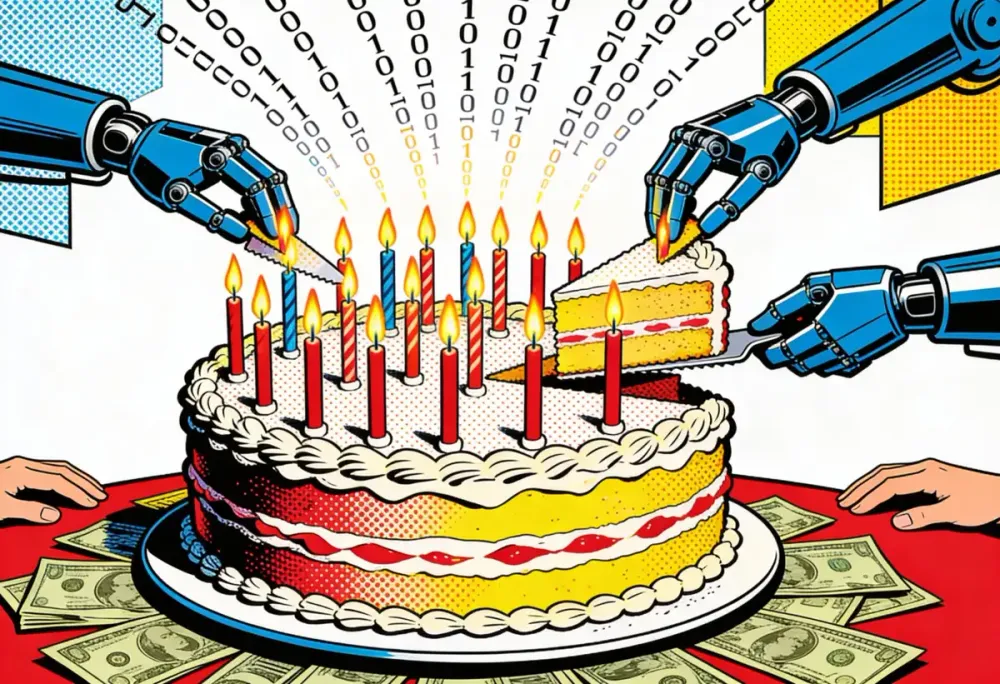
On Wikipedia's 25th birthday, the nonprofit finally extracted something from the companies that strip-mine its content: checks. Microsoft, Meta, Amazon, Perplexity, and Mistral AI have joined Google in paying for enterprise access to the world's largest encyclopedia. The Wikimedia Foundation announced the deals Wednesday with the quiet satisfaction of a landlord who finally caught the tenants using utilities they weren't paying for.
But look past the press release and the birthday balloons. The payments represent a ceasefire, not a victory. Wikipedia's fundamental problem remains unsolved: the companies scraping its content are worth trillions. The nonprofit asking them to pay runs on $180 million a year in donations, mostly from individuals. And human traffic to the site has fallen 8% in the past year alone.
The tech industry spent years treating Wikipedia like a public utility that someone else would maintain. Now they're writing checks. The catch is that nobody knows if those checks are enough to offset what their products are doing to the encyclopedia itself.
The Breakdown
• Microsoft, Meta, Amazon, Perplexity, and Mistral AI join Google in paying for Wikipedia enterprise access. Financial terms undisclosed.
• Human traffic to Wikipedia fell 8% in 2025 as AI chatbots answer questions without sending clicks to the source.
• New volunteer registrations dropped by a third since 2016. The median editor is now older than the median reader.
• Political attacks from Musk, Carlson, and Heritage Foundation add pressure as legal protections face new scrutiny.
The invoice arrives late
If you've ever asked Siri a factual question while cooking dinner, you've used Wikipedia without knowing it. The answer came back in a robotic voice. Your phone screen stayed dark. Wikipedia recorded zero visits. That's the arrangement now: the knowledge flows, the connection severs.
Search engines have been feeding on Wikipedia for two decades. Google's Knowledge Panels pull from it. So does Siri. So does Alexa. Behind all those quick answers sit 250,000 volunteer editors who get nothing for their labor. The deal worked as long as users still clicked through to read the full articles. Donations followed traffic.
Then came the chatbots.
ChatGPT, Claude, Gemini, and their competitors don't send users anywhere. They digest Wikipedia's information, pre-chew it, and serve it up so the user never has to hunt. The encyclopedia doesn't just become invisible. It disappears from the transaction entirely. Lane Becker runs Wikimedia Enterprise. He put it plainly to Reuters: "Wikipedia is a critical component of these tech companies' work that they need to figure out how to support financially."
Google signed up in 2022. It took three more years to bring the rest of the major players to the table. The enterprise product gives companies high-throughput API access, real-time streaming updates, and data formatted for their training pipelines. What the deals don't include: public dollar figures. Not one company disclosed what it's paying. The Wikimedia Foundation stayed silent too.
That silence protects the buyers, not the seller. If the numbers were large enough to secure Wikipedia's future, the Foundation would be shouting them from the rooftops to calm nervous donors.
Join 10,000+ AI professionals
Strategic AI news from San Francisco. No hype, no "AI will change everything" throat clearing. Just what moved, who won, and why it matters. Daily at 6am PST.
No spam. Unsubscribe anytime.
The traffic problem nobody solved
Before the AI scrapers arrived, Wikipedia already faced a slow bleed. Human visitors peaked years ago. The new enterprise deals address the cost of serving AI companies, but they do nothing to reverse the decline in actual readers.
Consider the arithmetic. Bandwidth for multimedia downloads jumped 50% in the fifteen months ending April 2025. Bots accounted for 65% of the most expensive requests to core infrastructure despite representing just 35% of pageviews. When Wikimedia upgraded its detection systems, it discovered that much of what looked like human traffic was actually automated scrapers disguised to evade blocks. The servers hummed along. The humans weren't there.
Cornered by rising costs, the Foundation built a toll booth: Wikimedia Enterprise. Pay us, and you get clean API access. Keep scraping for free, and we'll keep blocking you. Microsoft's Corporate Vice President Tim Frank offered the official framing: "We're helping create a sustainable content ecosystem for the AI internet, where contributors are valued."
And yet. AI chatbots answering questions with Wikipedia content don't link back to articles. Search engine overviews increasingly deliver summaries without sending clicks. The user gets the calories without having to hunt. The enterprise deals monetize this digestion. They don't fix the underlying problem.
Volunteers age out, and replacements don't arrive
Money can buy servers. Volunteers are harder. Wikipedia runs on a quarter-million unpaid editors who write, fact-check, and argue over 65 million articles. That labor force is shrinking, and no amount of enterprise revenue changes the math.
Wikimedia Statistics shows new user registrations down by more than a third since 2016. Christopher Henner has been editing Wikipedia for years. Last year he published an essay warning that the site risks becoming a "temple" where aging volunteers do work nobody looks at anymore. The median Wikipedia editor is older than the median reader. That gap keeps widening.
Ask someone on the other side of that gap. Hannah Clover won Wikimedian of the Year last year. Youngest ever. She edits Wikipedia from her phone between shifts. "A lot of us are just trying to pay our rent," she told WIRED. Before the recognition, Clover was editing from her phone during McDonald's shift breaks and on the bus home. Years of hypercapitalism trained her generation to view unpaid labor as exploitation. Making TikToks at least offers the possibility of monetization. Editing Wikipedia offers nothing but the satisfaction of contributing to the commons.
The Foundation's response: short-form videos. Eight hundred clips on TikTok, Instagram, and YouTube since October, 23 million views. Do those views translate into new editors? Nobody knows. The Depths of Wikipedia Instagram account proves people love the site's weird corners. Scrolling through them is one thing. Spending hundreds of unpaid hours maintaining them is another.
Daily at 6am PST
Don't miss tomorrow's analysis
No breathless headlines. No "everything is changing" filler. Just who moved, what broke, and why it matters.
Free. No spam. Unsubscribe anytime.
First Amendment protection meets political pressure
Wikipedia has always had American law on its side. Section 230 means users can write what they want without the nonprofit getting sued. The First Amendment means the government can't tell them what to take down. No U.S. editor has ever been arrested for their contributions. The FBI once demanded the site remove its logo. Wikipedia's lawyers laughed it off.
But political pressure doesn't require legal authority. Elon Musk calls the site "Wokepedia." Tucker Carlson devoted 90 minutes to attacking it as "completely dishonest and completely controlled." Republican congresspeople James Comer and Nancy Mace launched an investigation into alleged "information manipulation" in the editing process. The Heritage Foundation announced plans to "identify and target" Wikipedia's volunteer editors.
Musk launched Grokipedia, his AI-powered alternative, last year. Jimmy Wales dismissed it. "Large language models aren't good enough to write really quality reference material," he told the AP. "A lot of it is just regurgitated Wikipedia."
Wales added something else. "We'll still be here in 100 years, and he won't."
Maybe. That confidence rests on assumptions that look shakier by the year. Legal protections holding. Donations flowing despite declining traffic. Volunteers showing up for nothing. And it assumes the tech companies now paying for enterprise access don't eventually decide their own AI systems have made the original encyclopedia redundant. Why pay for the source when the derivative works just fine?
What the birthday party doesn't celebrate
Wikipedia turns 25 with more articles than ever: 65 million across 300 languages, viewed 15 billion times monthly. The only nonprofit anywhere near the top ten most-visited websites. The new enterprise partnerships suggest the industry finally acknowledges it cannot simply take what Wikipedia builds without contributing something in return.
The celebratory press release mentions a video docuseries about volunteer editors, a digital time capsule, a Baby Globe plushie. What it doesn't mention: whether the enterprise payments cover the increased server costs from AI scraping, or whether any plan exists to recruit younger volunteers fast enough to replace the ones aging out. The Foundation isn't saying. Nobody at the party is asking.
Wikipedia's survival never depended on birthday parties. What kept it alive was a belief, a specific one: that human-curated knowledge matters enough to maintain without compensation. That a noncommercial corner of the internet serves everyone better than one optimized for engagement. That communities can get closer to the truth through argument and evidence than algorithms ever will.
That belief looked obvious in 2001. In 2026 it looks like an article of faith. The tech companies showed up with checks. The question nobody wants to answer is whether they showed up with enough.
Frequently Asked Questions
Q: What is Wikimedia Enterprise and how does it differ from regular Wikipedia access?
A: Wikimedia Enterprise is a commercial product offering high-throughput API access to Wikipedia content. Companies pay for faster data streams, real-time updates, and content formatted for AI training pipelines. Regular users still access Wikipedia for free through the public website.
Q: How much are Microsoft, Meta, and Amazon paying Wikipedia?
A: The Wikimedia Foundation hasn't disclosed any financial terms. None of the tech companies revealed their payment amounts either. This silence suggests the deals may be smaller than needed to fundamentally change Wikipedia's financial position.
Q: Why is Wikipedia losing human traffic despite being used by AI systems?
A: AI chatbots synthesize Wikipedia content without sending users to the source. Google's AI overviews answer queries directly. Pew Research found only 1% of users click through from AI summaries. The traffic that once funded volunteers and donations now bypasses Wikipedia entirely.
Q: What political pressure is Wikipedia facing in 2026?
A: Elon Musk calls it "Wokepedia." Tucker Carlson devoted 90 minutes attacking it. Republican congresspeople launched investigations into alleged bias. The Heritage Foundation announced plans to "identify and target" volunteer editors. Musk's Grokipedia launched as an AI alternative.
Q: Can Wikipedia recruit enough young volunteers to replace aging editors?
A: New user registrations dropped by more than a third since 2016. The Foundation launched short-form videos that gained 23 million views, but whether views translate to editors remains unclear. Younger generations increasingly view unpaid labor with skepticism.

Free AI briefing · Weekdays
The AI stories that matter, sourced and explained.
Join the Morning Briefing. It goes out every weekday at 4:45 a.m. Pacific, with later sends for the East Coast, Berlin and Tokyo.
Free when you sign up: The Paperclip Compendium, our tested guide to running AI agents.
Free. Unsubscribe in one click.

Marcus Schuler
Editor-in-Chief and founder of Implicator.ai. Former ARD correspondent and senior broadcast journalist with 10+ years covering tech. Writes daily briefings on policy and market developments. Based in San Francisco. E-mail: editor@implicator.ai