IMPLICATOR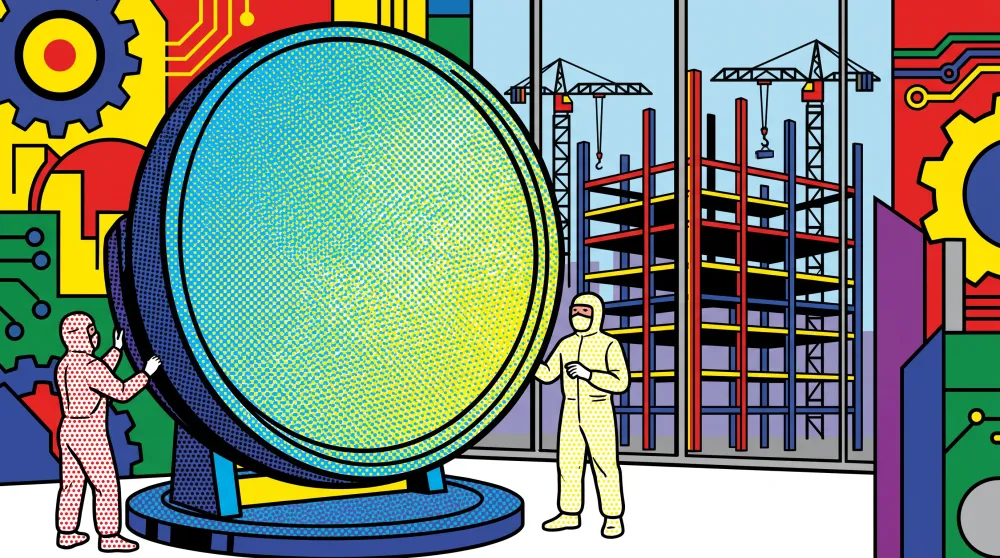
Zeiss Semiconductor Manufacturing Technology confirmed in July that its Oberkochen (Germany) expansion adds around 25,000 square meters of production and production-related space. Employees moved into the project’s new office building at the site that month. ASML’s 2025 annual report says its lithography-system output is limited by the capacity of the German optics maker.
What Changed
- Zeiss SMT's Oberkochen expansion adds around 25,000 square meters of production and production-related space, with employees moving into the new office building in July, roughly four years after the May 2022 groundbreaking.
- ASML's 2025 annual report names Carl Zeiss SMT as its single supplier of optical columns and says ASML "would effectively cease to be able to conduct our business" if that supply relationship ended.
- ASML's purchases from Zeiss SMT Holding and its subsidiaries reached €4.41 billion in 2025, up from €3.33 billion in 2023, while loans receivable from Zeiss rose to €1.91 billion.
- Zeiss has published no optical-column output figure for the expanded site, so the work cannot be tied to a specific number of additional scanners.
AI-generated summary, reviewed by an editor. More on our AI guidelines.
Zeiss’s July Handover
The move came roughly four years after Zeiss broke ground in May 2022. Further buildings will be handed over and put into operation in stages, the company said. Frank Rohmund, president and chief executive of Zeiss SMT, described the work as part of a wider capacity program in Germany and other markets.
“With the site expansion in Oberkochen and at our international locations, we are investing proactively in the future of the semiconductor industry,” Rohmund said in the company statement.
ASML’s annual report says that if Zeiss ended the supply relationship or could no longer produce optics, ASML “would effectively cease to be able to conduct our business.”
The added production space will support work on unusually large components and the equipment needed to manufacture them. Tom’s Hardware, citing Zeiss, reported that High-NA projection optics contain more than 40,000 parts and weigh about 12 tons. The associated illumination system adds 25,000 parts and another 6 tons. Individual mirrors weigh several hundred kilograms and can spend months in machining. Zeiss uses a purpose-built vacuum chamber measuring five by 10 meters to verify the optics, according to the same account.
Zeiss has disclosed no optical-column output figure for the expanded site. Its statement also provides no capital cost or added headcount, leaving the additional scanner capacity unspecified.
Note 26’s €4.41 Billion Purchase Line
Note 26 of ASML’s annual report describes the commercial relationship in direct terms. “Carl Zeiss SMT GmbH is our single supplier, and we are their single customer, of optical columns for lithography systems,” the filing states. Those columns can be produced only with manufacturing and testing facilities in Oberkochen and Wetzlar, according to the document.
ASML calls the alliance “two companies, one business.” Its purchases from Zeiss SMT Holding and its subsidiaries rose from €3.33 billion in 2023 to €3.95 billion in 2024. The total reached €4.41 billion in 2025.
Get Implicator.ai in your inbox
Strategic AI news from San Francisco. No hype, no "AI will change everything" throat clearing. Just what moved, who won, and why it matters. Daily at 6am PST.
No spam. Unsubscribe anytime.
The risk section says ASML’s system production is limited by Zeiss’s output of lenses, mirrors, illuminators, collectors and other optical components. The annual report says ASML could be unable to fulfill orders if Zeiss became unable to maintain and increase production levels over a prolonged period.
ASML’s 24.9% Zeiss Stake
ASML has held a 24.9% interest in Carl Zeiss SMT Holding since June 29, 2017. The chip-equipment maker classifies the partnership as a variable interest entity, with potential future operating losses that the annual report says “cannot be quantified.” ASML received a €320.5 million dividend from the stake in 2025, compared with €225.4 million the previous year.
Know someone who'd find this useful? ✉️ Email it to a friend in one click, or they can subscribe free here.
The financial relationship extends to factory funding. Loans receivable from Zeiss rose from €1.44 billion at the end of 2024 to €1.91 billion a year later. Advance payments moved in the other direction, falling from €1.42 billion to €1.19 billion.
A May 2025 restatement of the companies’ framework agreement made qualifying capital-expenditure loans interest-free, with repayment expected over seven or 15 years. Quarterly repayments vary with Zeiss SMT’s revenue inside an agreed corridor and begin after a three-year grace period. Carl Zeiss AG provides a parental guarantee, the filing states.
Christophe Fouquet’s 2027 EUV Plan
ASML sold 86 new lithography systems in the second quarter of 2026, up from 67 in the first quarter, according to its July 15 results release. The company reported €9.3 billion in quarterly sales and raised its full-year sales outlook to between €43 billion and €45 billion.
Chief Executive Christophe Fouquet said ASML plans to add 30% to its 2026 Low-NA EUV capacity of around 65 systems for 2027. The company is investigating another 30% increase for 2028. Its statement does not assign a portion of either increase to the new Oberkochen space.
ASML has scheduled its next Capital Markets Day for June 10, 2027, when Fouquet said the company will update its longer-term market and technology plans.
Frequently Asked Questions
Why does Zeiss SMT's capacity limit how many machines ASML can build?
ASML's 2025 annual report states that Carl Zeiss SMT is its single supplier of optical columns for lithography systems, and that those columns can be produced only with manufacturing and testing facilities in Oberkochen and Wetzlar. The report says ASML could be unable to fulfill orders if Zeiss became unable to maintain and increase production levels over a prolonged period.
How much does ASML buy from Zeiss SMT each year?
Purchases from Zeiss SMT Holding and its subsidiaries rose from €3.33 billion in 2023 to €3.95 billion in 2024, then reached €4.41 billion in 2025, according to ASML's annual report.
Does ASML own part of Zeiss SMT?
ASML has held a 24.9% interest in Carl Zeiss SMT Holding since June 29, 2017. It classifies the partnership as a variable interest entity and received a €320.5 million dividend from the stake in 2025, compared with €225.4 million the previous year.
How does ASML help fund Zeiss SMT's factory investment?
Loans receivable from Zeiss rose from €1.44 billion at the end of 2024 to €1.91 billion a year later. A May 2025 restatement of the framework agreement made qualifying capital-expenditure loans interest-free, with repayment expected over seven or 15 years and quarterly repayments that vary with Zeiss SMT's revenue.
How many additional EUV scanners will the Oberkochen expansion support?
Zeiss has disclosed no optical-column output figure for the expanded site, and no capital cost or added headcount, leaving the additional scanner capacity unspecified. ASML said separately that it plans to add 30% to its 2026 Low-NA EUV capacity of around 65 systems for 2027, without assigning any portion of that increase to Oberkochen.
AI-generated summary, reviewed by an editor. More on our AI guidelines.



Marcus Schuler
Editor-in-Chief and founder of Implicator.ai. Former ARD correspondent and senior broadcast journalist with 10+ years covering tech. Writes daily briefings on policy and market developments. Based in San Francisco. E-mail: editor@implicator.ai